EasyManua.ls Logo

Marantz 2270 - Phono and Tone Amplifiers; Power Amplifier

Marantz 2270
36 pages
Print Icon
To Next Page IconTo Next Page
To Previous Page IconTo Previous Page
Loading...
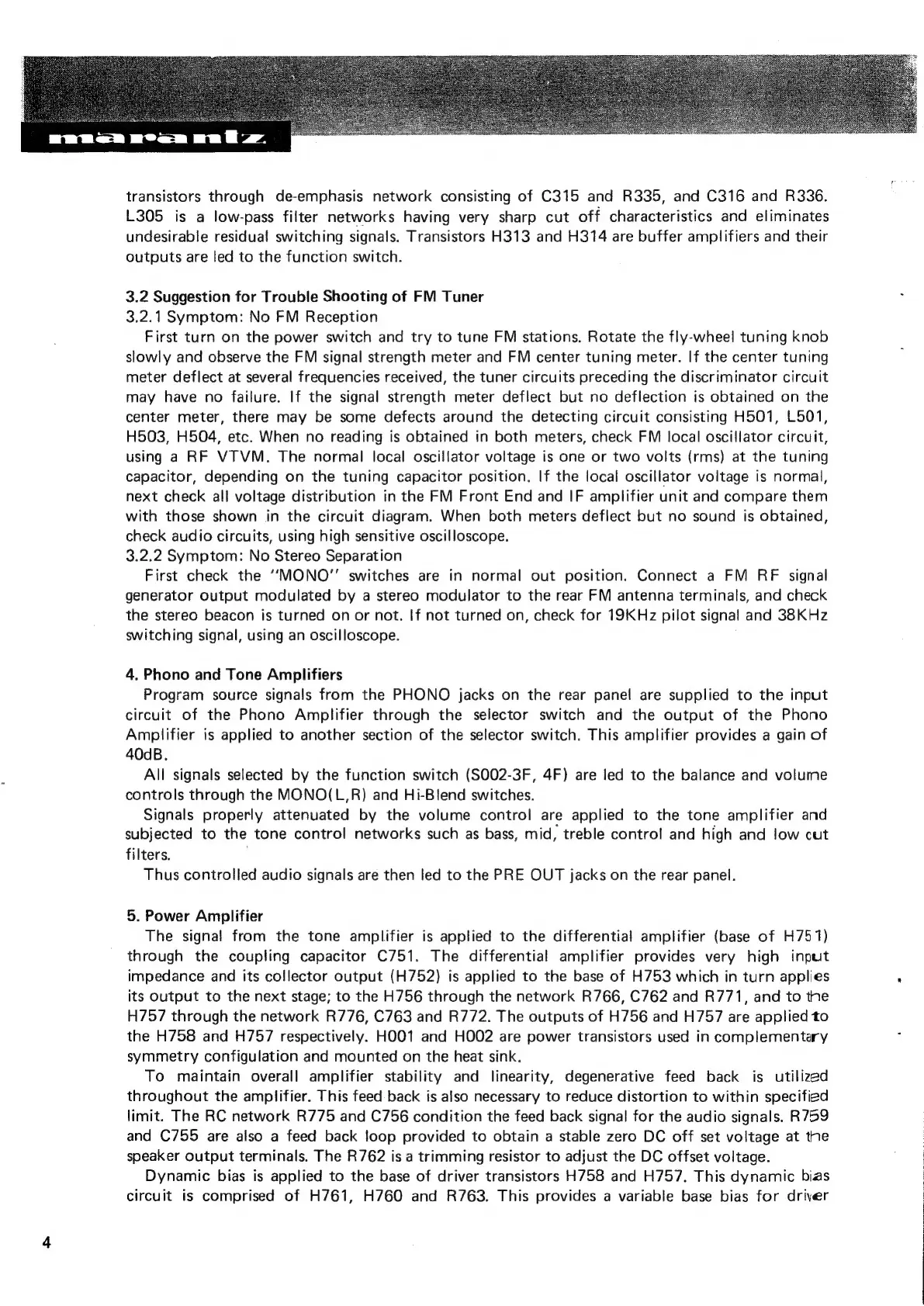
transistors
through
de-emphasis
network
consisting
of
C315
and
R335,
and
C316
and
R336.
L305
is
a
low-pass
filter
networks
having
very
sharp
cut
off
characteristics
and
eliminates
undesirable
residual
switching
signals.
Transistors
H313
and
H314
are
buffer
amplifiers
and
their
outputs
are
led
to
the
function
switch.
3.2
Suggestion
for
Trouble
Shooting
of
FM
Tuner
3.2.1
Symptom:
No
FM
Reception
First
turn
on
the
power
switch
and
try
to
tune
FM
stations.
Rotate
the
fly-wheel
tuning
knob
slowly
and
observe
the
FM
signal
strength
meter
and
FM
center
tuning
meter.
If
the
center
tuning
meter
deflect
at
several
frequencies
received,
the
tuner
circuits
preceding
the
discriminator
circuit
may
have
no
failure.
If
the
signal
strength
meter
deflect
but
no
deflection
is
obtained
on
the
center
meter,
there
may
be
some
defects
around
the
detecting
circuit
consisting
H501,
L501,
H503,
H504,
etc.
When
no
reading
is
obtained
in
both
meters,
check
FM
local
oscillator
circuit,
using
a
RF
VTVM.
The
normal
local
oscillator
voltage
is
one
or
two
volts
(rms)
at
the
tuning
capacitor,
depending
on
the
tuning
capacitor
position.
If
the
local
oscillator
voltage
is
normal,
next
check
all
voltage
distribution
in
the
FM
Front
End
and
IF
amplifier
unit
and
compare
them
with
those
shown
in
the
circuit
diagram.
When
both
meters
deflect
but
no
sound
is
obtained,
check audio
circuits,
using
high
sensitive
oscilloscope.
3.2.2
Symptom:
No
Stereo
Separation
First
check
the
‘‘“MONO”’
switches
are
in
normal
out
position.
Connect
a
FM
RF
signal
generator
output
modulated
by
a
stereo
modulator
to
the
rear
FM
antenna
terminals,
and
check
the
stereo
beacon
is
turned
on
or
not.
If
not
turned
on,
check
for
19KHz
pilot
signal
and
38KHz
switching
signal,
using
an
oscilloscope.
4.
Phono
and
Tone
Amplifiers
Program
source
signals
from
the
PHONO
jacks
on the
rear
panel
are
supplied
to
the
input
circuit
of
the
Phono
Amplifier
through
the
selector
switch
and
the
output
of
the
Phono
Amplifier
is
applied
to
another
section
of
the
selector
switch.
This
amplifier
provides
a
gain
of
40dB.
All
signals
selected
by
the
function
switch
(SO02-3F,
4F)
are
led
to
the
balance
and
volume
controls
through
the
MONO(L,R)
and
Hi-Blend
switches.
Signals
properly
attenuated
by
the
volume
control
are
applied
to
the
tone
amplifier
and
subjected
to
the
tone
control
networks
such
as
bass,
mid,
treble
contro!
and
high
and
low
cut
filters.
.
Thus
controlled
audio
signals
are
then
led
to
the
PRE
OUT
jacks
on
the
rear
panel.
5.
Power
Amplifier
The
signal
from
the
tone
amplifier
is
applied
to
the
differential
amplifier
(base
of
H751)
through
the
coupling
capacitor
C751.
The
differential
amplifier
provides
very
high
input
impedance
and
its
collector
output
(H752)
is
applied
to
the
base
of
H753
which
in
turn
applies
its
Output
to
the
next
stage;
to
the
H756
through
the
network
R766,
C762
and
R771,
and
to
the
H757
through
the
network
R776,
C763
and
R772.
The
outputs
of
H756
and
H757
are
applied
to
the
H758
and
H757
respectively.
HOO1
and
HOO2
are
power
transistors
used
in
complementary
symmetry
configulation
and
mounted
on
the
heat
sink.
To
maintain
overall
amplifier
stability
and
linearity,
degenerative
feed
back
is
utilized
throughout
the
amplifier.
This
feed
back
is
also
necessary
to
reduce
distortion
to
within
specified
limit.
The
RC
network
R775
and
C756
condition
the
feed
back
signal
for
the
audio
signals.
R759
and
C755
are
also
a
feed
back
loop
provided
to
obtain
a
stable
zero
DC
off
set
voltage
at
the
speaker
output
terminals.
The
R762
is
a
trimming
resistor
to
adjust
the
DC
offset
voltage.
Dynamic
bias
is
applied
to
the
base
of
driver
transistors
H758
and
H757.
This
dynamic
bias
circuit
is
comprised
of
H761,
H760
and
R763.
This
provides
a
variable
base
bias
for
driver

Other manuals for Marantz 2270

Related product manuals