NTP100 – Rev 2.2.0 Oct-12
19
© Masterclock
®
, Inc.
NOTE: The models NTP100-OSC and NTP100-OSC-HS do not have an external input, this feature will be grayed out
for this model. Thus, the stratum level can only be adjusted for the Internal Clock.
Brightness
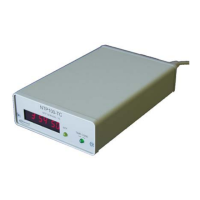
- The brightness or intensity of the NTP100’s front-panel time display can be adjusted from dim to bright.
The display can be dimmed here for low-light environments.
Advanced
– Certain advanced features may be configured using the “Advanced” button. These features include , access
to the telnet configuration interface and the ability to continue serving time during extended GPS or Time Code outages.
By default, the models NTP100-GPS, NTP100-GPS-HS, and NTP100-TC will allow time dissemination (NTP service) for a
period of 24 hours from loss of the primary source (GPS or Time Code respectively). During this “free-wheeling” or
“holdover” period, the NTP100-GPS and NTP100-TC will rely on the internal real-time clock (RTC) and temperature
compensated crystal oscillator, (TCXO )oscillator, which has a typical holdover of +/- 1 min /year (+/- 165mSec drift over
24 hours or +/- 6.875 mSec drift over 1 hour). The model NTP100-GPS-HS will rely on the internal RTC and OCXO (oven
controlled crystal oscillator), which has a typical holdover (stability) of < 7 sec/year (<19mS drift over 24 hours or <.8 mS
over 1 hour)
The NTP100 (models –GPS and –TC) will continuously discipline the internal RTC to provide maximum accuracy, while
locked to the primary GPS or Time Code reference, when trusted and available).


 To Next Page