20V max* LITHIUM-ION CORDLESS RECIPROCATING SAW - 054-8151-420V max* LITHIUM-ION CORDLESS RECIPROCATING SAW - 054-8151-4
1615
OPERATING INSTRUCTIONS
OPERATING INSTRUCTIONS
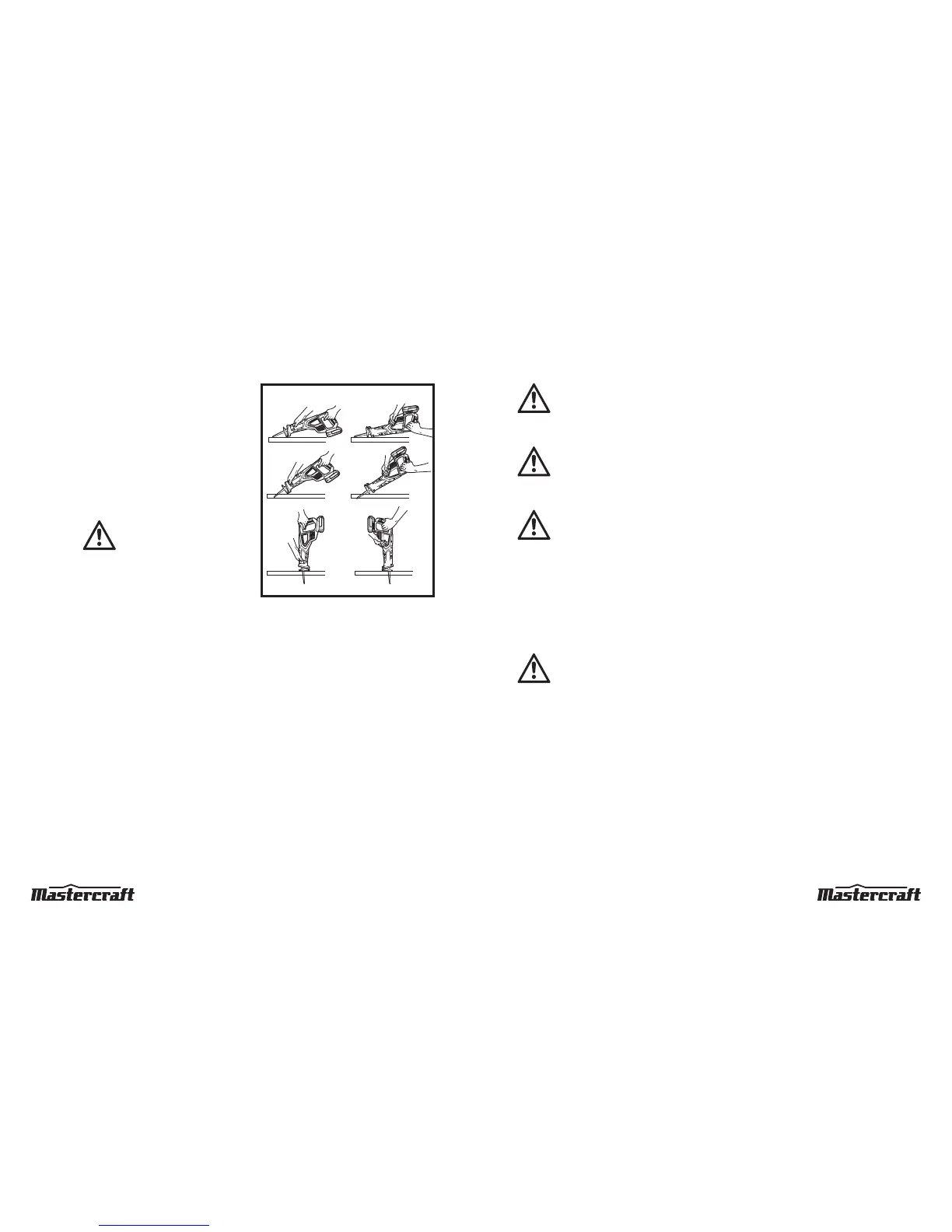
Plunge cutting
(g 8)
Your reciprocating saw is ideal for plunge cutting
directly into surfaces that cannot be cut from an
edge, such as walls or oors. Plunge cutting may be
performed two ways, depending on how the blade is
inserted.
Column A shows how to plunge cut with the teeth
of the blade facing down. Column B shows how to
plunge cut with the teeth of the blade facing up.
WARNING!
Do not plunge cut into metal surfaces.
1. Remove the battery pack from the saw.
2. Make sure that the workpiece is rmly clamped
in place.
3. Use the appropriate type and size of blade for the workpiece material and size.
4. Insert the blade into the tool.
5. Adjust the pivoting shoe as necessary to make sure that the blade will extend beyond the shoe and the
workpiece at all times.
6. Adjust the pivoting shoe as necessary to expose unworn blade teeth for longer blade life.
7. Check for clearance behind the workpiece so that the blade will not impact another surface.
8. Attach the battery pack to the saw.
9. If the blade is inserted with the teeth facing downward, hold the tool as shown in column A, resting the
edge of the shoe on the workpiece.
10. With the blade just above the workpiece, depress the lock-off button and trigger the switch to start the
saw and bring it to the maximum desired cutting speed. Then, using the edge of the shoe as a pivot,
lower the blade into the workpiece.
11. As the blade starts cutting, raise the handle of the tool slowly, until the at surface of the shoe rests
rmly on the workpiece.
12. After the blade has penetrated through the workpiece, continue sawing along the marked cutting line.
NOTE:
To make plunge cutting easier, use a heavy gauge blade and install the blade with the teeth facing
upward as show in Column B.
WARNING!
To reduce the risk of explosion, electric shock and property damage, always check the work
area for hidden gas pipes, electrical wires or water pipes when making blind or plunge cuts.
WARNING!
To avoid loss of control and serious injury, make sure that the blade reaches maximum speed
before touching it to the workpiece.
WARNING!
Do not make plunge cuts in metal materials.
Metal cutting
The saw can be used to cut metals, such as sheet steel, pipe, steel rods, aluminum, brass, and copper. Be
careful not to twist or bend the saw blade. Do not force the tool.
The use of cutting oil is recommended when cutting soft metals and steel. Cutting oil will keep the blade
cool, increase cutting action, and prolong blade life.
WARNING!
Never use gasoline, because normal sparking could ignite the fumes.
1. Securely clamp the workpiece in position, and make the cut close to the clamping point to minimize
vibration.
2. When cutting conduit pipe or angle iron, clamp the work in a vise, if possible, and cut close to the vise.
3. To cut thin sheet material, “sandwich” the material between pieces of hardboard or plywood, and
clamp the layers together to reduce vibration and tearing of the material.
fig 8


 To Next Page