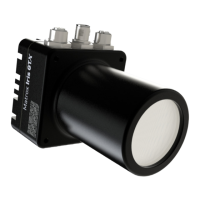
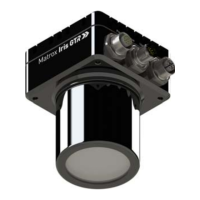
Matrox Iris GTX smart camera summary 55
CPU board
The CPU board of Matrox Iris GTX has the following features:
• SOC/CPU: Atom x6211E processor.
• Volatile memory: 4 Gbytes of LPDDR4x SDRAM.
• Non-volatile memory: 32 Gbytes of flash disk (eMMC) memory.
• Networking: One 100/1000 Mbits (or 100 Mbit/1 Gbit) Ethernet networking
interface. This interface can be used for communicating with external devices
using the PROFINET, EtherNetI/P, CCLink, or Modbus protocol. For
PROFINET, Matrox Iris GTX provides a hardware-assisted PROFINET interface
that support a minimum I/O cycle time of 1 msec. When using the
hardware-assisted PROFINET interface, it will create a second Ethernet
communication device with its own independent MAC address and IP
settings.The LAN connection associated with the hardware-assisted PROFINET
interface can be shared with other traffic.
• An advanced I/O engine that includes the following:
- Digital I/Os: 4 inputs and 3 outputs.
❯ 4 opto-isolated, digital auxiliary input signals (24V).
❯ Input signals have interrupt generation capabilities.
❯ Input signals can sink or source. To source voltage, you must connect an
auxiliary voltage source to the common input signal
(AUX_OPTOIND_IN_COMMON). For voltage expectations, see
Electrical specifications subsection of the Matrox Iris GTX specifications
section, later in this appendix. Whether all the input signals are sinking or
sourcing is dependent upon the connection of the common input signal.
❯ Input signals are debounced (that is, configured to wait a given amount of
time between accepting a signal change). The debouncing time can be
configured using Matrox Design Assistant. For more information, refer to
the Matrox Design Assistant help file.



 To Next Page