36
4.9 TRANSPORT
TRANSPORT SAFETY
• Makecertainthatyouareincompliancewithlo-
cal, state/provincial and federal regulations re-
garding transporting agricultural equipment on
public roadways.
• Make certain that all wheels and tires are in
good repair and that tires are inated to proper
pressure. Do not underinate or overinate.
• Make certain that all wheel bolts/lug nuts are
tightened to proper torque specications (refer
to specication chart in Section 7.2).
• Fully retract all telescoping Conveyor section
and secure before transporting.
• Makecertainthatallmechanicallocksandinte-
gral anchor chains are safely and positively con-
nected before loading or transporting.
• Raiseandsecurealljackstandsifapplicable.
• Wrapupandbindtotheframeallloosehydrau-
lic and electrical ends.
• BesurethatanynecessarySMV(slowmoving
vehicle) signs, reectors and lights required by
law are in proper place and are clearly visible to
oncoming and overtaking traffic.
• BesurethattheConveyorispositivelyhitchedto
the towing vehicle. Use a safety chain to assure
a safe hitch hook-up when transporting.
• Adheretolocalregulationsregardingmaximum
weight, width and length.
• Do not exceed 20 MPH (32 Km/H). Reduce
speed on rough roads and surfaces.
• DonotallowanyonetorideontheConveyoror
towing vehicle during transport.
• Alwaysusehazardashersonthetowingvehi-
cle when transporting.
Mayo Conveyors are designed to be easily and con-
veniently moved from location to location. The term
moving is used to describe the action of moving the
machine manually and is covered in Section 4.9 Op-
erating. Transporting is used to describe when the
machine is being towed by a tractor or other power
unit. When transporting, follow this procedure:
1. Disconnect and remove all auxiliary equipment
from the Conveyor and position so the tractor can
back up to the front of the machine.
2. Compress the Conveyor to its shortest length if
telescoping conveyor.
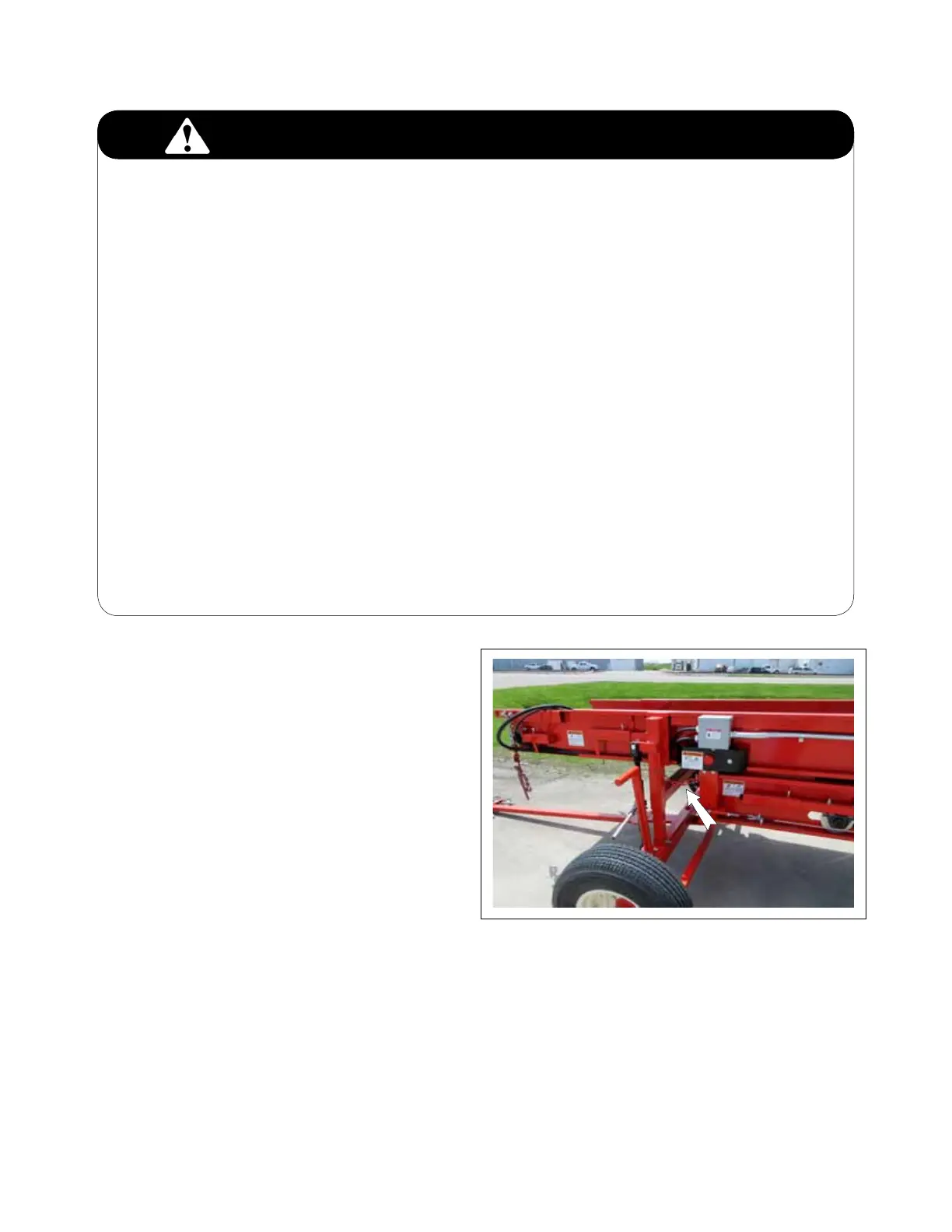
3. Attach the frame transport lock to prevent frame
extension.
FIG. 21 TRANSPORT LOCK (TELESCOPING)



 To Next Page