39
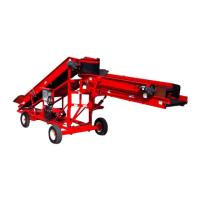
• Store the Straight Conveyor on a rm level
surface.
• Ifrequired,makesuretheunitisrmlyblocked
up.
• Makecertainthatallmechanicallocksaresafe-
ly and positively connected before storing.
• Storeawayfromareasofhumanactivity.
• Donotallowchildrentoplayonoraroundthe
stored Conveyor.
• Lock out power by turning off master control
panel or junction box and padlocking the door
shut to prevent electrocution or unauthorized
start up of the Conveyor.
STORAGE SAFETY
4.10.2 REMOVING FROM STORAGE
When preparing to use the machine at the start of the
season, follow this procedure:
1. Remove the tarpaulin if covered.
2. Transport or move to the working area.
3. Check
a. Check hydraulic oil level.
b. Conveyor belts and drive systems, hydraulic
and oil levels.
c. All hardware. Tighten as required.
d. Air pressure in tires. Add as required.
4. Replace any defective components.
5. Go through the pre-operation checklist (Section
4.6) before starting.
4.10 STORAGE
8. Check all rotating parts for entangled material.
Remove.
9. Touch up all paint nicks and scratches to prevent
rusting.
10. Select a storage area that is dry, level and free of
debris.
11. Cover with a weather-proof tarpaulin and tie down
if stored outside.
4.10.1 PLACING IN STORAGE
At the end of the season, the machine should be
thoroughly inspected and prepared for storage. Re-
pair or replace any worn or damaged components to
prevent any unnecessary down time at the beginning
of the next season. Follow this procedure:
1. Turn the power OFF at the master electrical panel
and lock out.
2. Unplug and remove power cord from machine.
3. Thoroughly wash the machine using a pressure
washer to remove all dirt, mud, debris or residue.
4. Lubricate all grease ttings. Make sure all grease
cavities have been lled with grease to remove
any water residue from the washing.
5. Inspect all the electrical cords, lines, junction
boxes and motors. Tighten any loose connec-
tions. Replace any cord that is badly cut, nicked or
abraded. Replace any damaged components.
6. Inspect each conveyor belt. Realign if the belt is
not tracking in the center of the frame. Replace
if the edges are damaged from rubbing on the
frame. Properly tension each belt.
7. Inspect all the hydraulic hoses, lines, ttings and
cylinders. Tighten any loose ttings. Replace
any hose that is badly cut, nicked, abraded or
separating from a tting. Replace any damaged
components.



 To Next Page