Need help?
Do you have a question about the Megger TDR2050 and is the answer not in the manual?
Press and hold the power button to turn the TDR unit on.
Select the desired test mode using the device's cursor keys.
Ensure test leads are not separated and are in good working condition.
Press the spanner/setting symbol to access the parameter menu.
Configure the velocity factor based on cable manufacturer data or examples.
Adjust cable impedance using the arrows; set to maximum if unknown.
Set gain level to best display the trace using the up/down arrows.
Adjust pulse width for optimal fault visibility based on fault distance.
Set the distance parameter to be greater than the known cable length.
Press C1-C2 buttons to select and swap between cursors for measurement.
Use left/right arrows to move the selected cursor along the trace.
Move C1 to the end of test leads and C2 to the first significant reflection.
TDR displays total distance to C2 and the difference between C1 and C2.
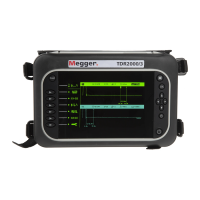
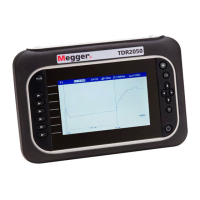
The Megger TDR2050 is a Time Domain Reflectometer designed for cable fault location and analysis. It is a portable, handheld device that allows users to quickly and accurately identify faults in various types of cables. The device features a clear display and intuitive controls, making it suitable for both experienced technicians and those new to TDR testing.
The primary function of the TDR2050 is to locate faults in electrical cables. It operates by sending a pulse down the cable and measuring the reflections that return. The time it takes for a reflection to return, combined with the cable's velocity factor, allows the device to calculate the distance to the fault. The TDR2050 can identify various types of faults, including opens, shorts, and impedance mismatches. It supports different test modes, such as T1, T2, T1 & T2, T1-T2, T2-T1, T1-M, and T2-M, offering flexibility for different testing scenarios. The device displays a trace on its screen, visually representing the cable's impedance profile and highlighting the location of any discontinuities. Cursor measurements enable precise fault location and delta measurements provide the difference between two cursor positions, aiding in detailed analysis.
The TDR2050 is designed for ease of use, with a straightforward operational flow.
Power Up: To begin, users simply press and hold the power button to turn the TDR on.
Select Test Mode: After powering on, the device prompts the user to select a test mode. This is done by pressing the 'select' button and then using the cursor keys to navigate through the available options (e.g., T1, T2, T1 & T2). The chosen mode is then confirmed.
Connection: For accurate measurements, it is crucial to connect the test leads correctly. The manual emphasizes ensuring that the test leads are not unduly separated and are in good condition. Only Megger-approved fused test leads should be used to maintain safety and performance.
Select Parameters: Before testing, several parameters need to be configured to match the cable being analyzed.
Moving Cursor: Once parameters are set and a trace is displayed, the cursors are used to pinpoint fault locations.
While the manual does not explicitly detail a dedicated "maintenance" section, it implicitly highlights several aspects that contribute to the device's longevity and reliable operation:
In summary, the Megger TDR2050 is a user-friendly and effective tool for cable fault location, designed with clear operational steps and an emphasis on accurate parameter configuration for reliable performance.
 General
| Type | Time Domain Reflectometer (TDR) |
|---|---|
| Battery Life | Up to 12 hours |
| IP Rating | IP54 |
| Pulse Width | 10 ns to 1 μs |
| Operating Temperature | -10°C to +50°C |
| Storage Temperature | -20°C to +60°C |
| Interface | USB |
| Display | Color LCD |
| Velocity Factor | 0.3 to 0.99 |

 To Next Page