6
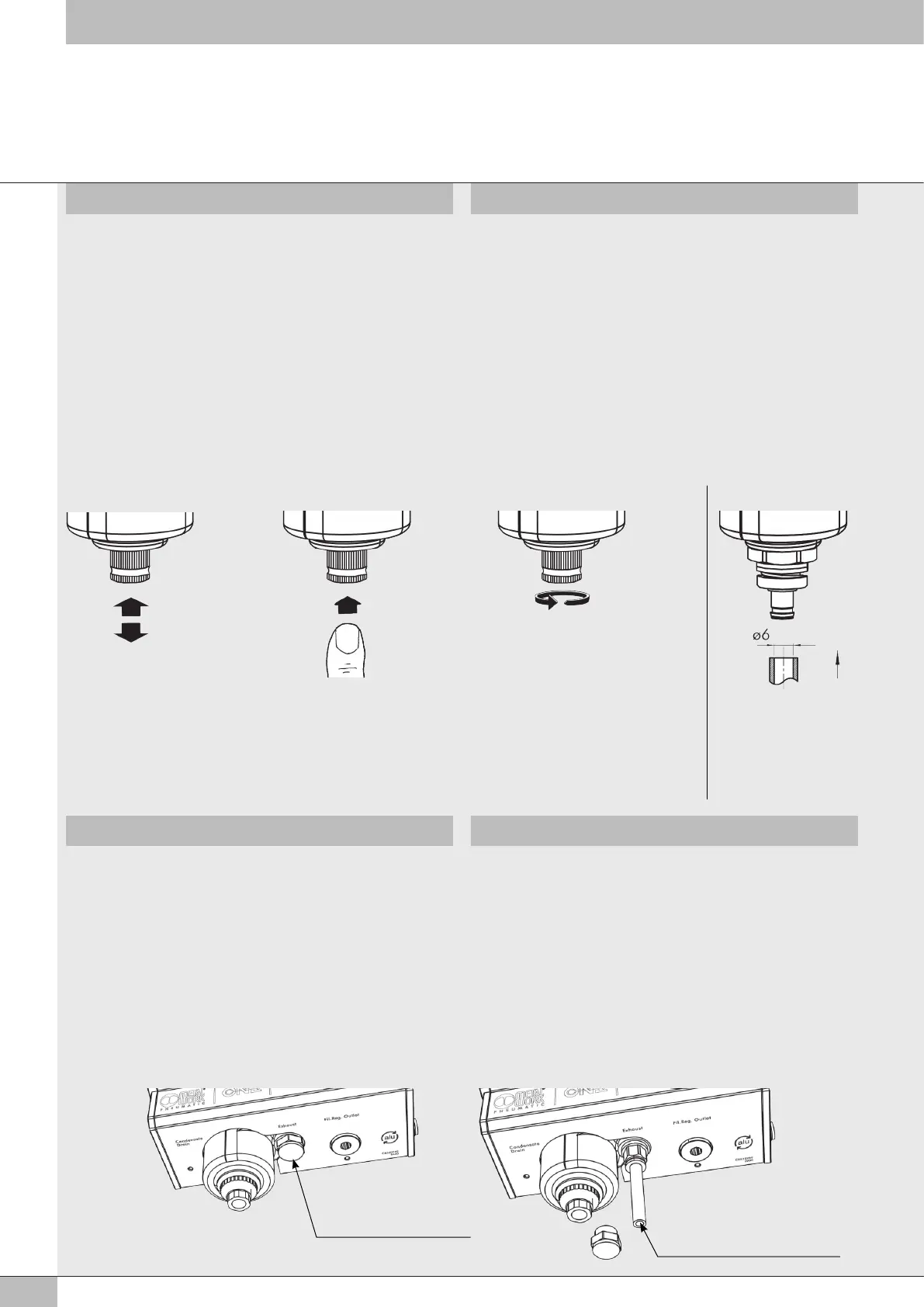
Ein integriertes effizientes System entfernt das meiste Kondensat aus der
Druckluft und sammelt dies in einem Sichtbehälter unten an der Einheit.
Dieses Wasser muss abgelassen werden.
Bei Ablass “RMSA” muss die Druckluftversorgung von Zeit zu Zeit
abgeschaltet werden, um das Kondensat abzulassen.
Alternativ muss die Ringmutter am Ablass manuell gedreht werden.
Bei vollautomatischem Ablass (RA) wird das Kondensat immer dann
abgelassen, wenn das Niveau im Behälter erreicht wird, bei dem das
Schwimmerventil anspricht.
Zur Beförderung des ablaufenden Wassers einen Schlauch mit 6 mm
Innendurchmesser im unteren Bereich einsetzen.
HINWEIS: Wenn der Durchmesser des Schlauches zu klein ist, oder
es gibt Biegungen oder Engstellen, so kann das Wasser nur schlecht
abfließen und der automatische Ablass funktioniert nicht exakt.
KONDENSATABLASS CONDENSATE DRAIN
An efficient internal system separates most of the water condensate in the
compressed air and collects it in a clear bowl at the bottom of the unit.
This water has to be drained out.
If an RMSA device is present, the compressed air supply must be
switched off periodically to drain out the condensate or, alternatively, the
ring nut must be pushed upwards by hand.
If there is an automatic drain RA, the condensate is drained out
automatically whenever the level in the bowl reaches the point of
intervention of the float valve.
To convey the draining insert the pipe having internal diameter 6 mm in
the lower part.
NB: If the diameter of the pipe is too small, or there are bends or
bottlenecks, it is difficult for the water to flow through it and the
automatic drain does not work properly.
The semi-auto
condensate drain is
the normally open
type. When there
is pressure in the
bowl, the drain
closes. When there
is no pressure in the
bowl,
it opens and the
condensate drains out.
Wenn es notwendig
ist, ist es auch möglich
das Kondensat unter
Druck abzuleiten. Die
einfache manuelle
Bewegung “Ventil
nach oben drücken”
ermöglicht den
Kondensatablass.
Bei Drehung des
Knopfes im
Uhrzeigersinn, wird
das Ventil verrastet
und es kann nur
dann arbeiten, wenn
der Knopf in die
zentrale Position
gestellt wird.
RMSA
RA
ONE hat ein einziges Druckentlüftungsventil unten an der Einheit.
Abluft wird freigesetzt, wenn:
1. Das manuelle V3V geschlossen ist.
2. Das elektrische V3V oder APR abgeschaltet ist.
3. Der Sekundärdruck am Regler den Einstellwert überschreitet.
Das Entlüftungsventil hat einen Gewindeanschluss 1/4” mit einem
Schalldämpfer in Metallgeflecht.
Wenn die Abluft geführt werden soll, so ist der Schalldämpfer durch eine
geeignete Verschraubung zu ersetzen. Ein Schlauch mit mindestens 6 mm
Durchmesser wird dazu empfohlen.
ENTLÜFTUNG AIR EXHAUST
Entlüftung 1/4” / Air exaust G1/4”
ø mindestens 6 mm / ø at least MIN 6 mm
ONE has a single compressed air relief valve at the bottom.
Downstream air is discharged when:
1. The V3V manual valve is closed.
2. The V3V electric valve or the APR is switched off.
3. The downstream pressure exceeds the reading on the regulator.
The exhaust valve has a 1/4” threaded port supplied standard with a
metal mesh silencer.
If you wish to convey the air out, replace the silencer with a suitable
fitting. A pipe with a diameter of at least 6 mm is recommended.
Der halbautomatische
Ablass ist normal
offen. Wenn Druck
im Behälter ist,
schließt der Ablass.
Wenn kein Druck
im Behälter ist,
öffnet er sich und
das Kondensat wird
abgeleitet.
If necessary, it is
possible to drain the
condensate whilst
the bowl is
pressurised.
The simple manual
operation of
“pushing up the
valve” will allow the
condensate to drain.
When rotating the
button clockwise,
the valve becomes
in locked position,
and can only work
when the button
is returned to the
central position.


 To Next Page
 Loading...