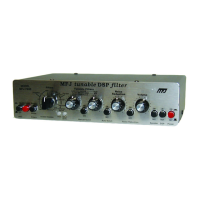
MFJ-784B Fast Start
Fast Start 2
5. How to operate the CW filter. (If you work SSB skip to step 6)
a. Your radio should still be tuned to a CW station and setup as in step
2 (except Power). Press and lock the DSP button. Adjust the DSP's
volume control.
b. Press and hold the red Program button. You will hear a "spotting"
tone at the center frequency of the CW filter.
c. Adjust the left Tunable Filters control (center frequency or fc) until
the tone is the same pitch as the CW station. When the tones are
closely matched, release the Program button.
d. Slowly adjust the right Tunable Filters control (bandwidth or BW)
clockwise. The CW station's signal should become clearer (less noise
and QRM).
e. With practice, you will be able to tune in signals without using the
spotting tone. You will also be able to separate multiple signals and
copy signals that were undetectable without the filter.
f. Experiment with the Noise Reduction, AGC, and Manual Notch
controls.
6. How to operate the SSB filter. (If you work CW skip to step 7)
a. Your radio should still be tuned to a SSB station and setup as in step
2 (except Power). Press and lock the DSP button. Adjust the DSP's
volume control.
b. Adjust the right Tunable Filters control (bandwidth or BW) clockwise
to make the SSB signal clearer (less noise and QRM) while not
making the signal less intelligible.
c. Adjust the left Tunable Filters control (center frequency or fc) to peak
the signal for maximum intelligibility.
d. Re-adjust the right Tunable Filters control (bandwidth or BW)
clockwise to eliminate most of the noise and QRM. At some point
decreasing the bandwidth will make the signal less intelligible.
e. Press the DSP button to the "out" position. Find another station that
has CW or some other tone interference audible with a SSB or voice
signal.
f. Press the DSP button to the "in" position and filter the voice signal.
Lock the Auto Notch button "in." Any remaining tones should
disappear or be greatly reduced.
g. Experiment with different filter adjustments and functions under
various conditions to become familiar with the various controls.
7. Now that you have used the DSP filter you can read other parts of this
manual to learn to use the other features of the MFJ-784B.


 To Next Page