MFJ-941EK Tuner Kit Instruction Manual
- 28 -
OPERATING INSTRUCTIONS
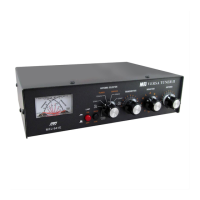
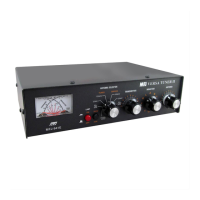
To measure forward and reflected power:
[ ] Select the desired forward power range (300W or 30W) and transmit a carrier.
[ ] View the Forward scale to read incident power.
[ ] View the Reflected scale to read reverse power.
[ ] For SWR, find the red curve closest to where the two meter pointers intersect.
To obtain highly precise SWR readings, record Forward and Reflected power
levels, then plug them into the formula:
SWR =
1 + Pr
Pf
1 - Pr
Pf
Pr = Reflected Powe
Pf = Forward Power
2. Using the Antenna Selector Switch:
The tuner's built-in Antenna Selector performs two functions:
[ ] Switches the T-network in and out of the tuner's RF path.
[ ] Selects between two coax lines, a single-wire feed*, and a dummy load.
If your transceiver has a tunable PA, you'll want to use the Dummy Load port in
conjunction with an external 50-Ohm load. However, for solid-state radios with
fixed 50-Ohm output, you may elect to use Dummy Load for a third coaxial-fed
antenna (the RF path is the same as for Coax-1 and Coax-2).
To accommodate ladder line or open-wire feeders, the internal 4:1 balun can be
energized at Balanced Line (see balun instruction).
3. Using the T-network Tuner:
The T-network is a highly flexible tool for matching a wide range of loads into 50
Ohms. Here is a control description and the preferred method for tuning them:
[ ] The Inductor switch provides maximum inductance at setting A and minimum
inductance at L. Typically, you'll need more inductance at low frequencies and


 To Next Page