© Microhard 114
6.0 Installation
6.2.2 2X2 MIMO Antenna Selection, Placement & Orientation
For optimal performance of the pMDDL modems one must consider and plan for the specific ap-
plication and environment where the pMDDL modules will be used. Described below are some of
the considerations that must be taken into account while using pMDDL modems.
Multipath Environments
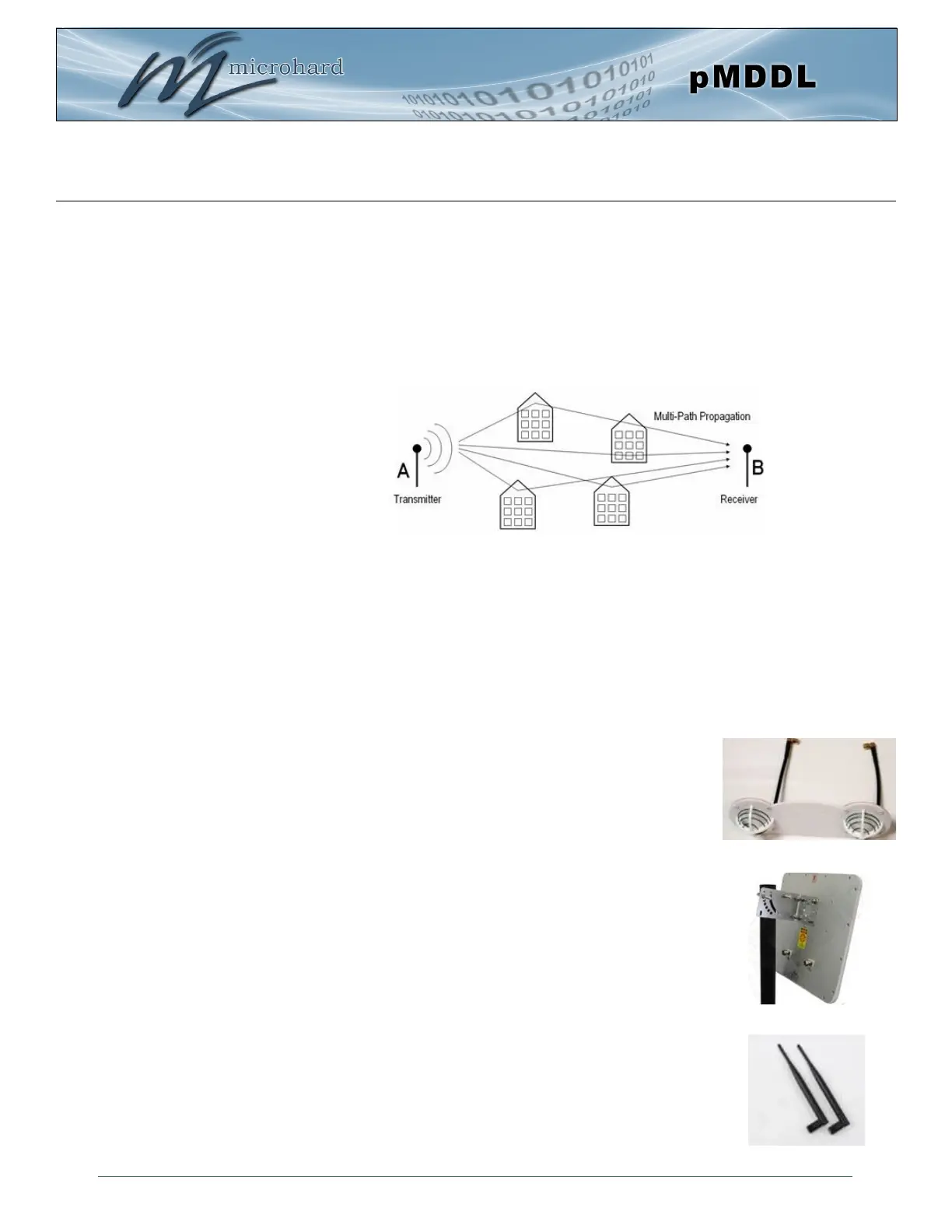
A multipath environment is where the signal from origin to destination may not have a direct path
as seen in the illustration below:
In a multipath rich conditions is it recommended that each pMDDL end have a pair (2) of omni
directional antennas that have at least half-wavelength distance between them. A set of (4) Omni-
directional antennas is good for a pair of pMDDL radios.
The wavelength* is determined by the specific frequency being used by the pMDDL. For example
the length of a wavelength @ 2.450 MHz is 122 mm, therefore the half wavelength is 61 mm. This
would mean that the pair of antennas on each pMDDL system would have to be spaced at least
61 mm apart.
* Refer to a wavelength calculator or antenna manufacturer for accurate wavelength calculations
Circular Polarized Antenna
Linear Orthogonal Antenna
LOS (Line of Sight) Environments
In good LOS applications, where the main LOS signal is much
stronger than other components, orthogonally polarized antennas
on both radios will out perform other types of antennas in terms of
spatial separation. With these types of antenna systems it is rec-
ommended to space each pair of antennas at least one or more
wavelengths apart on each end of the system to achieve as much
spatial diversity as possible.
• Circular polarized antennas (Left Hand Circular Polarization (LHCP)
and Right Hand Circular Polarization (RHCP)) will work with circular
polarized antennas (LHCP and RHCP) for best match.
• Circular polarized antennas (LHCP and RHCP) will work with linear
orthogonal antennas (V-POL and H-POL) at about 3 db loss. This
combination results in preferable performance for UAV applications as
circular polarized antennas at GCS acquire adequate signal no matter
what the UAV antennas’ orientation change to.
• Linear polarized antennas (V-POL and H-POL) will work with linear
orthogonal antennas (V-POL and H-POL) for best match.
• OMNI directional antennas work with OMNI directional antennas due
to dimension & weight limitation, two antennas are one or more wave-
lengths apart .
OMNI Directional Antenna(s)


 To Next Page