DOC 6501_Release V
ATS-6501 Users Guide
102
6. Troubleshooting
The following section provides some basic troubleshooting information to assist users in case
they suspect there is an issue with the system.
6.1 Front Panel Indications
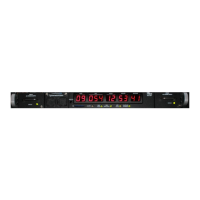
You can use the front panel indicators to assess the status and operation of the unit. Under
normal operating conditions the user should see:
• Green Status Indicator on both power supplies
• The front panel clock should display the last two digits of the year, the correct Julian Date
(see appendix D.) and the correct time (UTC). The time should also increment each
second.
• The Alarm Light is Off
• The OSC Lock, GPS Tracking, NTP Locked, and Outputs Enabled lights are green.
6.2 Alarm Light
The alarm light will turn red when the unit has detected a hardware failure or an event has
occurred that may cause the timing signals output by the unit to be outside of their specifications.
• Either power supply missing/failed or without AC/DC input power.
• Any output module reporting a failure or is not locked to the reference
• GPS has not been not tracking for at least 30 minutes or there is a hardware error
• Reference clock wander has exceeded 100 ns from UTC
• The Rubidium is unlocked.
• Over temperature (65 C)
• External Reference
o System is unable to communicate with the external reference source or,
o 10MHz input from the external reference is missing and
o Reference=external.
• If syscfg in enabled, use the status syscfg:errors command to get the current list of
configuration alarms.
If the alarm light is on users can determine the exact cause of the alarm by accessing the
command port and typing the alarms command and obtain a list of the current alarms.
If the alarm light was on and is currently off, users can connect to the command port and type the
command status health to view alarm occurrences or the syslog command to obtain the list of
errors from the system log file.
Note: Starting with Version 4.0 there are two types of alarm indications that may be raised
during the operation of the unit. The first alarm is an event alarm. This alarm is raised if the
system attempts, fails, and then continues attempting to perform a function, i.e. the system
attempted to steer the internal clock and this operation failed however the system continued
operating. These types of alarms are ‘latched’ such that the user is required to clear the alarm
using the clear_alarms command. The second type of alarm is the state alarm. This alarm is
generated if the system has entered a bad operating state, i.e. the phase error is greater than 100
ns, communications with the internal GPS receiver is lost, or the GPS receiver has not been


 To Next Page