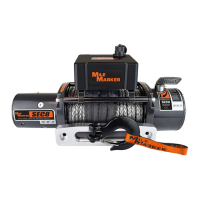
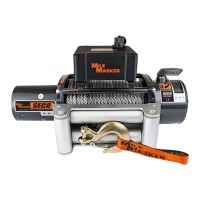
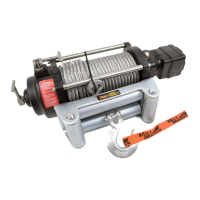
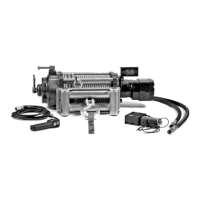
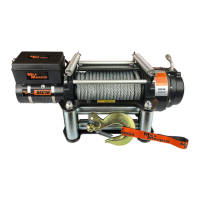
This document is an Installation & Operator's Manual for a Mile Marker SEC18 winch, rated at 18,000 lbs. It provides comprehensive instructions and guidelines for the safe installation, operation, and maintenance of the winch.
Function Description
The Mile Marker SEC18 winch is designed for intermittent use in horizontal pulling applications, primarily for vehicle self-recovery or moving heavy items. It utilizes a steel cable and a motor-driven drum to exert significant pulling force. The winch is controlled remotely via a wired switch assembly, allowing the operator to maintain a safe distance during operation. Its robust design, including a solenoid assembly and a clutch mechanism, enables controlled winding and unwinding of the steel cable. The winch is intended to be securely mounted to a vehicle or structure capable of withstanding its rated pulling force.
Usage Features
The manual emphasizes several key usage features and safety protocols to ensure effective and safe operation:
Installation:
- Mounting: The winch requires a flat, secure mounting surface, often necessitating a dedicated mounting frame and potentially additional steel reinforcement plates or bracing, which may need to be welded.
- Solenoid Assembly: The solenoid bracket attaches to the motor end bearing assembly, and the solenoid assembly itself is then mounted to the winch.
- Fairlead: A roller fairlead must be installed on the mounting frame to guide the steel cable and prevent damage to the winch and cable.
- Wiring: Proper electrical wiring is crucial, connecting the motor terminals, solenoid, and battery. The manual provides a wiring diagram and advises matching cable colors to terminals. It also includes a note on checking and potentially switching remote control directions by swapping yellow and blue cables.
- Battery Recommendation: A battery with at least 650 CCA (Cold Cranking Amps) is recommended for optimal performance.
Operation:
- Clutch Mechanism: The winch features a clutch handle to engage and disengage the drum, allowing for manual free-spooling of the cable when disengaged and powered winding/unwinding when engaged.
- Cable Management: Operators are instructed to pull the cable through the fairlead and attach the hook to the item being pulled. It is critical to leave at least five complete turns of cable on the drum to prevent damage.
- Remote Control: The winch is operated using a wired remote control that plugs into the solenoid. The remote has buttons for forward and backward movement of the cable.
- Safe Pulling Practices:
- Clear Area: Maintain a clear working area, keeping people away from the taut steel cable and its potential pathway in case of failure.
- Gloves: Heavy gloves are mandatory when handling the steel cable to prevent cuts from burrs and slivers.
- Hand and Finger Safety: Keep hands and fingers clear of the steel cable and hook, especially when reeling in the last few feet, and never guide a tensioned cable with bare hands.
- Straight Pulls: Avoid continuous pulls from extreme angles to prevent cable piling on one end of the drum. The cable should be as straight as possible in relation to the object being pulled.
- Intermittent Use: The winch is designed for intermittent use. Prolonged operation at or near rated load can cause the motor to overheat. If the motor becomes too hot, operators should stop and allow it to cool.
- No Overloading: Never exceed the winch's rated capacity or use inappropriate attachments to extend the cable's length.
- Snatch Block Use: The manual details the use of a snatch block to increase pulling power, change the direction of pull, and reduce strain on the winch. It also advises on using a tree saver strap to protect anchor points.
- Cable Dampener: Placing a cable dampener (e.g., towels or jackets) over the steel cable is recommended to mitigate the risk of whipping if the cable breaks.
- Vehicle Engine: Running the vehicle's engine during pulling operations helps keep the battery charged.
- Post-Operation: After use, the cable should be rewound onto the drum under a load of at least 500 pounds to prevent damage. The remote control should be disconnected and stored safely.
Maintenance Features
The manual outlines essential maintenance practices to ensure the longevity and reliable performance of the winch:
- Lubrication: All moving parts are factory-lubricated with high-temperature lithium grease, and no further internal lubrication is required for the life of the winch. However, if using steel cable, periodic lubrication with light penetrating oil is recommended.
- Cable Inspection and Replacement: The steel cable should be inspected frequently for damage such as fraying, broken strands, kinks, or knots. Any damaged cable must be replaced immediately with an identical Mile Marker steel cable that matches the original's strength, quality, lay, and stranding.
- Electrical Connections: Electrical connections can corrode over time due to environmental exposure, potentially reducing performance or causing shorting. Operators are advised to clean electrical connections before and after each use.
- Motor Temperature Monitoring: During operation, especially under high loads, the motor's temperature should be checked periodically. If it becomes too hot to touch, operation should cease until it cools down.
- Spooling Under Load: When rewinding the cable, it should be spooled evenly and tightly under a minimum load of 500 pounds to prevent damage to the cable and winch.
- Troubleshooting Guide: A comprehensive troubleshooting section helps diagnose common issues such as the motor not turning on, overheating, running slowly, or the cable drum not turning. It provides possible causes and suggested remedies, including checking the safety switch, battery connections, solenoid, and switch assembly, as well as draining water from the motor or recharging the battery.


 To Next Page
 General