OM-281136 Page 2
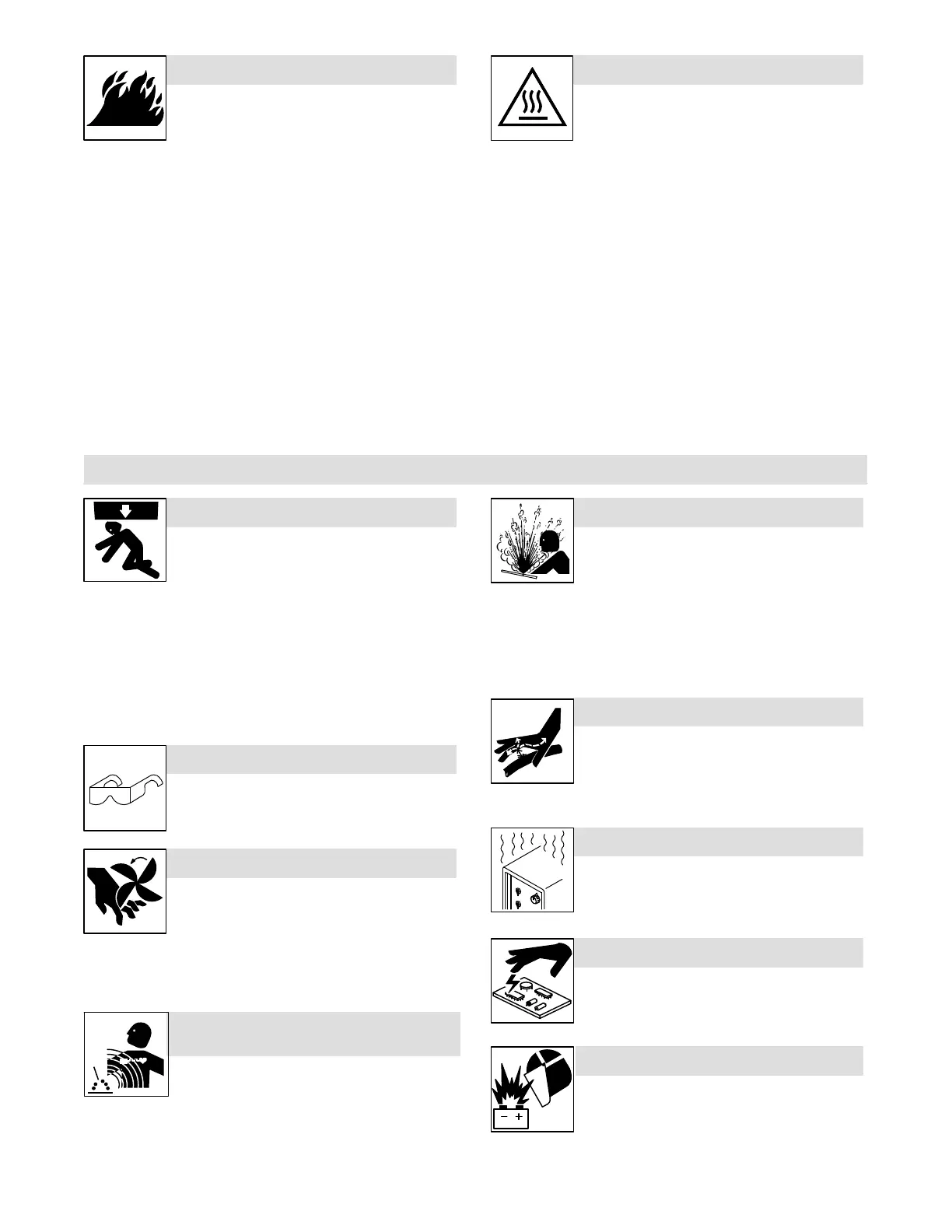
FIRE OR EXPLOSION hazard.
D Do not overheat parts.
D Watch for fire; keep extinguisher nearby.
D Keep flammables away from work area.
D Do not locate unit on, over, or near combustible surfaces.
D Do not use unit to thaw frozen pipes.
D Do not install unit near flammables.
D Do not cover an air−cooled blanket with any material that will
cause the blanket to overheat.
D Do not operate where the atmosphere can contain flammable
dust, gas, or liquid vapors (such as gasoline).
D After completion of work, inspect area to ensure it is free of
sparks, glowing embers, and flames.
D Use only correct fuses or circuit breakers. Do not oversize or by-
pass them.
D Read and understand the Safety Data Sheets (SDSs) and the
manufacturer’s instructions for adhesives, coatings, cleaners,
consumables, coolants, degreasers, fluxes, and metals.
D Wear body protection made from durable, flame−resistant mate-
rial (leather, heavy cotton, wool). Body protection includes
oil-free clothing such as leather gloves, heavy shirt, cuffless
trousers, high shoes, and a cap.
INDUCTION HEATING can burn.
D Do not touch hot parts bare-handed.
D Allow cooling period before handling parts or
equipment.
D Do not touch or handle induction head/coil during operation un-
less the equipment is designed and intended to be used in this
manner as specified in the owner’s manual.
D Keep metal jewelry and other metal personal items away from
head/coil during operation.
D To handle hot parts, use proper tools and/or wear heavy, insu-
lated welding gloves and clothing to prevent burns.
1-3. Additional Symbols for Installation, Operation, and Maintenance
FALLING EQUIPMENT can injure.
D Use handle and have person of adequate
physical strength lift unit.
D Move unit with hand cart or similar device.
D For units without a handle, use correct procedures and equip-
ment of adequate capacity to lift and support unit.
D Keep equipment (cables and cords) away from moving vehicles
when working from an aerial location.
D If using lift forks to move unit, be sure forks are long enough to
extend beyond opposite side of unit.
D Follow the guidelines in the Applications Manual for the Revised
NIOSH Lifting Equation (Publication No. 94−110) when manually
lifting heavy parts or equipment.
FLYING METAL OR DIRT can injure eyes.
D Wear approved safety glasses with side
shields or wear face shield.
MOVING PARTS can injure.
D Keep away from moving parts such as fans.
D Keep all doors, panels, covers, and guards
closed and securely in place.
D Have only qualified persons remove doors, panels, covers, or
guards for maintenance and troubleshooting as necessary.
D Reinstall doors, panels, covers, or guards when maintenance is
finished and before reconnecting input power.
ELECTRIC AND MAGNETIC FIELDS (EMF)
can affect Implanted Medical Devices.
D Wearers of Pacemakers and other Implanted
Medical Devices should keep away.
D Implanted Medical Device wearers should consult their doctor
and the device manufacturer before going near arc welding, spot
welding, gouging, plasma arc cutting, or induction heating
operations.
STEAM AND HOT COOLANT can burn.
Hose may rupture if coolant overheats.
D Never disconnect both ends of hose when in-
stalled on hot workpiece.
D If coolant flow stops, leave one end of hose connected to allow
coolant to return to cooler and relieve pressure.
D Remove hose from hot workpiece to prevent damage.
D Visually inspect condition of hoses, cords, and cables before
each use. Do not use damaged hoses, cords, or cables.
D Allow cooling period before working on equipment.
HIGH PRESSURE FLUIDS can injure or kill.
D Coolant can be under high pressure.
D Release pressure before working on cooler.
D If ANY fluid is injected into the skin or body seek medical help
immediately
.
OVERUSE can cause OVERHEATING
D Allow cooling period.
D Reduce output or reduce duty cycle before
starting to heat again.
D Follow rated duty cycle.
STATIC (ESD) can damage PC boards.
D Put on grounded wrist strap BEFORE handling
boards or parts.
D Use proper static-proof bags and boxes to
store, move, or ship PC boards.
BATTERY EXPLOSION can injure.
D Do not use induction equipment to charge bat-
teries or jump start vehicles unless it has a bat-
tery charging feature designed for this purpose.




 To Next Page