Remove jumper wires from terminals 9 (R signal) and
8 (P1 signal); then reconnect the appropriate wire
securely to terminals 9 (R signal). Adjustment of the
Maximum Speed Potentiometer is now completed.
TO ADJUST THE TORQUE
LIMIT POTENTIOMETER:
Required Equipment: If press is equipped with a “Per-
cent of Load” meter, no other equipment will be need-
ed. If this meter is not furnished, a snap-around type
ammeter may be used. Range of the ammeter should
cover at least 200% of the motor full load current.
NOTE: If a snap-on ammeter is used, place the meter
tongs around one of the “T” leads going to the
main drive motor.
Adjustment of the Torque Limit Potentiometer is made
to prevent firing of the coupling SCR whenever A.C.
motor current exceeds the preset value. This poten-
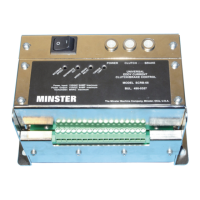
tiometer is located on the SCRB-68 unit and is labeled
“Torque Limit” and is located last from the left when
viewing the control. This potentiometer is accessible
through an opening on the front panel. To adjust, start
drive from rest and promptly turn speed control to the
maximum speed position. While flywheel is accelerat-
ing from rest to full speed, adjust the Torque Limit
Potentiometer so as to cause the motor current indica-
tor to fluctuate between 100% and 150% of full load.
The operator’s speed control, or one of the preset
potentiometers (as explained under maximum speed
adjustment) should be used to control the speed for this
setting. It is suggested that the slide not be cycled while
making this adjustment.
Care should be taken when making this adjustment
since too tight an adjustment will prevent any excitation
of the coupling, and too little will prevent any torque lim-
iting action.
TO ADJUST OPERATING POINT
OF SPEED SENSE RELAY:
Required Equipment: D.C. Voltmeter with 0 - 150
V.D.C. range. The potentiometer is located on the
SCRB-68 unit and is labeled “Speed Sense Relay” and
is located third from the left when viewing the control.
The operating point of the speed sensitive relay is
adjustable by a potentiometer accessible through an
opening on the front panel. It can be set to operate at
practically any speed falling within the range of the
press.
A D.C. voltmeter may be used as an indicator to show
when the relay is energized. Set meter range to the 0-
150 volt scale, attach negative probe to control terminal
16 (K2 signal) and positive probe to terminal 15 (K1 sig-
nal). When the relay is energized, meter reading will be
approximately 90 volts D.C. in the de-energized state,
only about 10 V.D.C will be indicated.
To Set Relay Operating Point:
1. Start press drive motor and adjust operator’s speed
control or one of the preset potentiometers (as
explained under maximum speed potentiometer
adjustment) to the speed desire for the operating
point of the relay. Allow sufficient time for the drive
to stabilize at the selected speed.
2. Set voltmeter to 0-150 V.D.C. range and attach
probes to control terminals 15 (+) and 16 (-).
3. If D.C. meter indicates relay is energized, turn
speed sense relay adjustment screw, counterclock-
wise until relay de-energizes. If relay is de-ener-
gized, turn the adjusting screw clockwise until the
relay is energized.
4. Double check adjustment by varying press speed
through the selected speed operating point and
observing relay drop out point. Make further fine
adjustments, if necessary.
5. Adjustment is now complete. Disconnect and
remove D.C. voltmeter.
TO ADJUST THE STROKES
PER MINUTE METER:
Voltage from the tachometer generator (in the eddy
current drive) is used to operate the strokes per minute
meter. That meter is essentially a voltmeter calibrated
in strokes per minute. Because of the variation in
speeds, meters and tachometer generator voltages, a
means of adjusting the meter to the actual press speed
is provided. Some of the meters are A.C. types while
others are D.C. operated; therefore, the type of cali-
bration network furnished will depend upon the meter.
Calibration instructions are included for the most popu-
lar arrangements. Follow instructions matching the
arrangement furnished.
When calibrating the S.P.M. meter, determine the actu-
al number of strokes per minute that the press is run-
ning by observing the stroke counter (if furnished), by
using a mechanical hand tachometer, or by actual
count.
The Bul. 490-0246 Digital S.P.M. Meter contains an
integral calibration network. Refer to the separate
Technical Bulletin, 193 or 2007, which is included in the
composite Service & Operating Manual, for detailed
calibration instructions on this unit.
— 10 —


 To Next Page