This document provides assembly instructions for the Kirra Desk by Mocka. It is a flat-pack furniture item designed for self-assembly.
Function Description
The Kirra Desk is a piece of furniture primarily designed as a workstation or study desk. It features a flat tabletop surface for working, and integrated drawers for storage, helping to keep the workspace tidy and organized. The desk is intended for indoor use in homes or offices.
Important Technical Specifications
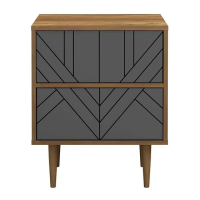
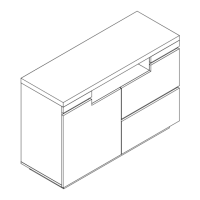
The manual does not explicitly list technical specifications such as dimensions, weight capacity, or materials (e.g., particle board, MDF, solid wood). However, based on the assembly diagrams, the desk appears to be a rectangular desk with a main tabletop and a side cabinet featuring multiple drawers.
The hardware supplied for assembly includes:
- Dowels (A): 13 pieces
- Screws (B): 12 pieces
- Bolts (C): 25 pieces
- Locking Nuts (D): 25 pieces
- Small Screws (E): 30 pieces
- Slide Rails (F): 3 pieces (for one set of drawers)
- Slide Rails (G): 3 pieces (for another set of drawers)
- Slide Rails (H): 3 pieces (for drawer sides)
- Slide Rails (I): 3 pieces (for drawer sides)
- Screws (J): 16 pieces (for legs)
- Wedges (K): 4 pieces (for back panel support)
- Screws (L): 4 pieces (for wedges)
- Long Screws (M): 6 pieces (for securing panels)
- Nuts (N): 2 pieces (for panel connection)
- Bolts (O): 2 pieces (for panel connection)
- Bolts (P): 3 pieces (for tabletop connection)
- Allen Key (Q): 1 piece (for bolts P)
Wall Strap Hardware (for anti-tip safety):
- Safety Strap (V): 1 piece
- Screw (W): 1 piece (for strap to furniture)
- Wall Anchor (X): 1 piece
- Screw (Y): 1 piece (for strap to wall)
- Washer (Z): 2 pieces
The desk features multiple drawer compartments. The assembly process indicates the construction of three separate drawers, each with its own set of side panels, front/back panels, and bottom panels. Slide rails (F, G, H, I) are used to allow the drawers to slide smoothly in and out of their compartments.
Usage Features
The Kirra Desk is designed for general use as a desk. Its primary usage features include:
- Work Surface: A spacious tabletop for placing computers, books, or other work-related items.
- Integrated Storage: Multiple drawers provide enclosed storage for stationery, documents, or personal items, helping to maintain a clutter-free workspace.
- Anti-Tip Safety: The desk comes with a safety wall anchor (V, W, X, Y, Z) to prevent tipping, especially important in households with children or in earthquake-prone areas. This feature enhances user safety by securing the furniture to a wall.
- Self-Assembly: The desk is a flat-pack item, requiring the user to assemble it following the provided step-by-step instructions. This allows for easier transportation and potentially lower cost.
Maintenance Features
The manual does not provide specific maintenance instructions for the Kirra Desk. However, general maintenance for this type of furniture typically involves:
- Cleaning: Wiping surfaces with a damp cloth and mild cleaner to remove dust and spills. Avoid harsh chemicals that could damage the finish.
- Hardware Checks: Periodically checking and tightening all screws, bolts, and locking nuts to ensure the desk remains stable and secure. Loose hardware can lead to instability and damage.
- Drawer Functionality: Ensuring the drawer slide rails (F, G, H, I) are clean and free of obstructions to maintain smooth operation. If drawers become stiff, a silicone-based lubricant can sometimes be applied to the rails (though not explicitly mentioned, this is common practice for furniture slides).
- Wall Anchor Integrity: Regularly checking the wall anchor (V, W, X, Y, Z) to ensure it remains securely fastened to both the furniture and the wall, especially after any movement of the desk or if there are signs of wear.
Assembly Tools Required:
- Phillips head screwdriver
- Flathead screwdriver
- Power drill (recommended for quicker assembly on a low-speed setting)
The assembly process is broken down into 18 steps, each with clear diagrams and instructions, indicating which panels and hardware to use at each stage. The laminated side of certain panels needs to face inwards during assembly, as highlighted in steps 9 and 13, which is a detail important for the aesthetic and structural integrity of the drawers. The final step emphasizes lifting, not dragging, the assembled furniture into place to prevent damage, and securing it to the wall using the provided safety strap.

 Need help?
 General

 To Next Page