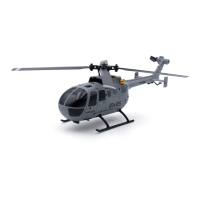
Manual MODSTER EC-135
www.modster.at 25
noticeably lower�
The maximum external cell temperature should not be exceeded during both charging
and discharging, otherwise the cell will suer permanent damage in the form of capa-
city loss� If exceeded for a longer period of time, it will be destroyed and may explode
and start to burn�
Self-discharge:
Lithium cells have an extremely low self-discharge rate (about 0�2% per day) and the-
refore can be stored for long periods without problems� If the voltage drops below 3
volts/cell, it is essential to recharge�
Deep discharge must be avoided, otherwise the cell will suer permanent damage in
the form of capacity loss and render the battery pack unusable�
Storage:
Before longer storage, the batteries should be charged to the storage voltage of
approx� 3�8���3�9 volts/cell� After approx� 3-5 months they should be recharged� Never
store or keep fully charged but only fully charge immediately before use� Store batte-
ries in a fireproof lithium safe or tested lithium bag� Store and keep at room tempera-
ture (17-22°C)�
Lifetime:
The theoretical life of a cell at low discharge currents, is approximately 500 charge/
discharge cycles� At medium discharge currents, the lifetime is lower and is only about
300 cycles� At high discharge currents, the number of cycles is in the range of 150-
200 cycles� At very high discharge currents even significantly lower�
After that, the battery is used up and must be disposed of� If the lithium batteries are
only discharged to approx� 70-75% during operation, they will thank you with a longer
service life� Stop operation before a noticeable loss of power becomes apparent� Dis-
connect the battery from the load after operation to avoid further discharge�
Memory eect, cell capacity
Since lithium cells have no memory or lazy-battery eect, the discharge-charge (cy-
cling, matching) required for NC and NiMH batteries is not necessary� Discharging
before charging should also be avoided� Since the capacity of the lithium battery
decreases slightly with each charge, this would cause unnecessary loss of capacity to
the cell�
Interconnecting battery packs
Interconnecting lithium cells in series or parallel to increase voltage or capacity is
problematic because of the dierences in charge voltage and capacity� Only selected
cells can be connected together to form a battery pack� For our lithium battery packs,
only selected cells are connected together to form a battery pack�
Disposal of rechargeable batteries
Never dispose of rechargeable batteries in the household waste� To protect the en-


 To Next Page