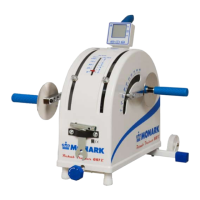
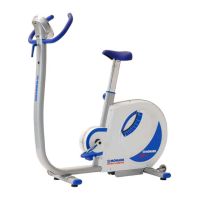
Testing with Ergomedic 939 E
The versatility of the 939 E / 939 Medical Ergometer
enable it to be utilized in a variety of testing
environments. The precision and reproducibility of
the test values obtained with the bike, along with the
uncomplicated way to set up the tests, means the bike
can be used in clinical work tests, in occupational
health services for the fitness tests as well as fitness
centers, schools, sports clubs and the like. The
backgrounds of both the individuals being tested and
those administering the test may be vastly different in
these widely varying testing situations.
In general, whether in a clinical laboratory or a health
club, the subject may be exercised quite strenuously,
depending on workloads which have been selected. As
a precaution, it may be advisable, prior to beginning
an exercise protocol, that each subject consults with
a physician.
Before testing, the operator should review the entire
protocol operation with the test subject, explaining
the work which will be required and the duration of
the procedure. A system of communicating fatigue,
chest pain or other abnormal physical response to the
exercise should be discussed.
The test subject should not engage in heavy physical
activity for several hours prior to testing to establish
maximum oxygen consumption. In addition, all
testing and exercise protocols should be performed
a reasonable time after meals. The test person should
also refrain from smoking within an hour of the
testing period.
The test person shall also have the appropriate
clothing for a work test. Training suit or loose-fitting
clothing is best. The test subject may need some
general education concerning the pedalling of the
ergometer. The saddle and the handlebars should be
adjusted for comfort and proper mechanical distance.
The appropriate height of the saddle is when the knee
is slightly bent when the sole of the foot is centred over
the pedal axle with the pedal to the bottom position.
The operation of the speed metronome and over/
under display should be reviewed.
The maintenance of the proper speed should be
practiced at a low workload.
Finally, put the chest belt on. Check for a minute
that a proper heart rate is displayed. The baseline
heart rate may also be of assistance in determining
the nervousness of the test subject. The test subject
should exhibit a relatively stable resting heart rate
prior to starting the protocol.
Power calculation
1 rpm = 6 m on the flywheel brake surface.
50 rpm = 300 m
2 kp force makes 2 x 300 = 600 kpm/min
100 rpm= 600 m
1 kp force makes 1 x 600 = 600 kpm/min
(watt = rpm x kp)


 To Next Page