Heart Rate (telemetry)
The test subject’s heart rate can be monitored by
chestbelt telemetry system. The chest belt is standard
equipment.
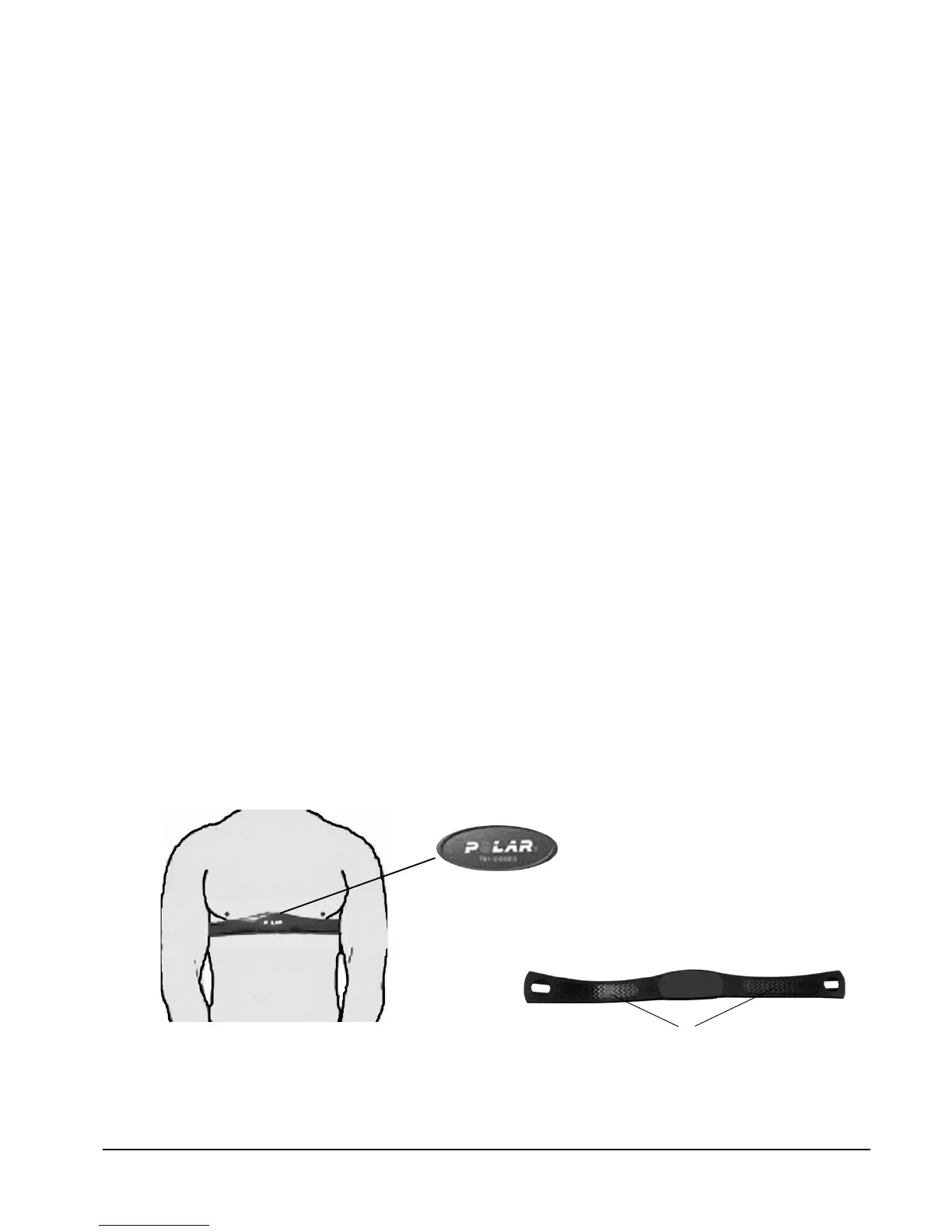
Fuss-free HR measurement requires that the belt is
correctly placed. When it is correctly fitted the logo
on the belt will be central and readable, outward
and upright, by another person. Before putting on
the belt, clean the skin where the belt is to be placed.
The chest belt should be secured at a comfortable
tension around the mid section, just below the breast
muscle, see Fig: Placement of the chest belt. Moisten
the electrodes before use, see Fig: Electrodes on the
back of the chest belt. To make contact with the HR
receiver on the bike, the distance should not be more
than 100 cm. It is especially important when first used
to identify the chest belt with the sensor, by standing
close to get the HR (maximum 60 cm). This relates
especially to the Polar heart rate belt.
NOTE! Electromagnetic waves can interfere with the
telemetry system. Cellular phones are not allowed to
be used near the bike during test.
In case of problems, turn off WiFi, Bluetooth and
similar on computers nearby.
Test person enforcement
The bike performs automated tests virtually by itself,
requiring minimal intervention by the test operator.
This allows the operator to pay careful attention to
the test subject without distraction. The response to
the exercise protocol can be accurately estimated and
appropriate action taken to assist the test person, if
necessary. Some programmes have sections where
the test person may develop significant physical
activity. The effect on the test person should not be
underestimated.
During the test it is important to observe the subject
person's appearance and heart rate. The testing should
be stopped immediately if the test person reports chest
pain, difficulty breathing, etc. A system of prompt
medical attention should be set up prior to testing, in
case of emergency.
The test person may also have difficulty keeping a
steady pedalling speed. This is of minor importance
(except in cases where the program assumes a constant
braking force, since the effect is automatically adjusted
to the correct value as long as the pedal speed is at least
35 revolutions / min (rpm)). However, it is important
to consider what each test documentation says about
the pedal speed.
Fig: Placement of the chest belt
Fig: Electrodes on the back of the chest belt (1)


 To Next Page