MOORE FANS LLC, Marceline, MO 64658 Phone (660 ) 376-3575 FAX (660) 376-2909
Page 13
TMC-647-(Rev E) - 01/06
4.2 BLADE OVERLOAD
Of all the aerodynamic abuses to be avoided in the
operation of a fan, the most important is that of overload-
ing the fan blades. Blade overload occurs because of
insufficient blade area: In other words, when there is an
inadequacy in the number of blades on the fan selected.
The Moore system of rating is based upon the pres-
sure that each blade will produce at a given RPM with good
efficiency. This pressure is called 100% blade load. When
blade load exceeds 110%, the fan will not only operate at
lower efficiency, it may be subject to structural damage as
well.
In selecting a fan, the total pressure divided by the
pressure to be produced by one blade determines the num-
ber of blades required for the anticipated performance.
Whenever information is available, The Moore Company
checks the selection. Even so, underestimation of the pres-
sure requirements by the system designer, or changes in the
operating conditions over time, may result in overload
conditions.
Why is a blade overload condition of such concern?
We are all aware of the fact that an airplane traveling at a
given speed can carry only a certain load. If the speed of the
airplane is decreased or the load increased, stalling flow
over the wing will occur. In the case of an airplane, approxi-
mately two-thirds of the lift provided by the wing is the
result of the air flow over the top or convex portion of the
wing. Lift is provided as a reaction to the flow of air being
accelerated and deflected downward as it passes over the
wing. A negative pressure area is thus formed on the top
surface of the wing which tends to lift it upward.
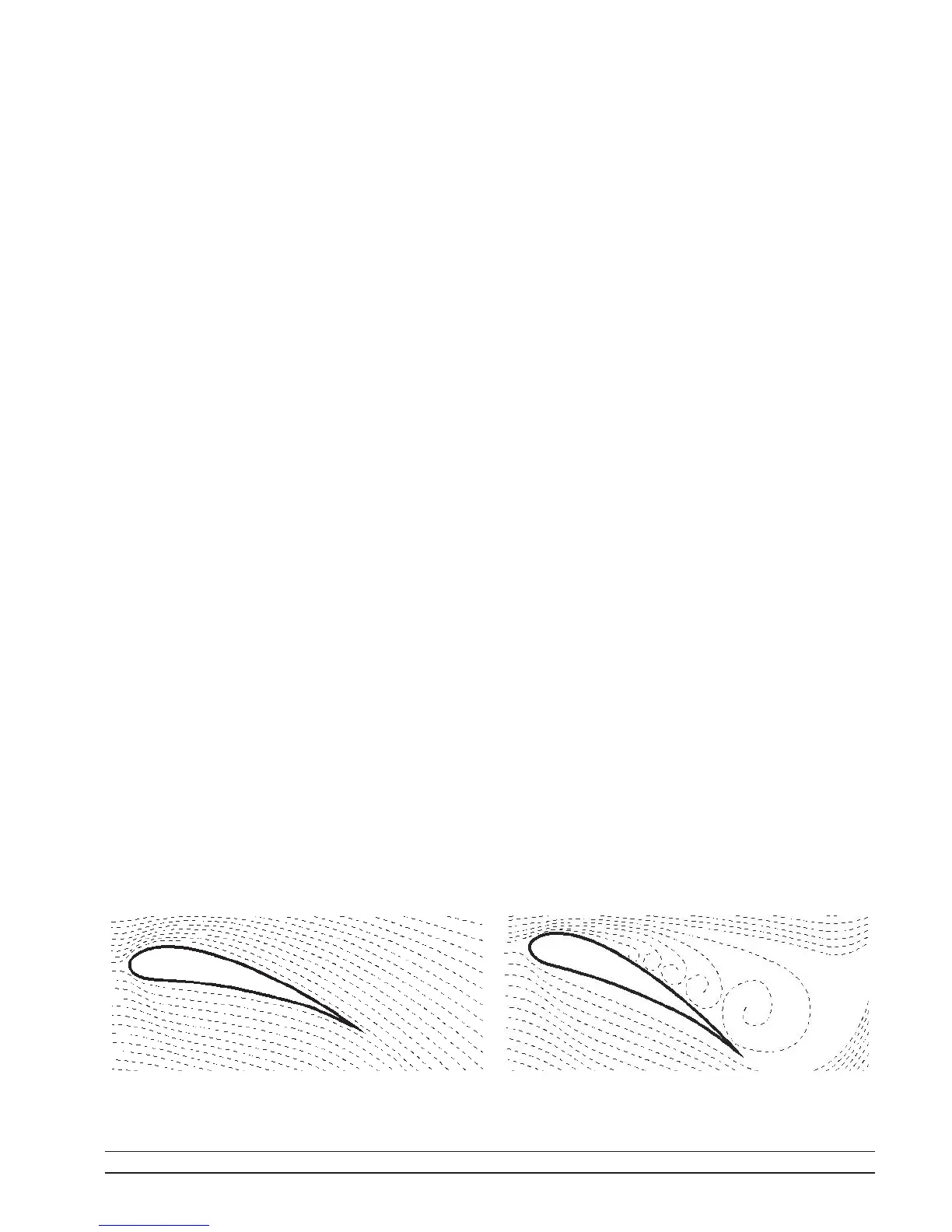
So long as air flow over the wing is smooth and clings
to the surface of the wing, little turbulence is present. When
the load is increased, or the speed decreased, the angle of
the wing to the air stream must be increased to a point
where the air flow breaks away from the upper surface of
the wing. This is known as stalling or burbling flow, since
the air, instead of clinging to the wing, breaks away near the
leading edge and leaves what might be called a turbulent
void above the upper wing surface, nullifying the acceler-
ated flow which was responsible for the greater part of the
lift of the wing.
When this occurs, the wing loses a large portion of
its lift. Flow, however, will re-establish briefly and break
again, the cycle being repeated continuously, resulting in a
severe vibration throughout the aircraft as the flow alter-
nately makes and breaks. Anyone who has experienced a
stall in an airplane will be familiar with this violent phe-
nomenon.
A fan blade is no different than an airplane wing
except that the air usually is being deflected upward rather
than downward, the convex side of the blade being the
lower surface rather than the upper surface as in the case of
an airplane. The result of blade overload is identical: When
blade load exceeds that allowable, a violent vibration will
take place in the blade as the laminar, or uniform, flow
makes and breaks perhaps many times a second.
Another way of looking at this problem is to consider
that the available number of blades are set at too steep an
angle to be able to move air at the axial velocity which is
necessary to maintain a smooth flow over the convex
surface. In other words, to move air at the velocity neces-
sary for this blade angle, plus overcoming the static resis-
tance of the system, the total pressure which would have to
be maintained for an air flow corresponding to this angle is
greater than the total pressure capability of the given
number of blades at this RPM. Such a condition can only
be corrected by decreasing the blade angle until smooth
flow is obtained or by increasing the number of blades and
the total pressure potential of the fan until the fan’s pres-
sure potential equals the pressure necessary to move the
specified quantity of air through the system.
Continued operation under conditions of stalling
flow, or blade overload, will significantly shorten the life of
the fan. Operation under these conditions will also reduce
efficiency to a ridiculously low figure. See the chart under
Section 4.4 Checking Blade Load which follows. Note that
although air flow remains constant or decreases, horse-
power continues to increase with increased blade angle.
In conclusion, if a given fan, in a given installation,
can only absorb forty horsepower, for example, the blades
may be pitched up to consume fifty horsepower without
any increase in air delivery, and possibly with a decrease.
As a result, the extra ten horsepower is totally wasted --
perhaps worse than wasted. It is good practice to select a
sufficient number of blades so that blade load will amount
to slightly less than 100% of full blade load when the motor
to be used as a driver is fully loaded. There are a number of
reasons for allowing this safety factor which are set out in
detail below.
AIRFLOW IN NORMAL FLOW
Downward flow provides lift to the wing
AIRFLOW IN STALLING FLOW
Note lack of air deflection downward.
OPERATION


 To Next Page
 Loading...