MOORE FANS LLC, Marceline, MO 64658 Phone (660 ) 376-3575 FAX (660) 376-2909
Page 17
TMC-647-(Rev E) - 01/06
charge may be increased by as much as 45
degrees under
high wind conditions.
In forced draft air coolers where the fan is mounted
horizontally, blowing upward, and nearly always in a
very short ring, the condition is even more critical. In such
an installation, the air on the inlet side of the fan has a
horizontal velocity which may be quite high. It is neces-
sary for the fan to pick up this air and direct it upward. In
4.5.1 GENERAL
Any condition which causes repeated blade loading
and unloading is detrimental to fan performance, both in
terms of efficiency and structural durability. Normal ob-
structions, of course, must be expected in the air stream.
There are certain conditions, however, which may be
avoided by reasonable attention to the points briefly dis-
cussed in this section. Additional information on the
importance of inlet and discharge conditions can be found
in Moore's General Catalog.
Ideally, air should approach a fan in an axial direc-
tion and at a uniform velocity over the area of the fan. Air
approaching a fan at an angle tends to increase the relative
velocity of the blades to the air on one side of the fan and
decrease the relative velocity on the other side. This means
that the fan blade during one-half of its revolution is
picking up a heavier air load due to the higher relative
velocity and, through the other half of its revolution, a
lower air load as it goes "down wind". The net result is a
repetitive loading and unloading of the blades at each
revolution of the fan. This condition can be quite serious if
the velocities are high and the angle of approach deviates
considerably from axial.
4.5.2 WIND
In an induced draft air cooler or cooling tower with
the fan mounted on top of the unit in a horizontal position,
blowing upward, and surrounded by a short fan ring or
stack, high winds may cause some concern. The higher
the ring extends above the fan, the less effect would be
expected from wind. It is a fact, however, that wind across
the top of the ring will affect the direction of air flow well
down into the ring. In the case of a fan installed near the
top of the ring, the direction from axial of the fan dis-
a strong wind, the angle of air moving through the fan
may be increased more than 45
degrees.
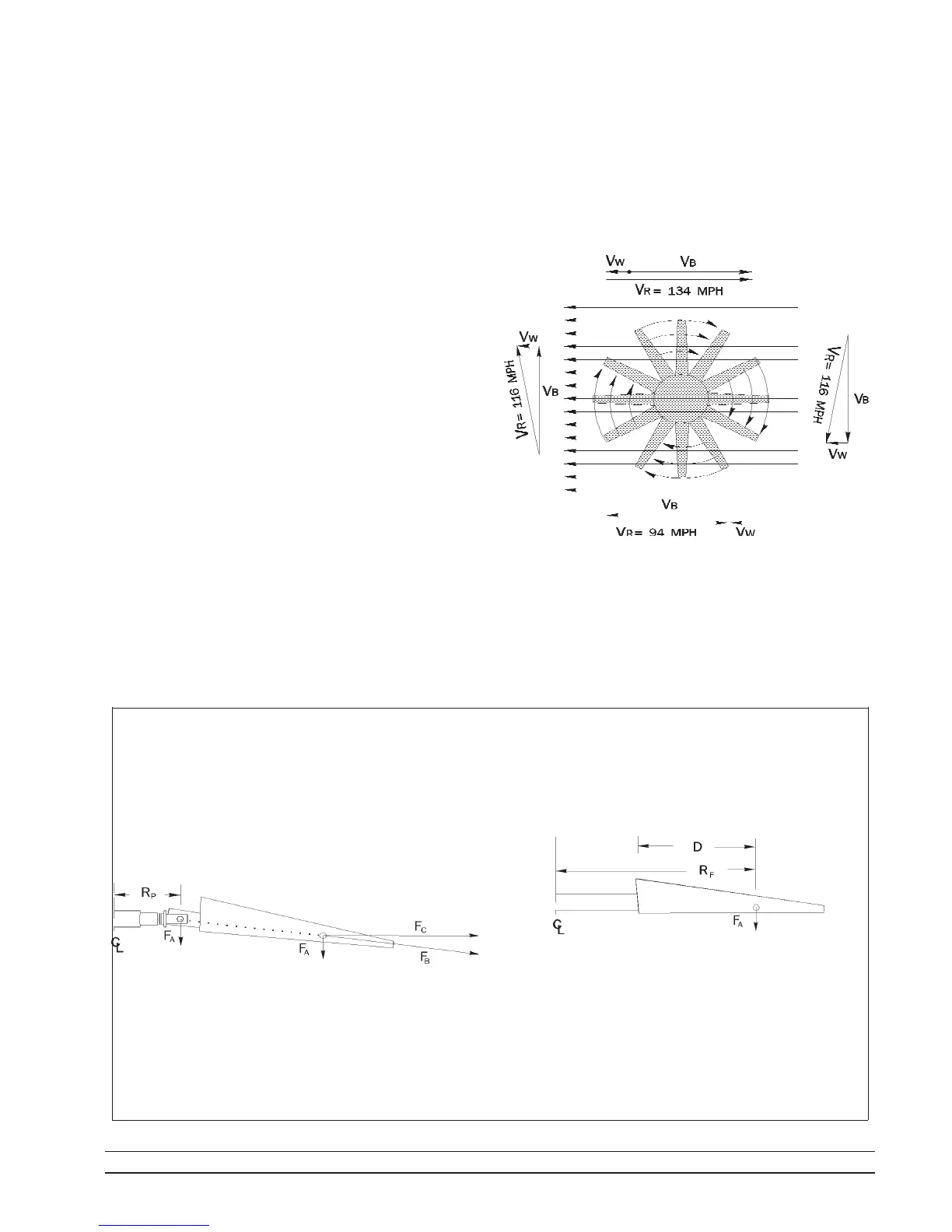
The illustration above assumes a fan operating with
a tip speed (VB) of 10,000 feet per minute (114 miles per
hour) with a horizontal component of wind velocity (VW)
of 20 miles per hour. Note that the velocity (VR) of the fan
blade relative to the air varies by a factor of 1.43. The
blade load varies as the square of this velocity, or 2.05.
4.5 DAMAGING OPERATING CONDITIONS
OPERATION
THE EFFECT OF AIR LOAD ON HUB AND DRIVE
Moore fan blades are attached to the hub by a pivot.
As the fan rotates, centrifugal force causes the blades to
rise (as do the blades of a helicopter). The air load (FA) is
uniform over the blade, but there is a point (shown on the
blade in the drawing below) where, if the total load were
applied at that point, the effect would be the same. The
resultant of the air load (FA), assumed in this example to
be downward, and the horizontal centrifugal force (FC) is
the force on the blade (FB). The blade automatically posi-
the bending moment at the shaft due to the air load is
equal to the load (FA) multiplied by the distance from the
fan centerline to the point of application of the force on
the blade (RF). This moment will be from 2 to 4 times as
great as that produced by the Moore fan under the same
conditions.
Also of concern with the conventional fan is the
bending moment due to the air load at the point of
attachment of the blades to the hub since this is usually
the structurally weakest area of the fan. The moment due
to the air load at this point is the load (FA) times the
distance (D). For the Moore fan, this moment is zero since
the blades are attached at the pivot point.
A more complete discussion of the Moore fan de-
sign can be found in Moore’s General Catalog.
tions itself in the direction of this force with the result that
the force is translated inward to the pivot point, as illus-
trated by the dotted line. The effect of this arrangement is
exactly as if the total air load (FA) were applied at the pivot
point rather than at the point outward on the blade. The
maximum bending moment applied to the shaft by the air
load is equal to the load (FA) multiplied by the distance
from the fan centerline to the pivot point (RP).
In conventional fans with rigidly attached blades,



 To Next Page