USER MANUAL | FOLDING WHEELCHAIR – TIE DOWNS
NOTE: If you ignore these Warnings or fail to inspect or maintain your wheelchair as directed in the manual , you may fall, tip over or lose control of the wheelchair and seriously
injure yourself or others or damage the wheelchair.
36
ATTENTION
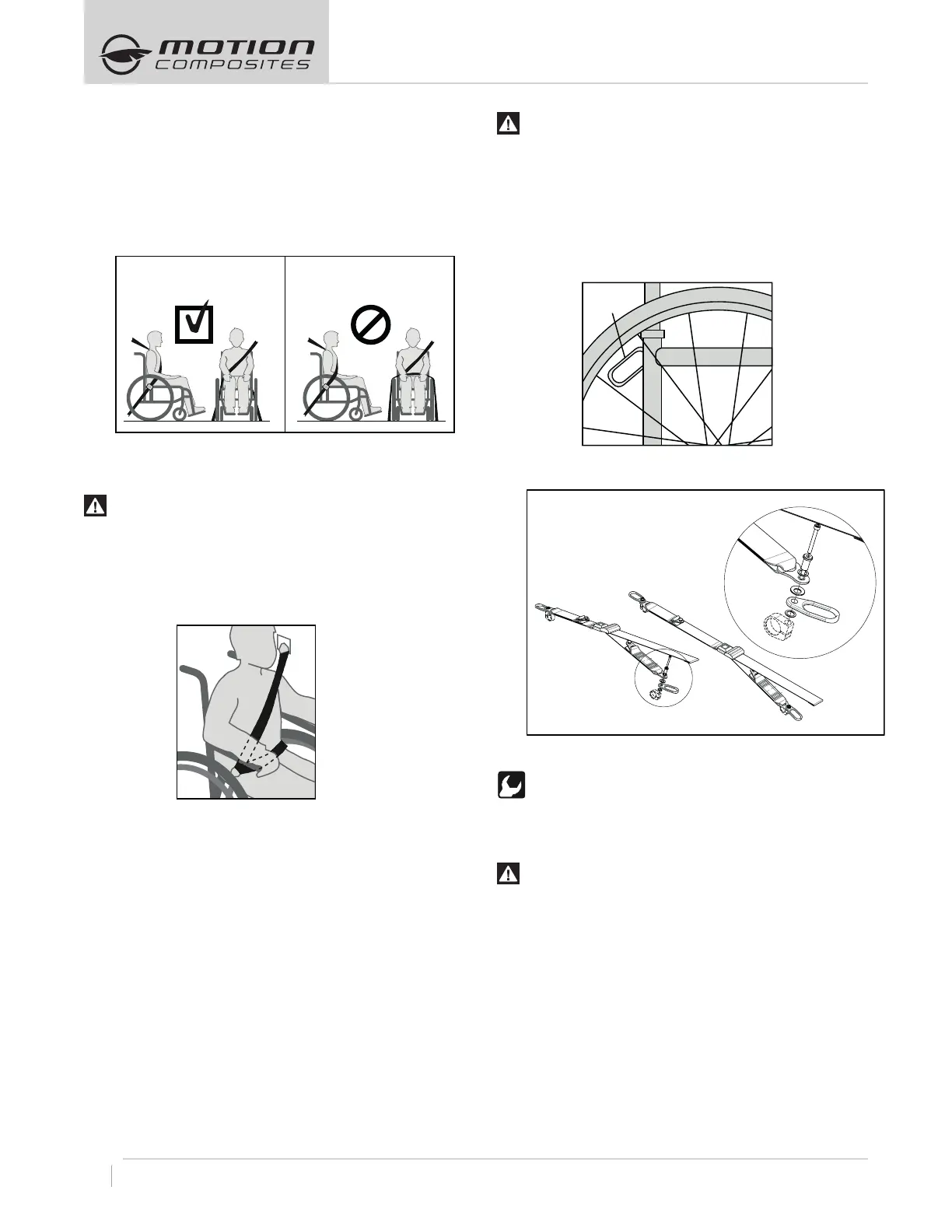
The wheelchair occupant must be secured with dynamically
crash-tested and approved pelvic and upper-torso belts or
with a five point child restraint harness as part of WTORS.
Place the pelvic belt across the front of the pelvis near the
upper thighs, not high over the abdomen. Place the upper-
torso belt across the middle of the shoulder and the center
of the chest, and connect to the pelvic belt near the hip of the
wheelchair occupant. See figure 6.
ATTENTION
The upper torso belt webbing should not be worn twisted in
a manner that reduces the area of contact of the belt with
the occupant. The upper-torso belt anchor point should be
anchored above and behind the top of the wheelchair oc-
cupant’s shoulder to ensure that the occupant is properly
restrained during transport. Both the pelvic and upper-torso
belt restraints should be adjusted as snugly as possible
consistent with user comfort. See figure 7.
ATTENTION
The buckle of belt restraint systems should not be located
near wheelchair components that may come in contact with
the buckle release button in the event of a vehicle accident or
collision. If your wheelchair is equipped with a crash-tested
pelvic belt that is anchored to the wheelchair frame,
complete the restraint system by attaching the lower end of
the WTORS upper-torso belt to the pelvic belt by
referring to the WTORS manufacturer’s instruction.
Crash-tested wheelchair-anchored pelvic belts will be labeled
to indicate compliance to the ANSI/RESNA WC/Vol 4, Section
19 standards. See figure 8, 9.
MANDATORY
A vehicle-anchored belt restraint system conforming to ANSI/
RESNA WC/Vol 4, Section 19 must be used if
the wheelchair occupant chooses not to utilize a
manufacturer-installed wheelchair-anchored belt
restraint system.
WARNING
Although postural supports and positioning belts may be
used in a moving vehicle in addition to the vehicle restraint
system, they should not be relied upon to replace vehicle
restraint system that have been designed and tested for this
purpose and should not interfere with proper vehicle belt
restraint placement.
igure 6. Proper Pelvic Belt Placement
Pelvic restraints should make full contact
accross the front of the body near
the junction of the tigh and pelvis.
Belt restraints must not be held away from
the body by wheelchair components such
as armrests or wheels.
Figure 7. Upper-Torso Belt
Placement
BELT
MOUNTING
BRACKET
igure 8. Wheelchair Belt Restraint
igure 9. Wheelchair-anchored Belt Restraint


 To Next Page