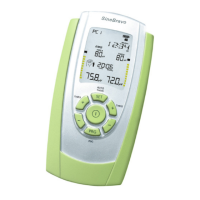
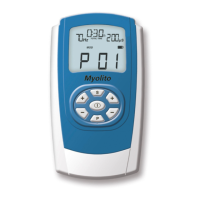
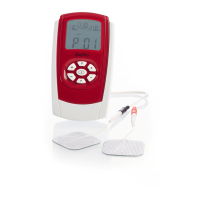
Dolito Bedienungsanleitung / Operators Manual
38
TENS (Transcutaneous
Electrical Nerve Stimulation)
TENS as a scientically recognised method for pain relief therapy is a suitable aid for pain for
many doctors. The stimulating electrical current impulses being produced by the Dolito nerve
stimulator are transferred from the electrodes to the skins nerve bres. The eect of pain relief
begins at the start of the application and is normally eective for an amount of time after the
stimulation period. This is achieved due to two dierent mechanisms:
Gate-Control-Eect:
The pain is transferred over the nerve bres of the body to the brain which perceives the pain.
Through stimulus of the nerves the Dolito nerve stimulator prevents further transmission of the
pain signals to the brain. The pain sensation is therefore eased or inhibited.
Beta-endorphins-release:
TENS-therapy stimulates the synthesis and release of beta-endorphins. Beta-endorphins as bod-
ily synthesised peptides, which have a similar eect to morphine for pain relief, but without the
side eects that morphine carries (e.g. respiratory depression).
TENS is available in three dierent treatment modes.
1. Continuous Tens (CONT): Electrical impulses are exchanged between the electrodes
continuously back and forth. They block the transmitting nerve bands. It is possible that
the body gets used rather quickly to this traditional treatment. The eects can subside with
prolonged treatment.
1a A special kind of continuous mode is named Dense-Disperse-Stimulation (CONT +
BURST) according to Prof. Han. The permanent alternation of frequency between 2 Hz
and 100 Hz within a few seconds (2-4 secs.) raises the output of dierent analgesic
substances.
2. Modulated Tens (MOD): By changing the parameters (frequency, pulse width and/or
intensity) regularly and automatically, the sensation of an increasing and decreasing current
is produced. Therefore the body will adapt distinctly delayed to the electrical impulses.
3. Burst (BST): 9 impulses with a set frequency and pulse range, twice per second are emit-
ted. This articially produced frequency of 2 Hz is able to increase the production of the
body’s own endorphins and therefore relieve pain in a more natural way.


 To Next Page