Need help?
Do you have a question about the NAD 7020 and is the answer not in the manual?
Technical parameters for the FM reception section.
Technical parameters for the AM reception section.
Performance metrics for audio amplifier and pre-amplifier.
Overall functional block diagram of the receiver.
Detailed schematic of the receiver's electronic circuitry.
Diagram illustrating internal wiring connections.
Step-by-step instructions for tuner and audio adjustments.
Visual guide for alignment points and internal layout.
Identification of components on printed circuit boards.
Exploded view showing the physical assembly of the unit.
Comprehensive list of all components used in the receiver.
Illustration of the packaging contents for the receiver.
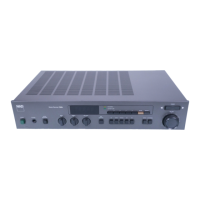
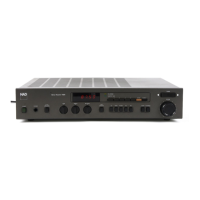
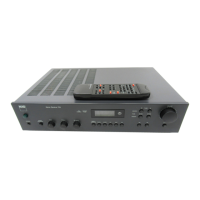
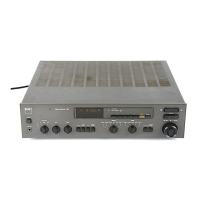
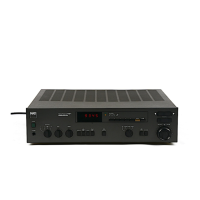
The NAD Model 7020 AM/FM Stereo Receiver is a versatile audio component designed to deliver high-fidelity sound for both radio reception and external audio sources. This service manual provides comprehensive information for maintaining and troubleshooting the device, ensuring its optimal performance and longevity.
The NAD 7020 serves as the central hub for an audio system, integrating an AM/FM tuner with a stereo amplifier. Its primary function is to receive radio broadcasts and amplify audio signals from various input sources, delivering them to loudspeakers. The receiver is equipped with a sophisticated FM tuner section, designed for clear and stable reception of stereo broadcasts, even in challenging signal environments. It features a PLL (Phase-Locked Loop) decoder for accurate stereo separation and a de-emphasis network to restore the original audio balance. The AM tuner section provides reliable reception of amplitude-modulated broadcasts.
Beyond radio, the NAD 7020 includes a dedicated phono preamplifier, allowing direct connection of a turntable for vinyl playback. This phono stage is carefully designed to provide accurate RIAA equalization, essential for proper reproduction of records. Additionally, the receiver offers auxiliary inputs, typically labeled "AUX" and "TAPE," enabling connection of other audio components such as CD players, cassette decks, or digital media players. The "TAPE REC" and "TAPE PLAY" connections facilitate recording from any selected source to a tape deck and playing back from it.
The power amplifier section is engineered to drive a wide range of loudspeakers, providing robust and clean audio output. A notable feature is NAD's "Soft Clipping" circuit, which is designed to gently limit the output signal when the amplifier is driven beyond its rated power. This prevents harsh distortion and protects loudspeakers from damage, allowing the listener to enjoy higher perceived loudness without audible clipping. The receiver also includes a headphone output for private listening.
Tone controls (Bass and Treble) allow users to adjust the frequency response to suit their listening preferences or room acoustics. A "Loudness" contour is often included to compensate for the ear's reduced sensitivity to bass and treble frequencies at low listening levels, providing a fuller sound. The "Balance" control allows adjustment of the relative volume between the left and right channels.
The power supply section is robust, designed to provide stable and clean power to all internal circuits, which is crucial for maintaining audio fidelity, especially during dynamic musical passages. Safety features, such as fuses, are integrated to protect the unit from electrical overloads.
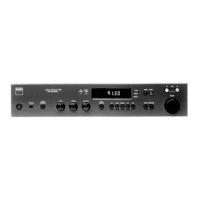
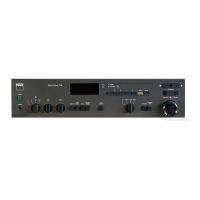
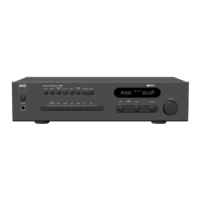
Operating the NAD 7020 is straightforward, designed for ease of use. The front panel typically features clearly labeled controls for source selection (Phono, FM, AM, AUX, Tape), volume, balance, bass, and treble. A tuning knob allows for manual selection of radio stations, often accompanied by a dial scale for frequency indication. Signal strength and FM stereo indicators provide visual feedback on reception quality.
The "FM Mute" switch is a convenient feature that silences inter-station noise when tuning, providing a cleaner listening experience. The "Soft Clipping" switch allows users to engage or disengage this protective circuit based on their preference and the characteristics of their loudspeakers.
Rear panel connections are clearly marked for loudspeakers (Speaker A and B terminals), phono input (with a ground terminal for turntables), auxiliary inputs, tape loop (record and playback), and FM/AM antenna connections (including 75-ohm and 300-ohm FM terminals, and an AM antenna bar). An AC outlet (switched) is often provided for powering other components, such as a turntable, from the receiver.
The service manual emphasizes several aspects of maintenance, primarily focusing on alignment procedures and parts replacement. Regular alignment of the FM and AM tuner sections is crucial to ensure optimal radio reception performance. This involves adjusting various coils and potentiometers to achieve maximum sensitivity, selectivity, and stereo separation. The manual provides detailed steps for these alignments, including the use of specialized test equipment such as an FM signal generator, stereo signal generator, VTVM (Vacuum Tube Voltmeter), oscilloscope, and frequency counter.
For the audio section, idle current alignment is a key maintenance procedure. This involves adjusting potentiometers to set the quiescent current of the power amplifier output transistors. Correct idle current ensures optimal sound quality, minimizes crossover distortion, and prevents excessive heat buildup. The manual specifies connecting a DC milli-voltmeter across specific resistors to measure and adjust the idle current.
DC offset alignment is another critical procedure for the power amplifier. This involves adjusting potentiometers to ensure that the DC voltage at the speaker terminals is as close to zero as possible. A low DC offset prevents damage to loudspeakers and ensures clean audio reproduction. The manual instructs connecting a DC milli-voltmeter to the speaker terminals and adjusting for a zero reading.
The manual also includes comprehensive parts lists, circuit diagrams, assembly diagrams, and PCB (Printed Circuit Board) parts locations. These resources are invaluable for identifying components, understanding the circuit layout, and facilitating the replacement of faulty parts. Fuses are listed and their locations indicated, allowing for easy identification and replacement in case of an overload. The detailed diagrams aid technicians in disassembling and reassembling the unit correctly during repairs. The packing diagram is useful for understanding how the unit should be packaged for safe transport or storage.
 General
| Frequency Response | 20 Hz to 20 kHz |
|---|---|
| Damping Factor | 50 |
| Input Sensitivity | 2.5 mV (MM), 150 mV (line) |
| Speaker Load Impedance | 4 to 16 ohms |
| Power Output | 20 watts per channel into 8 ohms (stereo) |
| Channel Separation | 50dB |

 To Next Page