Need help?
Do you have a question about the NAD 701 and is the answer not in the manual?
Specifications for phono input impedance, sensitivity, signal/noise, and RIAA accuracy.
Details on line level input impedance, sensitivity, maximum signal, and output impedance.
Specifications for the range of treble and bass tone controls.
Continuous output power, rated distortion, and clipping power into 8 ohms.
IHF headroom and dynamic power into 8 and 4 ohms.
Input impedance, sensitivity, frequency response, and signal/noise ratio.
Input sensitivity, capture ratio, AM rejection, and selectivity for FM.
Image rejection, IF rejection, harmonic distortion, and signal/noise ratio.
Usable sensitivity, selectivity, image rejection, IF rejection, and signal/noise for AM.
Dimensions (W x H x D), net weight, and shipping weight.
Information on remote control compatibility and NAD Link.
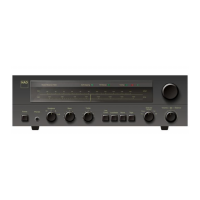
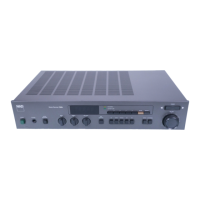
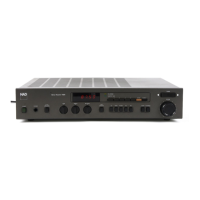
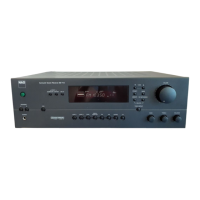
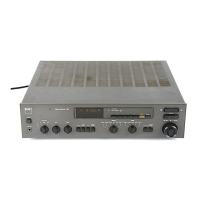
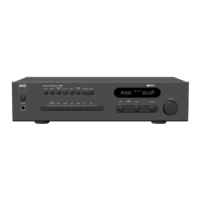
The NAD 701 Stereo Receiver, manufactured between January 1992 and December 1995, is a versatile audio component designed to serve as the central hub of a home entertainment system. It integrates a pre-amplifier, power amplifier, and an FM/AM tuner into a single chassis, offering a comprehensive solution for audio playback from various sources.
At its core, the NAD 701 is a stereo receiver, meaning it combines the functions of a pre-amplifier, a power amplifier, and a radio tuner. The pre-amplifier section handles input selection, volume control, and tone adjustments, preparing the audio signal for amplification. It features a dedicated phono input, allowing users to connect a turntable directly and enjoy vinyl records without needing an external phono pre-amp. This input is designed to accommodate Moving Magnet (MM) cartridges, providing the necessary gain and RIAA equalization for accurate vinyl playback. In addition to the phono input, the receiver includes multiple line-level inputs, enabling connection of various audio sources such as CD players, cassette decks, and even video sources, making it a flexible component for a diverse range of entertainment setups.
The power amplifier section is responsible for boosting the pre-amplified audio signal to a level sufficient to drive loudspeakers. The 701 delivers a continuous output power per channel into 8 ohms, ensuring robust sound reproduction for most home audio environments. A key feature of NAD amplifiers, including the 701, is their "Extended Dynamic Power" capability. This allows the amplifier to deliver significantly higher power for short durations, effectively handling dynamic peaks in music without clipping or distortion. This is particularly beneficial for reproducing complex musical passages with impact and clarity. The inclusion of NAD's proprietary "Soft Clipping" circuit further enhances the listening experience by gently limiting waveform peaks when the amplifier is driven beyond its rated power, preventing harsh distortion and protecting loudspeakers.
The integrated tuner section provides access to both FM and AM radio broadcasts. It incorporates circuits developed from NAD's award-winning NAD 402 tuner, known for its precise tuning and sensitivity. This ensures clear reception of radio stations, even in areas with weaker signals. The tuner offers fine tuning in 25 kHz steps, allowing for accurate station acquisition. Users can store a significant number of their favorite FM and AM stations as presets, providing quick and convenient access to preferred broadcasts.
The NAD 701 is designed for ease of use despite its extensive capabilities. The front panel, while appearing "busy" due to its numerous controls, is logically laid out to provide intuitive access to all functions. Users can select between various input sources, adjust volume, and fine-tune the sound using the integrated tone controls for treble and bass. The receiver also includes selectable mono and loudness switches. The mono switch can be useful for improving reception of weak stereo radio signals or for playing mono recordings, while the loudness switch compensates for the human ear's reduced sensitivity to bass and treble frequencies at lower listening volumes, providing a fuller sound profile.
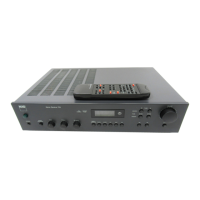
A significant convenience feature of the 701 is its remote control capability. The receiver can be operated via a simple remote control, allowing users to adjust volume, change inputs, and select radio presets from the comfort of their listening position. This enhances the overall user experience, making it more convenient to manage the audio system. The inclusion of CD, video, and phono inputs highlights the receiver's role as a central audio hub, capable of integrating various components of a home entertainment system. The ability to connect video sources means that the 701 can manage the audio portion of a video setup, routing sound from a VCR or other video player through the receiver's amplification stage to the loudspeakers.
The tuner's preset memory allows users to store their preferred radio stations, making it quick and easy to switch between them without manually tuning each time. This is particularly useful for those who frequently listen to radio broadcasts. The fine tuning steps ensure that even stations with slightly off-frequency broadcasts can be accurately tuned in for optimal sound quality.
While the manual does not explicitly detail user-level maintenance procedures, the design and construction of NAD products typically emphasize durability and long-term reliability. The robust build quality, characteristic of NAD components from this era, suggests that the 701 is designed to withstand years of regular use with minimal need for intervention.
General maintenance for such a device would typically involve keeping it clean and ensuring adequate ventilation. Dust accumulation can affect performance and longevity, so occasional dusting of the exterior and ensuring that ventilation grilles are unobstructed is recommended. As with any electronic device, avoiding exposure to extreme temperatures, humidity, and direct sunlight will contribute to its longevity.
The internal components are designed for stability and performance over time. Should any issues arise, professional servicing would be required, as the internal circuitry is complex and not intended for user repair. The use of high-quality components in its construction, a hallmark of NAD's engineering philosophy, contributes to its reliability and reduces the likelihood of premature failure. The "Date of manufacture: Jan 92 - Dec 95" indicates a specific production window, which can be useful for identifying parts or service information if needed in the future. The note about the document containing text from the original product brochure and some technical statements potentially being out of date suggests that while the core functionality remains, minor revisions or updates might have occurred during its production run, or that modern standards might differ. However, for a device of this vintage, the original specifications and features remain the primary reference for its intended performance and capabilities.
 General
| Frequency Response | 20Hz to 20kHz |
|---|---|
| Total Harmonic Distortion | 0.03% |
| Tuning Range | FM, MW |
| Damping Factor | 50 |
| Input Sensitivity | 2.5mV (MM), 150mV (line) |
| Speaker Load Impedance | 4Ω to 16Ω |
| Signal to Noise Ratio | 80dB |
| Channel Separation | 50dB |

 To Next Page