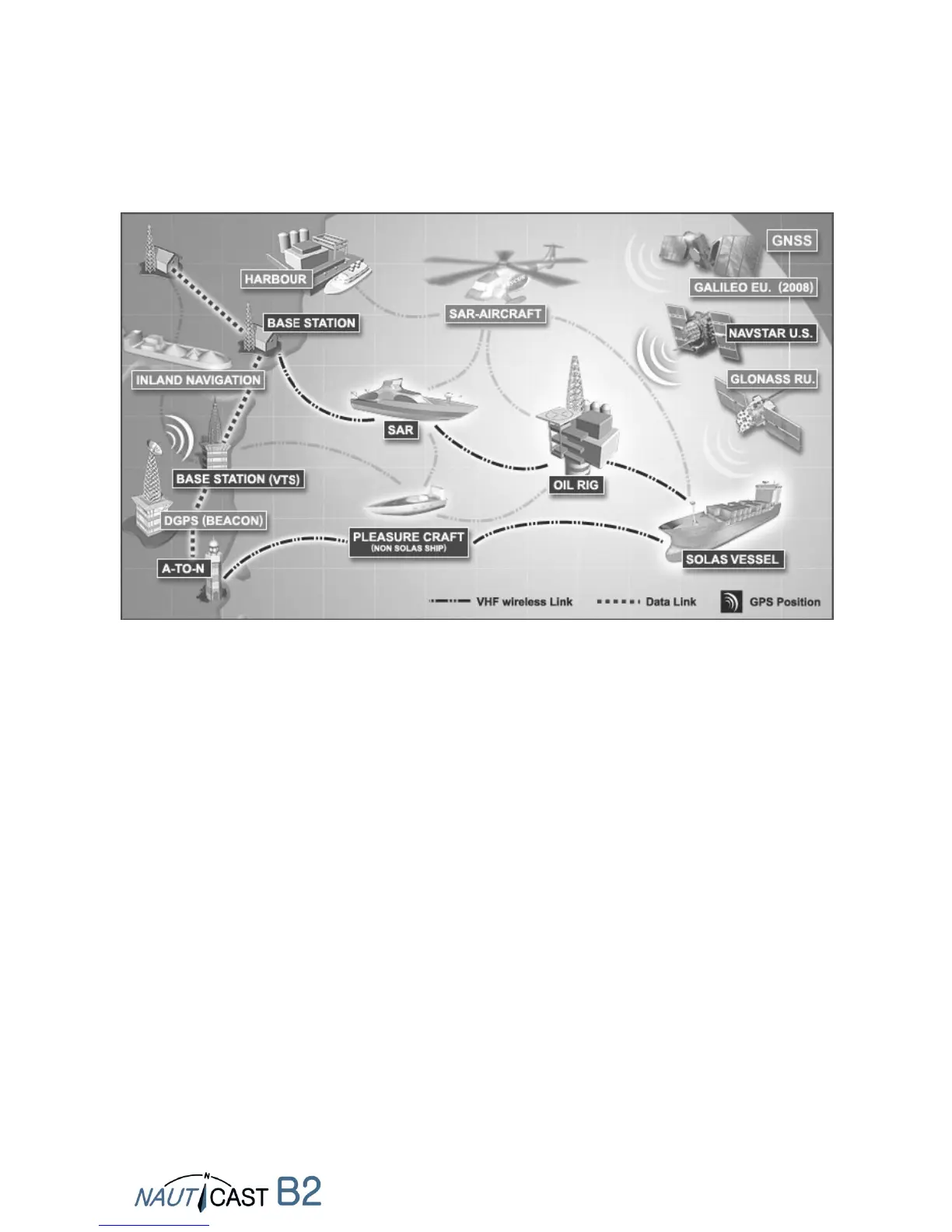
The illustration below depicts a typical Nauticast B2 installation in a common environment. When
the Nauticast B2 is connected to the vessel’s power supply and both VHF and GPS antenna it fulfils
the requirement for standard operation. The scenario shows a full AIS coverage area (including all
applications and complete shore infrastructure).
1.1 AIS Classes
There are two classes of AIS units fitted to vessels, Class-A and Class-B. In addition to those, AIS
base stations may be employed by the Coastguard, port authorities and other authorized bodies.
AIS units acting as Aids to Navigation (A to N) can also be fitted to fixed and floating navigation
markers such as channel markers and buoys.
Class-A units are a mandatory fit under the safety of life at sea (SOLAS) convention to vessels above
300 gross tons or those that carry more than 11 passengers in international waters. Many other
commercial vessels and some leisure craft are fitted with Class-A units voluntarily. Class-B units are
designed for vessels which do not fall under the mandatory Class-A requirements.
The Nauticast B2 is a fully compliant Class-B AIS unit.


 To Next Page