7 MAINTENANCE
PAGE
7.3R
Recommended for the following applications:
- Low temperature (danger of freezing)
- Operation in a vacuum (dry running)
- Media which must be isolated from the atmosphere (eg. due to build up of solid
deposits or because of less severe damage to the environment, like smell)
Leakages will be transportet away by the quenching liquid.
In vacuum operation dry running of the seals is avoided.
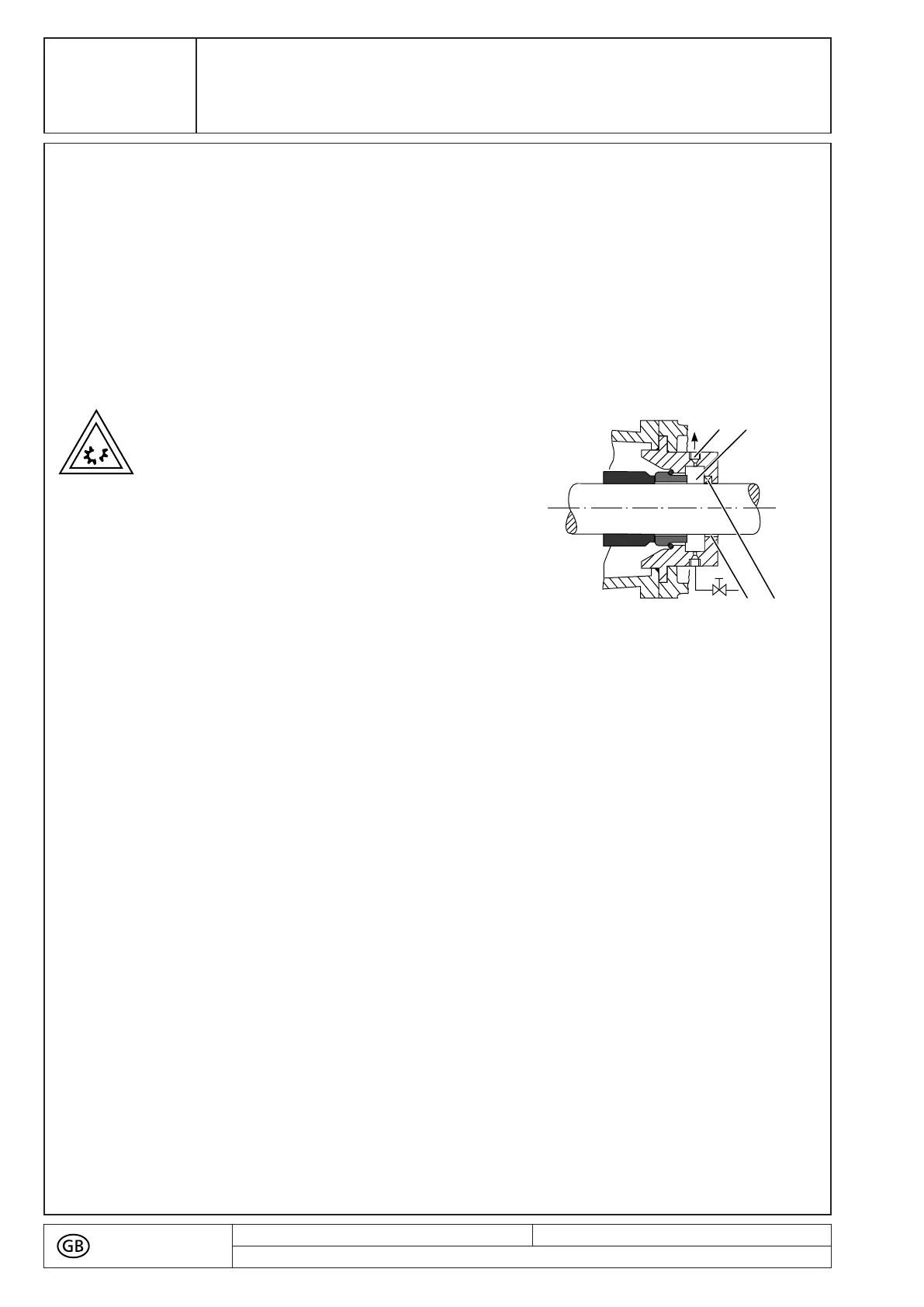
No pressure higher than that of the pumped
medium in front of the mechanical seal is allowed
to build up in the quenching area (1) behind the
mechanical seal. Otherwise the counter ring will be
pushed out of the housing. Free discharge from (2)
is necessary!
Closing off the quenching area from the
atmosphere can be done in three ways:
1. In the case that high emission levels can be
tolerated:
Through a throttle bush (4). Cooling liquid not
permanently used, only released from time to time.
2. In the case that medium emission levels can be tolerated:
By a radial shaft seal ring (3). Permanent radial shaft seal lubrication through
quenching liquid is necessary.
3. In the case that low emission levels can be tolerated:
By installing an additional single mechanical seal. This results in forming a double
mechanical seal in tandem arrangement. Permanent mechanical seal lubrication on
the atmospheric side through quenching liquid is necessary.
For procedures 2 and 3 requiring permanent quench, the supply of quenching liquid
can be performed in two ways:
1. Feeding in via a supply line over a throttle / check valve, and having an outlet from
the seal quench area.
2. Feeding in through a tank, which should be arranged maximum one meter above
the seal, and having a drain valve from the seal quench area. The level mark in the
tank must always show and the filling be half way on the sight glass. Control
intervals should be determined by the user.
The quenching liquid should be changed and the quenching area should be cleaned
periodically.
Background: there is an exchange of media between quenching liquid and the
pumped media. If you have a sticky pumped media the rising concentration of this
media within the quenching liquid might cause the mechanical seal to stick together.
By the time impurities of the media might settle in the quenching area.
text no.
R 07400-1/2
issued: 09.01.2013 Revision: 6
copy to:
IPP - EN - EN_07400_20130109/2 - D8411276 - 4300003998 - 000100 - NPS - 00229929 N 2018-02-21 19:03:25



 To Next Page