POWER FAILURE:
(1) Remove the blower access door and air filters for better air circulation. If the furnace is in an enclosed area (furnace room)
open the door to the room.
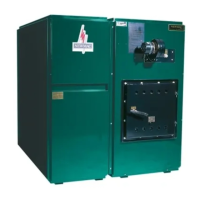
(2) To control the fire open the slide plate damper in the furnace door. THIS DAMPER SHOULD BE CLOSED FOR NORMAL
OPERATION.
(3) Do not load the fire box higher than half way up the fire box liner.
SOOT FIRE
Close all sources of air that can reach the fire through the furnace and draft regulator. Insure the draft fan above the fire door is
turned off. Do not attempt to take the flue pipes down until the fire has been completely extinguished.
RUNAWAY FIRE
This can be caused by too high a flue draft or excessive fueling.
(1) Close all sources of air to the furnace. Insure draft fan is turned off.
(2) Set the barometric draft regulator wide open to reduce draft. The excessive heat caused by a runaway fire may damage
the furnace safety controls. Their operation should be checked before the furnace is returned to service. After a soot or
runaway fire inspect chimney connection and chimney.
AIR CONDITIONING
The following thin-line boxed sections are excerpts from NFPA 90B, Standard for Installation of Warm Air Heating and Air
Conditioning Systems:
4-1.4 Air Cooling Equipment. Mechanical refrigeration used with air duct systems shall be installed in accordance with
ANSI/ASHRAE 15, Safety Code for Mechanical Refrigeration.
4-1.5 Furnaces Used with Cooling Units.
4-1.5.1 Combination units in which a refrigeration coil is provided shall have the refrigeration coil located downstream from the
heating furnace, or the coil shall be located parallel to the heating furnace.
Exception: Where the heating furnace is specifically approved for installation downstream from the coil.
4-1.5.1.1 When the heating furnace is located upstream from the coil, the coil shall be designed or equipped so as not to
develop excessive temperatures and pressures. In those cases where the coil is located parallel to the heating furnace,
dampers or other means to control flow of air shall be adequate to prevent chilled air from entering the furnace section. If the
dampers are manually operated, means shall be provided to prevent operation of either unit unless the damper is in the full
heat or cool position. Adequate means shall be provided for the disposal of condensate and to prevent dripping of condensate
on the heating element.
4-1.5.2 Furnaces (including duct furnaces) may be installed downstream from the evaporative coolers or air washers provided
that condensate will not fall into any portion of burners, pilots, or burner carry-over arms and provided that the heating element
is made of corrosion-resistant material, such as stainless steel, ceramic-coated steel, or an aluminum coated steel in which the
bond between the steel and the aluminum is an iron-aluminum alloy. Air washers operating with chilled water which delivers air
below the dew point of the ambient air at the appliance are considered as refrigeration systems.
4-1.5.3 The capacity of the blower shall be adequate to overcome the external static pressure imposed by the combined
heating and cooling units at the air throughput required for heating or cooling, whichever is greater.
4-3.6 Accessory Equipment. Material used in the construction of accessory equipment attached to or installed in a supply
or return system shall comply with the requirements for the materials of that portion of the system to which it is attached. This
shall not preclude the attachment to a plenum or duct of small devices, such as humidifiers, specifically listed for such use.
Motors and electrical wiring and equipment shall comply with section 4-2.
CONVERSION OF CL115/170 C & G TO 5 TONS A/C
· ¾ HP Motor Recommended.
· 7” X ¾ Blower Pulley Recommended (Standard is 8").
· 41” Blower Belt required for 7” pulley.
· See A/C wiring diagram with Honeywell 8405A Relay (or equivalent).
· Install a By-Pass damper or blast as per sketch “Typical A/C Coil Installation”.
· For CL115, 140, 155, 170, a minimum supply duct free area of 220, 220, 240, 260 sq. in. respectively, must be maintained
at all times during heating the cycle.
· For CL115, 140, 155, 170, a minimum return duct free area of 250, 250, 280, 300, sq. in. respectively, must be maintained
at all times during heating the cycle.
· A/C coils installed above heat exchanger should be located over oil section.
· A/C coils installed above heat exchanger should be located as high as possible and no less than 12 inches above the top
of the heat exchanger.
· A/C coils must not be located on return air side.
· Ensure condensate from coil does not drip onto heat exchanger surfaces.


 To Next Page
 Loading...