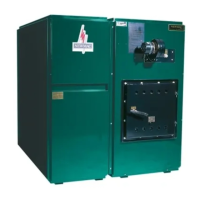
This furnace must be connected to a chimney approved for wood burning appliances, ie. ULC S629 (Canada) and
UL103 (US), or a masonry chimney conforming to the requirements of provincial regulations or, in the absence of such
regulations, to the requirements of the National Building Code of Canada. Newmac recommends an 8” round or 8”
square chimney flue (inside dimension), however, this may be reduced to a 7” providing there is enough draft at the
appliance to operate as designed. It is the responsibility of the installer to ensure there is sufficient draft in all cases.
Draft should be between -0.03 and -0.05 ins wc. No other appliance should be connected to this chimney flue, unless
the installation conforms to clause 5 of B365.
amended May 2009
The installation must conform with the regulations of the local authorities having jurisdiction with the applicable
Electrical Code, and with the regulations in C.S.A. Standard B365 “The Installation Code for Solid Fuel Burning
Appliances and Equipment”.
Flue pipe connections must be secured with metal screws and have as few elbows as possible. Fuel storage should
conform to local bylaws. This furnace should be installed by a qualified furnace serviceman.
Caution:
The flue collar is sized so that a trade size flue pipe fits snugly inside it. Joints in flue pipes, including the connection
at the appliance and the chimney, shall have at least 30 mm (1 3/16 inch) over lap. Flue pipe connections must be
secured with at least 3 metal screws or an equivalent mechanical means; and be made tight in accordance with
good practice.
The flue products may contain carbon monoxide particularly when the wood fire is being starved for air (made to
burn at slow rate). Therefore, the flue pipe must seal tight and must not be inserted into the return air stream of the
circulating blower.
Wood storage should conform to local bylaws, and should not be within minimum clearances for combustible
surfaces as shown above. This furnace must be installed by a qualified furnace serviceman.
NOTE
:
COMBUSTION AIR
: Where fans are used in the fuel storage area, they should be installed so as not to create
negative pressures in the room where the solid fuel burning appliance is located.
OUTSIDE COMBUSTION AIR
: Provision for outside combustion air may be necessary to ensure that fuel-burning
appliances do not discharge products of combustion into the house. Guidelines to determine the need for additional
combustion air or not may not be adequate for every situation. If in doubt, it is advisable to provide additional air.
Outside combustion air may be required if:
1. the solid-fuel-fired appliance does not draw steadily, experiences smoke roll-out, burns poorly, or back-drafts
whether or not there is combustion present.
2. existing fuel-fired equipment in the house, such as fireplaces or other heating appliances, smell, do not operate
properly, suffer smoke roll-out when operated, or back-draft whether or not there is combustion present;
3. any of the above symptoms are alleviated by opening a window slightly on a calm (windless) day;
4. the house is equipped with a well-sealed vapor barrier and tight fitting windows and/or has any powered devices
which exhaust house air;
5. there is excessive condensation on windows in the winter; or
6. a ventilation system is installed in the house.
If these or other indications that infiltration air is inadequate, additional combustion air should be provided from the
outdoors.
DUCT INSTALLATION:
Not to be connected to ductwork that is still connected to another furnace.
Because the unit may be used as a gravity furnace when the power is off, the following is recommended:
1. Locate the furnace as centrally as possible in the home so the best warm air distribution may be enjoyed.
2. Use an extended plenum (central duct) at least one size larger than called for in National Warm Air Standards.
3. Use a minimum pipe size of six inches diameter in runs and in no case smaller than five inches diameter.
4. Slope extended plenums and runs as much as possible to facilitate gravity flow of warm air.
BELT TENSION:
When adjusting the proper pulley setting make certain that the belt is able to flex approximately
one inch without movement of the motor pulley.
IMPORTANT:
This furnace must have a MINIMUM return air duct size equal to 250 sq. in. and a MINIMUM supply
air duct size equal to 180 sq. in. The supply air extended plenum should extend 8 – 10 feet out from the furnace,
then gradually transitioned to the end of the duct system to provide a .20” W.C. static pressure.
HUMIDIFIER
Install the humidifier in the return air plenum. This prevents possible damage due to excessive temperatures when
there is a power failure.
Metal connecting ducting from the warm air plenum is recommended rather than plastic ducting.



 To Next Page