9
Electric Shock Hazard! The motor must be properly grounded through the furnace wiring harness.
Be careful when touching the exterior of an operating motor. It may be hot enough to cause serious injury.
This condition is normal for most motors when operated at rated load and voltage.
A motor should not be operated under conditions that cause the motor protection mode to run continually. A
motor that operates continually in motor protection mode may be overloaded, or the supply voltage or
frequency may be incorrect.
Actual operating speed is determined by the load applied. In general, if a motor is properly sized and
connected to its load, a detectable speed difference will be noted when different speed taps are energized.
When operating without a load, however, a motor may run continuously to a maximum speed. Then stop and
restart operation.
Operating Mode Checklist
For air moving applications, all enclosure covers and panels must be in place before measuring the
amperage.
Voltage and moving parts around motors and motor driven equipment can cause serious or fatal injuries.
Turn OFF electrical power before connecting or servicing the motor.
After installation, motor operation should be tested in all system modes for the following:
Start-Up and
Shut-Off Delays
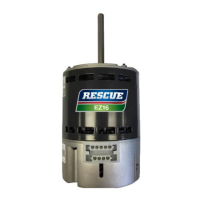
Once the motor is powered ON, it is normal for a RESCUE
®
EZ13
motor to experience a 10-12 second delay before beginning
operation and may take 30-255 seconds before reaching full speed.
When the motor is turned OFF, it is normal for the motor to
experience a 30-255 second delay before turning OFF.
Unusual Noise
or Vibration
If unusual noise or vibration is detected, refer to the
Troubleshooting section on page 11.
Amperage reading at the highest speed setting should be within 10%
of the specification shown on the nameplate.
Verify that the correct airflow is present in all operating modes.
Final Checks
Check the mounting and fastening of both the motor and the control. Make sure the motor and control are
securely attached together and mounted tightly in HVAC system.
Check the wiring harness. Inspecting for shorts and detached wiring. Ensure that the wiring harness is
securely connected to the control connector.
Check the wiring harness and signal connections. Make sure both are securely connected to the control
connectors.
Check the blower motor and verify wheel rotation. Make sure it spins freely manually without effort or
assisted means in both directions.
Verify that the set screw on the blower wheel is securely tightened.
Check that the circuit breaker is ON.



 To Next Page