DE
EN
NL
FR
DA
SV
EN
DE
15
Alterations which serve the technological progress as well as errors excepted! ORIGINAL MANUAL NORSUP
WWW.NORSUP.EU Alterations which serve the technological progress as well as errors excepted!
3.5 SWIMMING POOL HEAT PUMPS ELECTRICAL
WIRING
The unit has a separate molded-in junction box with a
standard electrical conduit nipple already in place. Just
remove the screws and the front panel, feed your
supply lines in through the conduit nipple and wire-
nut the electric supply wires to the three connections
already in the junction box (four connections if three
phase). To complete electrical hookup, connect Heat
Pump by electrical conduit, UF cable or other suitable
means as specified (as permitted by local electrical
authorities) to a dedicated AC power supply branch
circuit equipped with the proper circuit breaker,
disconnect or time delay fuse protection.
Disconnect - A disconnect means (circuit breaker,
fused or un-fused switch) should be located within
sight of and readily accessible from the unit. This is
common practice on commercial and residential air
conditioners and heat pumps. It prevents remotely-
energizing unattended equipment and permits
turning off power at the unit while the unit is being
serviced.
3.6 INITIAL STARTUP OF THE UNIT
Start up Procedure - After installation is completed,
you should follow these steps:
1. Turn on your filter pump. Check for water leaks and
verify flow to and from the pool.
2. Turn on the electrical power supply to the unit, then
press the key ON/OFF of wire controller. It should
start in several seconds.
3. After running a few minutes make sure the air
leaving the top(side) of the unit is cooler (Between
5-10°C)
4. During the operation of the unit, if the filter pump
turns off, the unit should also turn off automatically.
5. Allow the unit and pool pump to run 24 hours per
day until desired pool water temperature is reached.
When the water-in temperature reaches this
setting, the unit will slow down for a period of time,
if the temperature is maintained for 45 minutes the
unit will turn off. The unit will now automatically
restart (as long as your pool pump is running) when
the pool temperature drops more than 0.2 below
set temperature.
Time Delay- The unit is equipped with a 3minute
built-in solid state restart delay included to protect
control circuit components and to eliminate restart
cycling and contactor chatter. This time delay will
automatically restart the unit approximately 3
minutes after each control circuit interruption. Even
a brief power interruption will activate the solid state
3minute restart delay and prevent the unit from
starting until the 5minute countdown is completed.
3.2 SWIMMING POOL HEAT PUMPS LOCATION
The unit will perform well in any outdoor location
provided that the following three factors are
presented:
1. Fresh Air - 2. Electricity - 3. Pool filter piping
The unit may be installed virtually anywhere outdoors.
For indoor pools please consult the supplier. Unlike a
gas heater, it has no draft or pilot light problem in a
windy area.
DO NOT place the unit in an enclosed area with a
limited air volume, where the units discharge air will
be re-circulated.
DO NOT place the unit to shrubs which can block air
inlet. These locations deny the unit of a continuous
source of fresh air which reduces it efficiency and may
prevent adequate heat delivery.
3.3 HOW CLOSE TO YOUR POOL?
Normally, the pool heat pump is installed within 7.5
metres of the pool. The longer the distance from the
pool, the greater the heat loss from the piping. For the
most part, the piping is buried. Therefore, the heat
loss is minimal for runs of up to15 meters (15 meters to
and from the pump = 30 meters total), unless the
ground is wet or the water table is high. A very rough
estimate of heat loss per 30 meters is 0.6 kW hour,
(2000BTU) for every 5°C difference in temperature
between the pool water and the ground surrounding
the pipe, which translates to about 3% to 5% increase
in run time.
3.4 SWIMMING POOL HEAT PUMPS PLUMBING
The Swimming Pool Heat Pumps exclusive rated flow
titanium heat exchanger requires no special
plumbing arrangements except bypass (please set
the flow rate according to the nameplate). The water
pressure drop is less than 10kPa at max. Flow rate.
Since there is no residual heat or flame Temperatures.
The unit does not need copper heat sink piping. PVC
pipe can be run straight into the unit.
Location: Connect the unit in the pool pump
discharge (return) line downstream of all filter and
pool pumps, and upstream of any chlorinators,
ozonators or chemical pumps. Standard model have
slip glue fittings which accept 32mm or 50 mm PVC
pipe for connection to the pool or spa filtration piping.
By using a 50 NB to 40NB you can plumb 40NB Give
serious consideration to adding a quick coupler fitting
at the unit inlet and outlet to allow easy draining of
unit for winterizing and to provide easier access
should servicing be required.
Condensation: Since the Heat pump cools down the
air about 4 -5, water may condense on the fins of the
horseshoe shaped evaporator. If the relative humidity
is very high, this could be as much as several litres an
hour. The water will run down the fins into the base
pan and drain out through the barbed plastic
condensation drain fitting on the side of the base pan.
This fitting is designed to accept 20mm clear vinyl
tubing which can be pushed on by hand and run to a
suitable drain. It is easy to mistake the condensation
for a water leak inside the unit.
NB: A quick way to verify that the water is
condensation is to shut off the unit and keep the pool
pump running. If the water stops running out of the
base pan, it is condensation. AN EVEN QUICKER WAY
IS to TEST THE DRAIN WATER FOR CHLORINE - if the
is no chlorine present, then it‘s condensation.
11
3.INSTALLATION AND CONNECTION
3.4
Swimming Pool Heat Pumps Plumbing
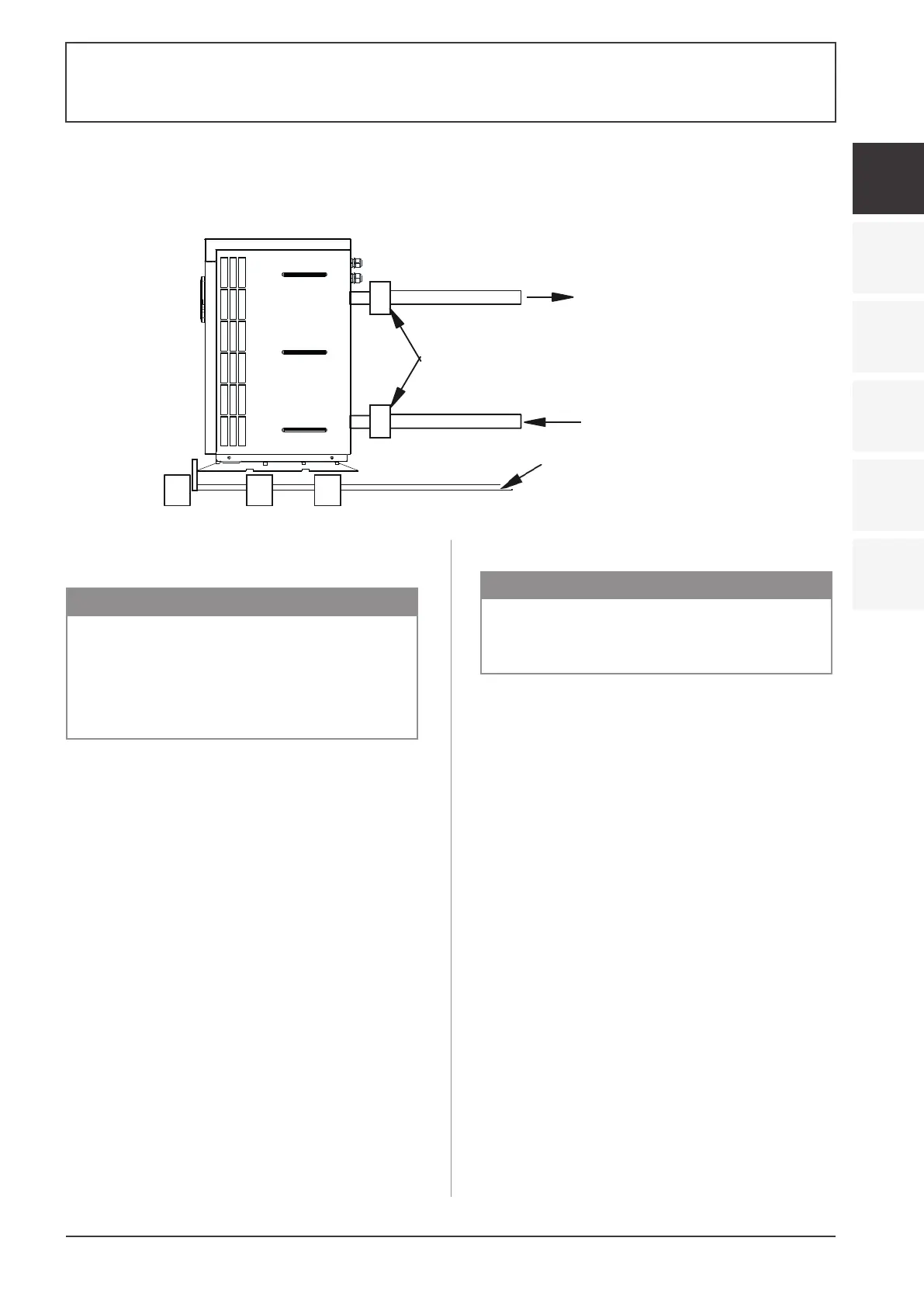
The Swimming Pool Heat Pumps exclusive rated flow titanium heat exchanger requires no
special plumbing arrangements except bypass(please set the flow rate according to the
nameplate). The water pressure drop is less than 10kPa at max. Flow rate. Since there is no
residual heat or flame Temperatures, The unit does not need copper heat sink piping. PVC pipe
can be run straight into the unit.
Location: Connect the unit in the pool pump discharge (return) line downstream of all filter
and pool pumps, and upstream of any chlorinators, ozonators or chemical pumps.
Standard model have slip glue fittings which accept 32mm or 50 mm PVC pipe for
connection to the pool or spa filtration piping. By using a 50 NB to 40NB you can plumb 40NB
Give serious consideration to adding a quick coupler fitting at the unit inlet and outlet to allow easy
draining of unit for winterizing and to provide easier access should servicing be
To pool
PVC COUPLER
RECOMMENDED(Provided)
From pump
CONDENSATION
DRAIN
BARB FTG
Condensation: Since the Heat pump cools down the air about 4 -5
℃
, water may condense on the
fins of the horseshoe shaped evaporator. If the relative humidity is very high, this could
be as much as several litres an hour. The water will run down the fins into the basepan and
drain out through the barbed plastic condensation drain fitting on the side of the basepan. This
fitting is designed to a
ccept 20mm clear vinyl tubing which can be pushed on by hand and run to
a suitable drain. It is easy to mistake the condensation for a water leak inside the unit.
NB: A quick way to verify that the water is condensation is to shut off the unit and keep the pool
pump running. If the water stops running out of the basepan, it is condensation. AN
EVEN QUICKER WAY IS to TEST THE DRAIN WATER FOR CHLORINE - if the is no chlorine
present, then it's condensation.
3.INSTALLATION AND CONNECTION
1
3.2
Swimming Pool Heat Pumps Location
The unit will perform well in any outdoor location provided that the following three factors are
presented:
1. Fresh Air - 2. Electricity - 3. Pool filter piping
The unit may be installed virtually anywhere outdoors. For indoor pools please consult the
supplier. Unlike a gas heater, it has no draft or pilot light problem in a windy area.
DO NOT place the unit in an enclosed area with a limited air volume, where the units
discharge air will be re-circulated.
DO NOT place the unit to shrubs which can block air inlet. These locations deny the unit of a
continuous source of fresh air which reduces it efficiency and may prevent adequate heat
3.3
How Close To Your Pool?
Normally, the pool heat pump is installed within 7.5 metres of the pool. The longer the distance
from the pool, the greater the heat loss from the piping. For the most part ,the piping
is buried. Therefore, the heat loss is minimal for runs of up to15 meters(15 meters to and from the
pump = 30 meters total), unless the ground is wet or the water table is high. A very rough
estimate of heat loss per 30 meters is 0.6 kW-hour,(2000BTU) for every 5
℃
difference in
temperature between the pool water and the ground surrounding the pipe, which translates to
about 3% to 5% increase in run time.
NOTE
Although the unit heat exchanger is electrically
isolated from the rest of the unit, it simply prevents
the flow of electricity to or from the pool water.
Grounding the unit is still required to protect you
against short circuits inside the unit. Bonding is
also required.
NOTE
In order for the unit to heat the pool or spa, the
filter pump must be running to circulate water
through the heat exchanger.
Air inlet
Air outlet
1500mm
700mm
300mm
500mm
700mm
SWIMMING POOL HEAT PUMP TYPE SP
SWIMMING POOL HEAT PUMP TYPE SP



 To Next Page
 Loading...