Northstar Explorer 660 Installation and Operation Manual 33
Shadows
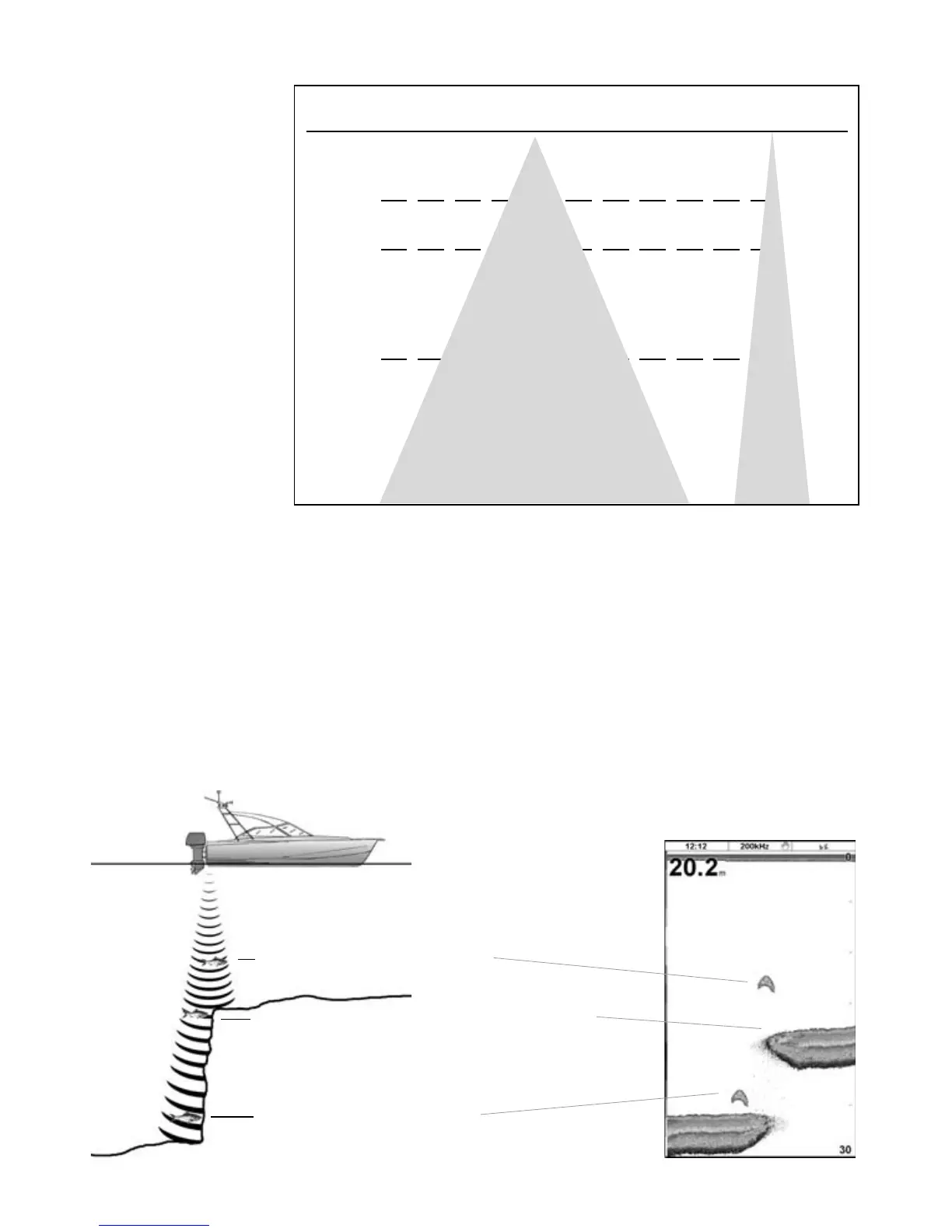
Shadows are created around areas where the ultrasonic beam cannot ‘see’. These areas include hollows
on the bottom or beside rocks and ledges, where the strong echoes returned off the rocks obscure the
weak echoes of the fish and may also create a double bottom trace. See following for an example of the
sonar display in such an environment. A double bottom trace is shown on the display.
When looking for fish with the wide angled 50 kHz frequency, be aware of increased shadows. Use the
high frequency 200 kHz in areas that have rocks and ledges because this frequency reduces the shadow
effect considerably.
Frequency and cone width
Sonar display of same area
fish is visible on the display
fish is hidden by the strong echoes off the
bottom and is not shown on the display
Example of shadows
fish is visible on the display
Water Cone width Cone width
Depth at 50 kHz at 200 kHz
25 20 5
50 40 10
100 80 20
150 130 30
200 170 40
300 250 60
400 330 80
600 500 120
800 660 150
1000 830 190
45° cone
11°
cone
The sonar pulse
generated by the Explorer
660 transducer travels
down through the water,
spreading outwards in
a cone shape. The cone
width is dependent
upon the frequency of
the pulse; at 50 kHz it
is approximately 45°,
and at 200 kHz it is
approximately 11°.
The differences in the
cone width affect what is
displayed. See section 8-3.


 To Next Page