ML0042 October 15, 2019 - 92 - Copyright 2019 Bitronics, LLC
6.3 Voltage Channels
All voltage inputs are measured relative to a common reference level (essentially
panel ground). See Appendix 1 for input connection information. Common mode
signals can be removed by signal processing algorithms, instead of the more
traditional difference amplifier approach. This greatly simplifies the external analog
circuitry, increases the accuracy, and allows measurement of the Neutral-to-Ground
voltage at the panel. The 7kV input divider resistors are accurate to within +/-
25ppm/DegC, and have a range of 400V
PEAK
, from any input to panel ground. Each
sample is corrected for gain using factory calibration values stored in non-volatile
memory on the board. Additionally, a continuous DC removal is performed on all
inputs.
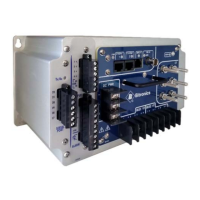
The advantages of this method of voltage measurement are apparent when the M66X
is used on the common 2, 2½, and 3 element systems (refer to Section 6.5). The
M66X is always calculating Line-to-Neutral, and Line-to-Line voltages with equal
accuracy. On 2 element connections, any phase can serve as the reference phase.
On 2½ element systems, one of the phase-to-neutral voltages is missing, and the
M66X must create it from the vector sum of the other two phase-to-neutral voltages.
In order to configure the M66X for 2½ element mode and which phase voltage is
missing, select one of the following: 2.5 element - A, 2.5 element - B, or 2.5 element –
C.
The average of the 3 voltage phases ((Va + Vb + Vc)/3) is also available and is made
available on a per cycle basis.
6.4 Voltage Aux
The M66X M3 provides a measurement for the voltage connected to the power supply
terminals. This is a differential voltage. The value can be AC or DC depending upon
the power supply voltage source.
6.5 Power Factor
The per-phase Power Factor measurement is calculated using the "Power Triangle",
or the per-phase WATTS divided by the per-phase VAs. The Total PF is similar, but
uses the Total WATTS and Total VAs instead. The sign convention for Power Factor
is shown in Figure 10.
6.6 Watts / Volt-Amperes (VAs) / VARs (Uncompensated)
On any power connection type (2, 2½, and 3 element), the M66X calculates per-
element Watts by multiplying the voltage and current samples of that element


 To Next Page