REGULATORS
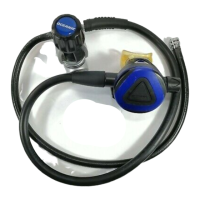
DELTA 4 SECOND STAGE
© 2002 Design, 2005
PG-12
OCEANIC® Product Service Guide
Doc. 12-2803-r02 (10/3/10)
2. Connect the Delta 4 Second Stage LP Hose to a Low Pressure
Port of the First Stage. Ensure that all other Ports are sealed
with Port Plugs, with the exception of an additional Low Pressure
Quick Disconnect Hose.
3. Connect a recently calibrated Low Pressure Test Gauge to the
additional Low Pressure Hose, and connect the First Stage to a
pure breathing gas source of 3,000 PSI (200 BAR).
4. Slowly open the valve to pressurize the Regulator, and check
the Test Gauge to ensure that the Intermediate Pressure is set
as recommended in the Specications for the First Stage being
used.
NOTE: If the Intermediate Pressure is found to be other than
recommended, refer to that Regulator's Trouble Shooting
Section to determine possible cause and treatment.
TUNING
1. Prior to tuning the Delta 4, check the following items:
A. 2 to 3 threads on the Shaft of the POPPET (15) should extend
past the Outer Surface of the LOCK NUT (20) inside the HOUS-
ING ASSEMBLY (5).
B. The FRONT COVERS (2/3) should be secure and properly
aligned.
C. The ADJUSTMENT KNOB (33) should be turned counter
clockwise 1-1/2 turns from fully open (or out).
D. Connect an In-Line Adjustment Tool between the Low Pres-
sure Hose and SWIVEL COUPLING (12).
E. The MOUTHPIECE (9) should be cleaned and disinfected
with warm, soapy water.
2. Pressurize the Regulator with a pure air source of 3,000PSI
(205 BAR) and listen to determine that a slight air ow is initially
present. If necessary, use the In-Line Adjustment Tool to turn
the ORIFICE (11) counter clockwise, slightly out, to initiate this
air ow.
NOTE: While pressurized, the slotted blade of the In-Line
Adjustment Tool will be held away from the ORIFICE (11),
and will therefore need to be pushed inward and held while
turning in either direction. Locate the Slotted Head of the
ORIFICE by touch before attempting any adjustment.
3. Use the In-Line Adjustment Tool to turn the ORIFICE (11) in
clockwise using small fractions of a turn just until air ow is no
longer present. Pause to listen carefully for air ow or leakage
after each adjustment.
NOTE: Turning the ORIFICE (11) in further than necessary
to stop air ow will result in LEVER ARM (17) slack and ex-
cessive Spring load tension, prohibiting peak performance.









 To Next Page