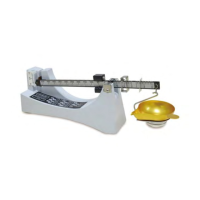
HOW TO USE THE LARGE POISE (500 GRAIN)
The principle of the large poise consists of an accurately adjusted weight which
moves parallel to the longitudinal axis of the beam and which is positioned at
weight values by means of a pawl engaging notches in the beam. The poise run
is from 0 to 500 grains. The equally-spaced notches divide this distance into 50
equal parts so that each subdivision is equivalent to 10 grains of weight.
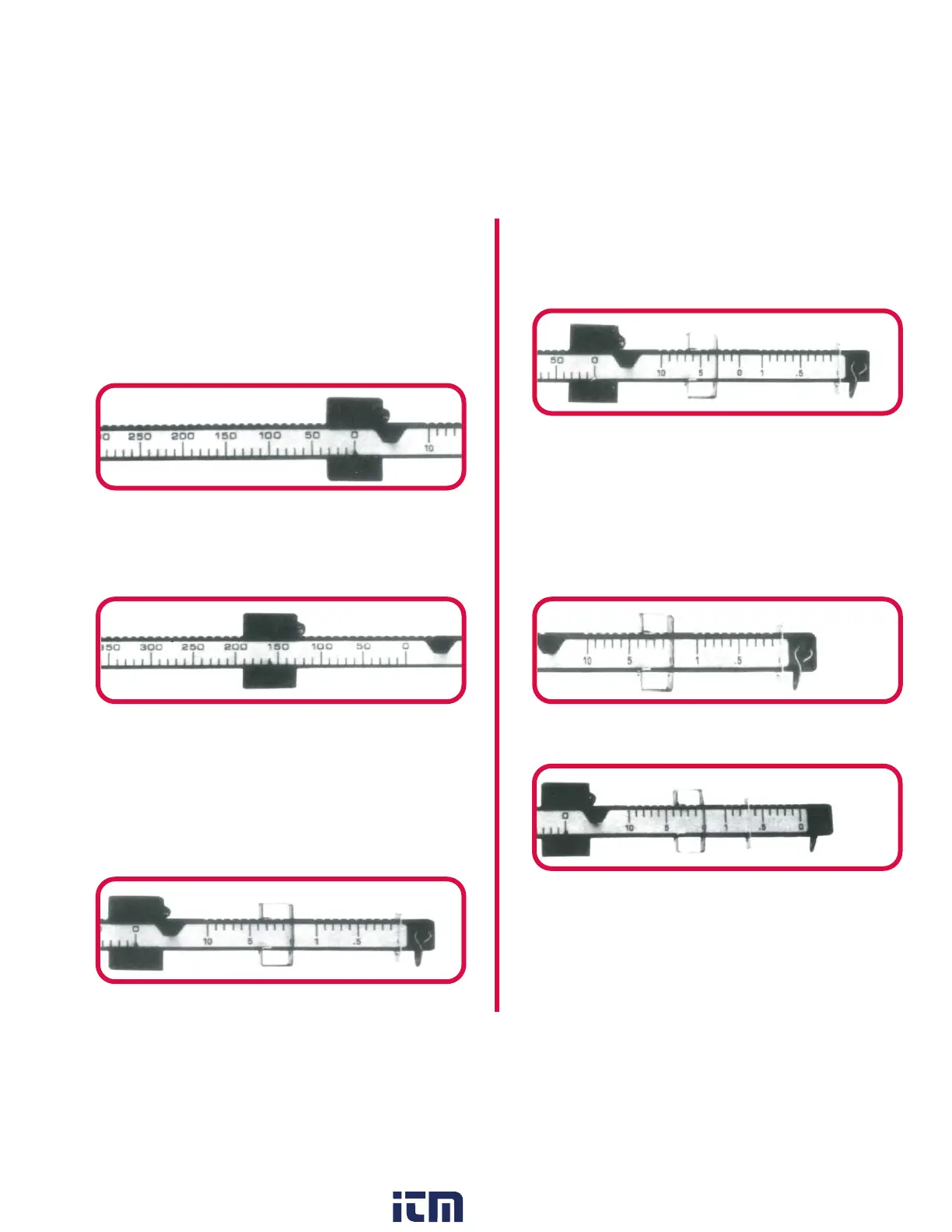
To zero the large poise, move it to the position where the pawl, located on the
right side of the poise, engages the first notch on the right end of the poise travel.
The poise indicator will line up with the zero graduation.
To increase weight values, move the poise to the left and line up the indicator
with the desired graduation. Always make sure the pawl is seated in the
notch.
Illustrated is a setting of 160 grains.
To increase weight values, move the poise to the left and line up the indicator
(right-hand edge) with the desired graduation. Always make sure the pawl is
seated in the notch.
Illustrated is a setting of 3 grains.
Do not attempt to set the middle poise at any position except firmly seated in a
notch. Always use the small poise for weight values between the 1 grain
increments of the middle poise.
HOW TO USE THE SMALL POISE (1 GRAIN)
The principle of the small poise is the same as for the first two poises. This poise
run is from 0 to 1 grain. The equally spaced notches divide this distance into 10
equal parts so that each subdivision is equivalent to 1/10th (.1) grain of weight.
To zero the small poise, move it to the position where the pawl, which is the top
edge of the rectangular slot through the poise, engages the notch directly above
the zero graduation. The long, vertical edge of the poise is the indicator and will
line up with the zero graduation.
Do not attempt to set the large poise at any position except firmly seated in a
notch. Always use the middle poises for weight values between the 10 grain
increments of the large poise.
HOW TO USE THE MIDDLE POISE (10 GRAIN)
The principle of the middle poise is the same as that of the large poise. This poise
run is from 0 to 10 grains. The equally spaced notches divide this distance into 10
equal parts so that each subdivision is equivalent to 1 grain of weight.
To zero the middle poise, move it to the position where the pawl, which is the top
edge of the rectangular slot through the poise, engages the notch directly above
the zero graduation. The long, vertical right-hand edge of the poise is the indicator
and will line up with the zero graduation.
To increase weight values, move the poise to the left and line it up with the
desired graduation. Always make sure that the pawl is seated in the notch.
Illustrated is a setting of .7 grains.
Do not attempt to set the small poise at any position except seated in a notch.
HOW TO ZERO BALANCE THE SCALE
Place all three poises at zero. If the scale has been placed on a reasonably level
surface, the beam pointer will come to rest fairly close to the zero graduation on
the dial plate. Raise or lower the left end of the base by means of the leveling
foot to line them up.
www.GlobalTestSupply.com
Find Quality Products Online at: sales@GlobalTestSupply.com
w ww . . co m
information@itm.com1.800.561.8187


 To Next Page
 Loading...