15
OBSERVATION METHODS (Using BX-RLAA)
6-1 Reflected Light Brightfield/Darkfiled Observation
See “MOTORIZED REFLECTED LIGHT BRIGHTFIELD/DARKFIELD OBSERVATION PROCEDURE” on page 5.
6-2 Reflected Light Nomarski DIC (Differential Light Contrast) Observation
# The performance of polarizer may deteriorate when it has been exposed to light for a long period (about continu-
ous 2000 hours). If this happens, replace the polarizer.
# When performing sensitive color observation using the U-DICRH DIC slider, combine the U-POTP3 polarizer.
# When using the high-intensity light source, be sure to use the U-25L42 filter to prevent the polarizer from being burnt.
1
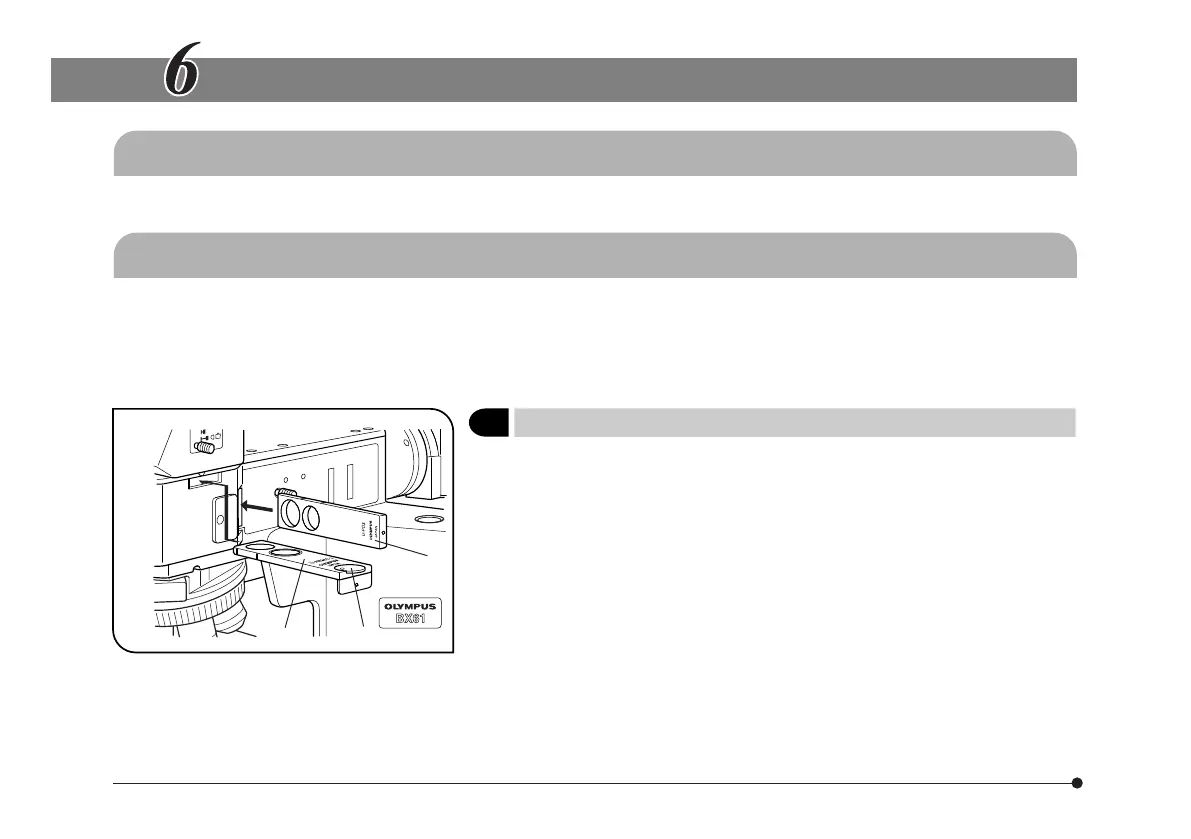
Setting the Analyzer and Polarizer
(Fig. 11)
# In the current step, do not engage the DIC slider in the light path.
1. Bring the specimen in approximate focusing using the 10X or 20X objec-
tive.
2. Remove the cover to enable installation of the U-AN360-3 analyzer. Then
put the analyzer @ in the insertion slot.
3. Insert the U-PO or U-POTP3 polarizer ² so that the surface with indication
comes on the front, and engage the polarizer in the light path.
4. Rotate the analyzer rotating dial ³ to find the position where the field of
view is darkest.
}An approximate crossed-Nicol position can be obtained by setting the
index on the dial ³ on the outer side. Fine-adjust the dial by rotating it
near this position to find the position where the field of view is darkest.
Fig. 11
@
²
³



 To Next Page