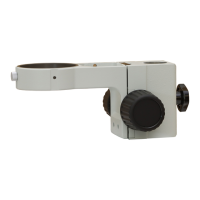
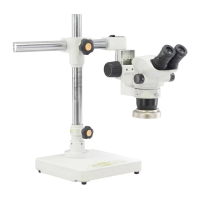
This document serves as an instruction manual for Olympus Arms Used with Microscopes for Equipment Mounting, specifically covering models SZ2-STS, SZ2-STB1, SZ2-STP, SZ2-STB2, and SZ2-STB3. The manual emphasizes safety, optimum performance, and thorough familiarization with the equipment. It is recommended to keep the manual in an easily accessible place near the work desk for future reference.
Function Description:
These Olympus arms are designed to mount various equipment, including microscope frames and illuminators, to a microscope system. They provide mechanisms for secure attachment, focus adjustment, and angle adjustment, facilitating precise positioning of components for different applications. All modules are equipped with an electrostatic discharge (ESD) feature, except for the clamping knobs of the SZ2-STS, SZ2-STB2, and SZ2-STB3 models.
Important Technical Specifications:
The manual provides detailed specifications for each model:
SZ2-STS (Arm for SZX Stand):
- Microscope attaching method: Insertion (attaching hole diameter 76 +0.2/0 mm). Attaching using a clamping knob.
- Focus adjustment: Ball guide system, up/down movement with rack & pinion. Focus adjustment stroke 50 mm. Focus adjustment knob tension adjustable.
- Illuminator (LSGA) attaching method: Possible using an LSGA attaching holder (IHA or IHD).
- Mounting on the equipment: Insertion (attaching hole diameter 32 H8 +0.039/0 mm). Mounting using a clamping knob. Load up to 7 kg.
- Weight: Approx. 1200 grams.
SZ2-STB1 (Bonder Arm):
- Microscope attaching method: Insertion (attaching shaft diameter 15.8 f8 -0.016/-0.043 mm). Microscope attaching angle adjustable. Load up to 7 kg.
- Focus adjustment: Ball guide system, up/down movement with rack & pinion. Focus adjustment stroke 50 mm. Focus adjustment knob tension adjustable.
- Illuminator (LSGA) attaching method: Possible using an LSGA attaching holder (IHA or IHD).
- Mounting on the equipment: Insertion (attaching shaft diameter 15.8 f8 -0.016/-0.043 mm). Microscope attaching angle adjustable. Load up to 7 kg.
- Weight: Approx. 900 grams.
SZ2-STB2 (Bonder Arm):
- Microscope attaching method: Insertion (attaching hole diameter 76 +0.2/0 mm). Clamping using three hex-socket retaining screws (using the provided Allen wrench).
- Focus adjustment: Ball guide system, up/down movement with rack & pinion. Focus adjustment stroke 45 mm. Focus adjustment knob tension adjustable.
- Illuminator (LSGA) attaching method: The LSGA cannot be attached to this model.
- Mounting on the equipment: Insertion (attaching hole diameter 24.5 +0.06/+0.01 mm). Mounting using a clamping knob. Load up to 7 kg.
- Weight: Approx. 800 grams.
SZ2-STP (Prober Arm):
- Microscope attaching method: Attaching using three or more hex-socket screws (M4x10). (Four mounting holes).
- Focus adjustment: Ball guide system, up/down movement with rack & pinion. Focus adjustment stroke 45 mm. Focus adjustment knob tension adjustable.
- Illuminator (LSGA) attaching method: The LSGA cannot be attached to this model.
- Mounting on the equipment: Attaching using three or more hex-socket screws (M4x10). (Four mounting holes). Load up to 7 kg.
- Weight: Approx. 500 grams.
SZ2-STB3 (Bonder Arm):
- Microscope attaching method: Insertion (attaching hole diameter 76 +0.2/0 mm). Attaching using a clamping knob.
- Focus adjustment: Up/down movement with rack & pinion and dovetail guide. Focus adjustment stroke 43 mm. Focus adjustment knob tension adjustable.
- Illuminator (LSGA) attaching method: Possible using an LSGA attaching holder (IHA).
- Mounting on the equipment: Insertion (attaching hole diameter 24.5 +0.06/+0.01 mm). Mounting using a clamping knob. Load up to 3 kg.
- Weight: Approx. 600 grams.
Usage Features:
- Mounting on the Equipment (SZ2-STS, SZ2-STB2, SZ2-STB3): Loosen the clamping knob, fit the equipment mounting hole onto the pole of the system, and then tighten the clamping knob firmly. For SZX equipment, the drop-prevention ring must be removed from the stand. It is crucial not to tighten the clamping knob if the pole is not inserted into the equipment mounting hole.
- Mounting on the Equipment (SZ2-STB1): Loosen the clamping screw on the mount section, insert the equipment mounting shaft into the mount section, and tighten the clamping screw. The shaft can be inserted from either up or down; for heavy objects like photography units, upward insertion is recommended. To adjust the optical axis angle, loosen the retaining screws with the provided Allen wrench, adjust the angle, and then tighten the two accessible retaining screws.
- Mounting on the Equipment (SZ2-STP): Fix the equipment mounting focusing arm firmly by inserting and tightening three or more hex-socket screws. Ensure that the optical axis of the microscope and the surface of the specimen are not tilted after mounting.
- Attaching the Microscope Frame (SZ2-STS, SZ2-STB1, SZ2-STB3): Loosen the clamping screw, insert the microscope frame, and then firmly tighten the clamping screw. The clamping screw can be attached to any of the three positions around the arm.
- Attaching the Microscope Frame (SZ2-STP, SZ2-STB2): Use the provided Allen wrench to fully loosen the three hex-socket retaining screws around the arm, insert the microscope, and then firmly tighten the three retaining screws. A key limitation is that when an SD or SF series microscope frame is attached to the SZ2-STP or SZ2-STB2, the ring fluorescent lamp cannot be used.
- Attaching the LSGA Illuminator: The LSGA illuminator can be attached to the SZ2-STS, SZ2-STB1, and SZ2-STB3 models using an IHA or IHD holder. It can be attached to any of the five (or three with SZ2-STB3 in combination with the IHA mounting holder) LSGA attaching positions on the arm. Refer to the LSGA instruction manual for detailed instructions. Note that the LSGA cannot be attached to the SZ2-STB2 and SZ2-STP models.
- Adjusting the Focus Adjustment Knob Tension: Hold both the left and right focus adjustment knobs with two hands. Fix one knob and rotate the other to increase or decrease the tension. This adjustment prevents spontaneous lowering of the microscope frame. It is recommended to set the tension slightly higher than the point where spontaneous lowering occurs for optimal ease of use.
Maintenance Features:
The manual does not explicitly detail maintenance features but implies that proper handling and adherence to mounting instructions contribute to the longevity and performance of the equipment. The provision of an Allen wrench for specific adjustments suggests that users may perform minor adjustments themselves. Regular checks for firmly tightened screws and proper alignment are implicitly part of routine care to ensure safety and optimal operation.

 Need help?
 General

 To Next Page