EasyManua.ls Logo

Olympus VANOX-T - Page 15

Olympus VANOX-T
41 pages
Print Icon
To Next Page IconTo Next Page
To Previous Page IconTo Previous Page
Loading...
@
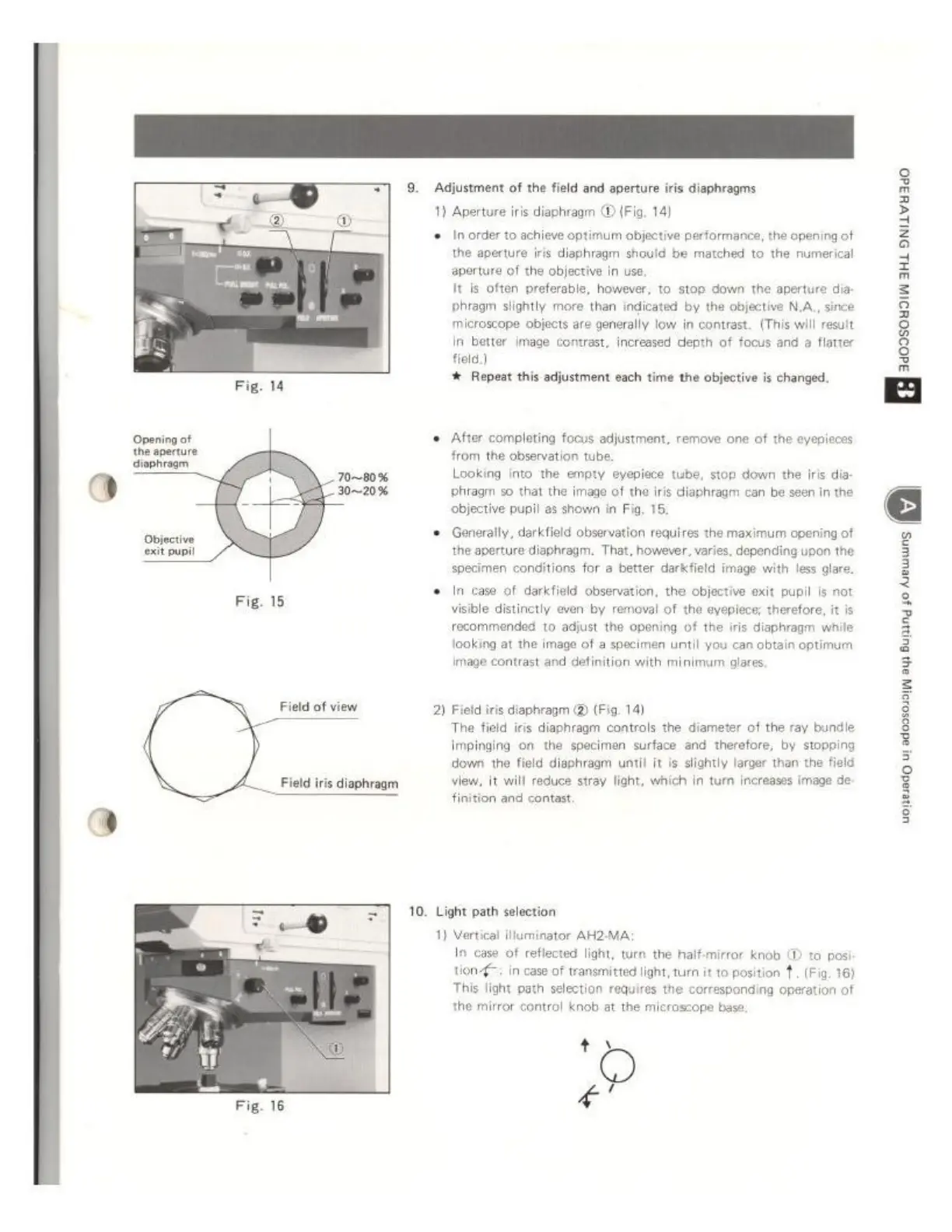
Opening
of
the
aperture
siaphraar
Objectiva
exi
pupil
Fig.
14
70-80%
3020%
Fig.
15
Field
of
view
d iris
diaphragm
9
10.
Adjustment
of
the
field
and
aperture
iris
diaphragms
1)
Aperture
iris
diaphragm
©
(Fig,
14)
+
In
order
to
achieve
optimum
objective
performance,
the
opening
of
the
aperture
iris
diaphragm
should
be
matched
to
the
numerical
aperture
of
the
objective
in
use.
It
is
often
preferable,
however,
to
stop
down
the
aperture
dia
phragm
slightly
more
than
indicated
by
the
objective
N.A.,
since
‘microscope
objects
are
generally
low
in
contrast.
(This
will
result
in
better
image
contrast,
increased
depth
of
focus and
a
flatter
field.)
*
Repeat
this
adjustment
each time
the
objective
is
changed.
+
After
completing
focus
adjustment,
remove
one
of
the
eyapieces
from
the
observation
tube.
Looking
into
the
empty
eyepiace
tube,
stop
down
the
iris
dia
phragm
so
that
the
image
of
the
iris
diaphragm
can
be
seen
in
the
‘objective
pupil
as
shown
in
Fig,
15.
©
Generally,
darktield
observation
requires
the
maximum
opening
of
the
aperture
diaphragm.
That,
however.
varies,
depending
upon
the
specimen
conditions
for
a
better
darkfield
image
with
less
glare,
+
In
caso
of
darkfieid
observation,
the
objective
exit
pupil
is
not
visible
distinctly
even
by
removal
of
the
eyepiece;
therefore,
it is
recommended
to
adjust
the
opening
of
the
iris
diaphragm
while
looking
at
the
image
of
a
specimen
until
you
can
obtain
optimum
image
contrast
and
definition
with
minimum
glares.
2)
Field
iris
diaphragm
@
(Fig.
14)
The
field iis
diaphragm
controls
the
diameter
of
the
ray
bundle
impinging
on
the
specimen
surface and
therefore,
by
stopping
down
the
field
diaphragm
until
itis
slightly
larger
than
the
field
view,
it
will
reduce
stray
light,
which
in
turn
increases
image
de
finition
and
contast
Light
path
selection
1)
Vertical
iluminator
AHZ.MA;
In
case
of
reflected
light,
turn
the
half-mirror
knob
(D
to
posi
rion
in
case
of
transmitted
light,
turn
it
10
position
È.
(Fig.
16)
This
light
path
selection
requires
the
corresponding
operation
of
the
mirror
control
knob
at
the
microscope
base,