Need help?
Do you have a question about the Omron TL-Q5MC1 and is the answer not in the manual?
Highlights the sensor's capabilities for various industrial applications.
Details on selecting and ordering specific sensor models.
Information on optional mounting accessories and their compatibility.
Comprehensive technical data for DC 2-wire proximity sensors.
Comprehensive technical data for DC 3-wire proximity sensors.
Graphs illustrating sensing area, leakage current, and output voltage.
Visual guides for connecting sensor input/output circuits and timing.
Detailed physical dimensions and mounting hole specifications.
Step-by-step instructions for mounting sensors and using DIN tracks.
Critical safety warnings and general guidelines for product operation.
Guidance on selecting sensing object material, size, and plating.
Best practices for wiring, load connections, and series/parallel configurations.
Specifies environmental conditions for reliable sensor operation.
Procedures for inspection, maintenance, and quick failure diagnosis.
OMRON's warranty policy and limitations on liability.
Advice on product suitability and important disclaimers.
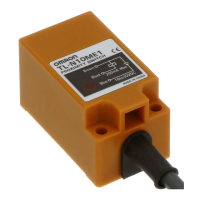
This document describes the TL-N/TL-Q/TL-G series of rectangular standard proximity sensors, offering a wealth of models suitable for various applications.
The TL-N/TL-Q/TL-G series of proximity sensors are designed to detect the presence of objects without physical contact. They operate by generating a high-speed pulse, making them suitable for applications requiring high-speed rotation control and other rapid detection tasks. These sensors are available in both DC 2-wire and DC 3-wire/AC 2-wire configurations, catering to different electrical system requirements.
The sensors are capable of detecting ferrous metals, with sensing distance decreasing for non-ferrous metals. They come in various sensing distances, ranging from 2 mm to 20 mm, depending on the model and size. The operation mode can be either Normally Open (NO) or Normally Closed (NC), providing flexibility in control circuit design.
For DC 2-wire models, the sensors feature an operation indicator (red) and a setting indicator (green) for D1 models, and only an operation indicator (red) for D2 models. They include load short-circuit protection and surge suppressors to ensure reliable operation and protection against electrical anomalies.
DC 3-wire models also feature a detection indicator (red) and offer NPN open collector or NPN transistor output. They are equipped with reverse polarity protection and surge suppressors.
AC 2-wire models include an operation indicator (red) and are protected by surge suppressors.
The TL-G3D-3 model is a grooved type sensor, specifically designed for high-speed response to toothed metal plates. It requires the sensing objects to be at least the size of the standard sensing object, with sufficient distance between them, to achieve a response frequency of 1 kHz minimum.
Easy Installation: The TL-N/TL-Q/TL-G sensors are designed for easy installation, including direct mounting to metal surfaces for -N Models. Various mounting brackets are available as accessories, including brackets for conduits, to facilitate diverse installation scenarios.
Application Versatility: These sensors are ideal for a wide range of applications such as limit control, counting control, and high-speed rotation control. The availability of different sensing distances and output configurations (NO/NC, NPN/AC) allows for selection based on specific application needs.
Environmental Robustness: The sensors are designed to operate in a broad ambient temperature range, typically from -25 to 70°C (with no icing or condensation), and an ambient humidity range of 35% to 95% (with no condensation). They feature a degree of protection rated at IEC 60529 IP67, indicating oil resistance and protection against dust and water ingress.
Influence of Surrounding Metal: When mounting the sensor within a metal panel, specific clearances must be maintained to prevent deterioration in performance. The document provides detailed guidelines and tables for these clearances, which vary depending on the sensor model and the number of metal objects.
Mutual Interference Prevention: To avoid mutual interference when installing sensors face-to-face or side-by-side, minimum separation distances are specified. Some models are available with different frequencies to prevent interference, offering an additional solution for close-proximity installations.
Cable Management: The cable length of built-in amplifier sensors can be extended up to 200 m using standard cables. When bending cables, a bend radius of at least three times the outer diameter is recommended. Guidelines for cable tensile strength are also provided to prevent damage. For applications where power lines are near sensor cables, using separate metal conduits is recommended to prevent malfunction or damage.
Load Connection Guidelines: Detailed I/O circuit diagrams are provided for DC 2-wire, DC 3-wire, and AC 2-wire models, illustrating how to connect the load and power supply. For AC 2-wire sensors, recommendations for connecting a bleeder resistor are given to bypass leakage current and ensure proper load operation. Similarly, for DC 2-wire sensors, guidelines are provided to ensure the load current is designed such that (leakage current) × (load input impedance) < reset voltage.
Power Supply Considerations: It is crucial to use a voltage within the specified operating range to prevent explosion or burning. For DC power supplies, an insulated transformer should be used, not an auto-transformer.
Surge Protection: Although the sensors have a built-in surge absorption circuit, if external devices (like motors or welders) cause large surges, it is recommended to insert an additional surge absorber near the source of the surges.
Leakage Current Management: For 2-wire sensors, a small leakage current flows even when the sensor is OFF. This can cause load reset failures if the residual voltage in the load is too high. Solutions like connecting a bleeder resistor are provided to mitigate this issue.
Using Electronic Devices as Loads: Specific precautions are outlined when connecting AC 2-wire sensors to electronic devices that use AC half-wave rectification, as this can lead to unstable sensor operation. In such cases, using a relay to turn the power supply ON and OFF is suggested.
Periodic Inspection: To ensure long-term stable operation, regular inspections are recommended. These inspections should cover:
Disassembly and Repair: Users are advised not to attempt to disassemble or repair the product under any circumstances, as this could compromise its performance and safety.
Quick Failure Check: For convenient troubleshooting, the E39-VA Handy Checker can be used to quickly check the operation of the sensor.
Water Resistance: While the sensors have a water-resistant structure, attaching a cover to prevent direct contact with water is recommended to improve reliability and prolong product life. They should not be used in water, rain, or outdoors without proper protection.
Ambient Conditions: To maintain operational reliability and service life, the sensors should only be used within the specified temperature range and avoided in environments with chemical vapors, especially strong alkalis or acids. They are also not suitable for use in explosive atmospheres.
 General
| Model | TL-Q5MC1 |
|---|---|
| Rated Sensing Distance | 5 mm |
| Output Type | NPN |
| Protection Rating | IP67 |
| Operating Temperature | -25 to 70 °C |
| Type | Inductive |
| Connection Method | Cable |
| Body Material | Brass |
| Supply Voltage | 12 to 24 VDC |


 To Next Page