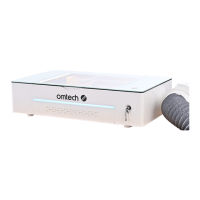
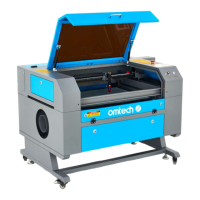
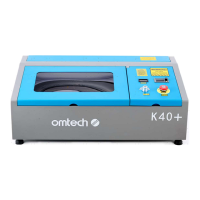
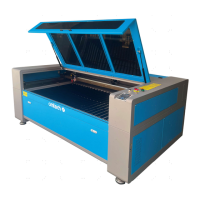
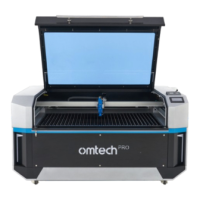
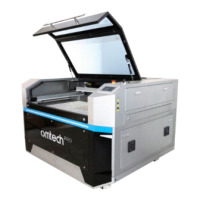
This document describes the Omtech Laser Marking Machine, a fiber laser marking system designed for both personal and professional use. It provides comprehensive instructions for installation, setup, safe operation, and maintenance.
Function Description
The laser marking machine operates by emitting a powerful laser beam from its fiber laser source, which is then transmitted through a fiber optic cable. This beam's power is focused through a galvanometer lens to etch designs onto various substrates. The system utilizes a nanoscale fiber laser source, known for its single-mode output, efficient heat dissipation, high efficiency, and compact structure, making it ideal for high-precision laser marking.
The machine is intended for engraving signs and other consumer products on applicable substrates. It can process a wide variety of metals, including steel, aluminum, titanium, brass, copper, tungsten, carbide, and chrome. It can also be used with stone and some hard plastics like acrylic.
Important Technical Specifications
The manual details three product models: LYF-20MN, LYF-30MN, and LYF-50MN. All models share several common specifications:
- Voltage: AC 110-120V~60 Hz
- Overall Rated Power: 600W
- Processing Area: 9.8×13.4 in. (250×340 mm)
- Max. Marking Speed: 393.7 ips (10000 mm/s)
- Marking Accuracy: 0.01 mm
- Marking Depth: 0.01 in. (0.3 mm)
- Beam Combiner Lens Size: Ø20×2 mm
- Applicable Rotary Axis Type: D50/D60
- Laser Type: Fiber
- Expected Service Life: 100,000 hr.
- Wavelength: 1064 nm
- Modulation Frequency: 30-60 kHz
- Pulse Width: 100 ns
- Laser Class: 4
- Operating Temperature Range: 0-104°F (0-40°C)
- Required Operating Software: EZCad (Lightburn also supported, not included)
- Laser Safety Goggles Protection Level: OD 6+
- Applicable Computer System: Windows 7/8/10/11 (MacOS for Lightburn)
- Applicable Image Formats: BMP, GIF, JPG, JPEG, DXF, DST, AI, etc.
- Dimensions: 15.7×13.4×21.3 in. (40×34×54 cm)
- Net Weight: 39.7 lb. (18 kg)
The primary difference between the models lies in their Rated Power:
- LYF-20MN: 20W
- LYF-30MN: 30W
- LYF-50MN: 50W
And their Field Lens Aperture:
- LYF-20MN: 110×110 mm
- LYF-30MN: 150×150 mm
- LYF-50MN: 150×150 mm
Usage Features
The machine's design includes several key components for operation:
- Focus Adjustment Wheel: Moves the laser arm up and down for precise focus alignment across different materials and thicknesses.
- Support Column: Provides stability and support for the laser arm and moving parts.
- Galvo Scanning Head: A high-speed galvanometer scanning head focuses the laser beam to a fine point, directing it to specific locations on the target material during engraving.
- Field Lens: Ensures consistent, focused laser spot size across the working area for vivid markings on flat surfaces.
- Worktable: Holds the target material and features optional positioning holes for accurate alignment.
- Control Box: Houses the control system and electronics managing machine operation.
- Laser Cable: Transmits the laser beam from its source to the marking head.
Control buttons and connection inputs are clearly defined:
- Emergency Stop Button: Instantly stops the machine. It can be reset by turning clockwise and pressed down to stop.
- Fiber Laser Switch: Activates/deactivates the laser source using a key.
- Rotary Axis Button: Controls the startup/shutdown of an optional rotary axis.
- Focus Button: Controls the startup/shutdown of the red dot guider, which projects two red dots onto the worktable that merge into one when the laser is in focus.
- Power Cord Input: 3-pin port for standard 3-prong power cord.
- Foot Pedal Cord Input: For an optional foot pedal to control laser activation.
- Rotary Axis Cord Input: For an optional rotary axis.
- USB Cord Input: Connects the device to a computer.
- Power Switch: Toggles machine power (I for on, O for off).
Operation Workflow:
- Safety First: Always wear OD 6+ laser safety goggles. Ensure others in the vicinity also wear protective eyewear.
- Power On: Toggle the power switch to 'I', then turn the emergency stop button clockwise to deactivate it.
- Focus Adjustment: Press the focus button on the scanning head to activate the red dot guider. Place test material on the worktable. Rotate the focus adjustment wheel until the two red dots merge into one, indicating proper focus. Measure and note this distance for future reference.
- Laser Activation: Insert the key and turn it clockwise to activate the laser.
- Software Control: Use EZCad software (or Lightburn) to load or create designs. Adjust engraving parameters (frequency, speed, power, loops) to control contrast and depth. The manual recommends settings from 10–75% of maximum rated power for optimal longevity.
- Testing: Activate the laser guidance system in EZCad (F1 or "Red") to preview the design. Place a test material (of the same type as the actual material) and click "Mark" (F2) to engrave. Examine the quality and adjust parameters as needed.
- Engraving: Replace test material with actual material and click "Mark" (F2) to engrave the design.
- Shutdown: Disconnect the computer, press the emergency stop button, turn the laser key counterclockwise, press the focus button to turn off the red dot guider, flip the power switch to 'O', and disconnect from the power supply.
Material Safety:
The machine can safely engrave aluminum, brass, carbide, gold, silver, steel, stone (granite, marble), titanium, and tungsten. Caution is advised for other metals and hard plastics. Materials like PVC, Teflon, and other halogen-containing substances, phenolic resins, paper, and paperboard are explicitly forbidden due to toxic fumes or high flammability. Users are responsible for consulting Material Safety Data Sheets (MDS) for new materials.
Maintenance Features
Regular maintenance is crucial for optimal performance and longevity:
- Cleanliness: Keep the workroom clean and dust-free.
- Power Off: Ensure the machine is fully powered off and disconnected from the power supply when not in use or during maintenance.
- Lens Protection: Cover the galvanometric lens when not in use.
- Worktable Cleaning: Clean the worktable after use with a cloth wetted with >75% rubbing alcohol. Avoid abrasive/caustic cleansers, aerosol sprays, or excessive water near electrical components. Allow surfaces to dry completely.
- Dust Removal: If using a vacuum to remove dust from vents, use the lowest power setting to prevent damage to internal components.
- Professional Servicing: Only trained and skilled professionals should perform adjustments, maintenance, or disassembly of electrical components or the laser itself. The operator should not attempt to service or replace other parts.
Troubleshooting:
The manual provides a troubleshooting guide for common issues:
- No laser output: Check focus, software parameters, connections between laser/mainboard, and laser/power supply. Consider if fiber laser source or power supply is worn out.
- No engraving despite laser output: Confirm material compatibility, correct focus, and adjust software parameters for greater intensity. Check control panel, scanning lens, and its power supply.
- Other laser errors: Check fiber laser source and mainboard.
The average lifespan of the machine is around 100,000 working hours, but constantly running the laser above 80% of its maximum rated power can significantly shorten its service life. Using settings between 10–75% of the maximum rated power is recommended for optimal performance and longevity.

 Need help?

 To Next Page
 General