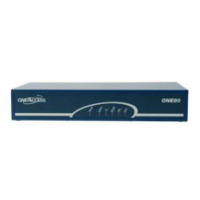
ONE100 Chapter 1
Installation Guide Safety Instructions
8
Over-current Protection Protection contre les surcharges
• Do not use another type of power supply than
the one delivered or prescribed by OneAc-
cess.
• Always use a power cable approved for this
use as the one delivered or prescribed by
OneAccess.
• This device requires that the building's electri-
cal installation is designed for protection
against short-circuit (over-current) protection.
A fuse or circuit breaker no larger that 10A
must be used on the phase conductor (AC) or
the active conductor with respect to the protec-
tive earth (DC).
• Ne pas utiliser d'autre type d'adaptateur que
celui livré ou prescrit par OneAccess.
• Toujours utiliser un type de câble d'alimenta-
tion agréé pour cet usage comme celui livré ou
prescrit par OneAccess.
• La protection contre les courts-circuits de cet
équipement dépend de l'installation électrique
du local à laquelle il est raccordé. Vérifier
qu'un fusible ou disjoncteur de maximum 10A
est installé sur le conducteur de phase (AC) ou
le conducteur actif par rapport à la terre (DC).
Safety and hazards
Do not operate the ONE100 radio interface:
• Near medical equipment, life support equipment, or any medical equipment which may be suscep-
tible to any form of radio interference. In such areas, the ONE100 radio interface MUST BE POW-
ERED OFF. Otherwise, the ONE100 radio interface can transmit signals that could interfere with
this equipment. Always obey to instructions when asked to switch off ONE100 or deactivate its
radio interface where electronic medical devices are known to operate and when asked by the
entity responsible for managing the risk. Some electronic medical devices, e.g. those used to sup-
port life, may not work normally when exposed to high-level RF fields. It is important that patients
should seek specific advice from their doctor in respect to their electronic medical device.
• In an aircraft, the ONE100 radio interface MUST BE POWERED OFF.
Otherwise, the ONE100 radio interface can transmit signals that could interfere with various
onboard systems and may be dangerous to the operation of the aircraft or disrupt the cellular net-
work. Use of a radio equipment in an aircraft is illegal in some jurisdictions. Failure to observe this
instruction may lead to legal action. Always obey to airline instructions when asked to switch off
ONE100 or deactivate its radio interface in an aircraft. Some airlines may permit the use of radio
equipment while the aircraft is on the ground and the door is open. The ONE100 radio interface
may be used normally at this time.
• Where explosive or flammable atmospheres may be present.
Because in flammable atmospheres including refuelling points, fuel depots, and chemical plants, if
high level of RF fields cause sparking, a fire or explosion may occur. Always obey to instructions
to switch off the ONE100 or deactivate its radio interface when asked to do so by the entity respon-
sible for managing the risk.
• Where electro-explosive devices may be present.
Because RF fields may cause detonators to explode, always obey to instructions to switch off the
ONE100 or deactivate its radio interface when asked to do so by the entity responsible for manag-
ing the risk.
• In areas where blasting is in progress.

 To Next Page
 Loading...