6
S-176-9-E
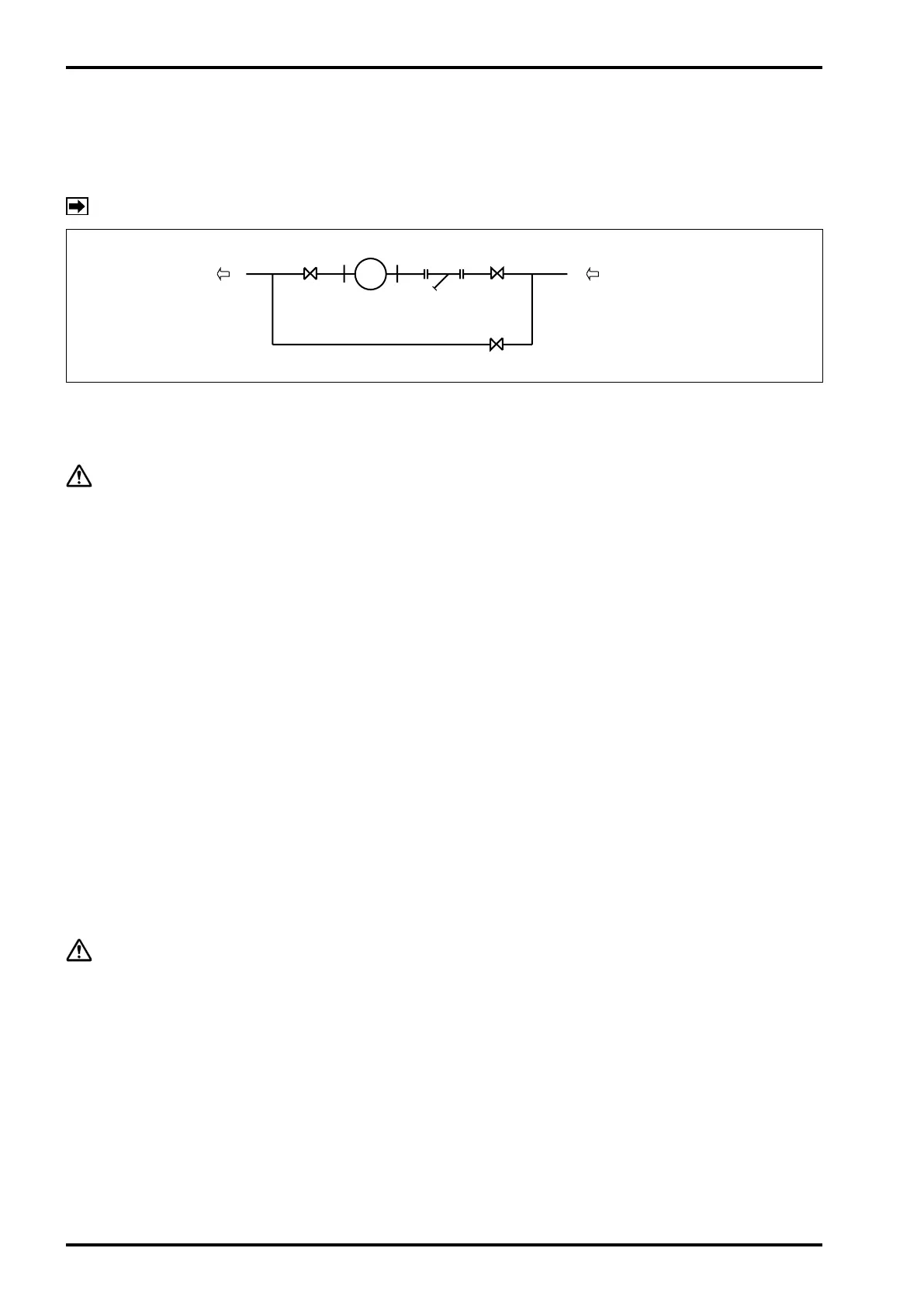
Bypass Loop
Strainer
Valve
Meter
C
B A
Flow Direction
5. OPERATING INSTRUCTIONS
5.1 Operation
Adhere to the operations sequence outlined below for the first time operation, allowing the
process fluid flow within the flow range specified.
NOTE: See the tubing diagram below
.
(1)
Shut off upstream valve (A) on the inlet side and valve (B) on the outlet side and then open bypass
line valve (C) to allow the uid in the bypass line, thereby removing weld spatters, metal chips, scales
and other foreign matter left in the tubing assembly.
CAUTION: This is particularly important for new or rebuilt tubing assemblies.
(2) Carefully and slightly at rst, open valve (A) upstream of the meter progressively and then, slightly
at rst, open valve (B) downstream of the meter progressively
.
(3) Slowly close bypass line valve (C) and make sure that the total counter in the receiving instrument
a
dvances in response. Bubbles in the measuring chamber can produce meter errors; bleeding all
air is essential at the time of meter installation in the tubing assembly.
With Meter Size 38, allowing the uid at 50ml/min. or so for more than one minute is suggested.
With meters other than Size 38, allow the uid at a rate 10 to 20% of the maximum owrate for
more than 15 minutes and ensure that all the air has escaped from the tubing assembly.
In applications where temperature exceeds 60℃, run the meter at least for 30 minutes in this state
to ensure that heat distribution in the measuring chamber becomes uniform.
(4) Following the break-in (preheating) period, shut off bypass line valve (C) completely and open
u
pstream valve (A) progressively until fully open and slowly open downstream valve (B) until the
rated ow is reached.
(5) Flowrate should be regulated with downstream valve (B) and should be held within the rating.
(6) The strainer net should be inspected for condition and cleaned on a regular basis.
A
newly installed tubing assembly in particular requires daily net inspection for condition to prevent
any ow obstructions. The service intervals may be reduced progressively to, say once a week
thereafter.
CAUTION: Use extra care to avoid running the meter too fast.



 To Next Page