6.2. Care of the crane
6.2-1 Cleaning agents and equipment
Regular expert care will serve to preserve the value of your crane. How often the crane needs to be
washed depends on how frequently it is used, the season, weather influences. etc.. Road salt, oils,
dust, etc. attack the paintwork of your crane and an increased corrosion of the crane components
can occur.
Only wash the crane when the electrical unit is switched off.
Cleaning agents:
For the care of your crane use only pH-neutral cleaning agents to avoid oxidation on chrome parts.
When selecting cleaning agents please ensure that you only use environment-friendly products.
Some cleaning agents are harmful to the skin. Be informed about
your cleaning agent and protect yourself accordingly before
starting the cleaning work.
Cleaning equipment:
When using high-pressure cleaning equipment there must always be enough distance between the
nozzle and the crane being cleaned as otherwise damage can be caused by the high water
pressure.
Electrical components, plastic components, signs and bearings must not be cleaned using high-
pressure cleaning equipment.
Therefore ensure that:
• lubricant is washed out of the bearings.
• adhesive signs are not loosened from the crane by sideways or excessively long spraying.
• plastic parts are not damaged by excessively high water temperature or high pressure.
• Crane parts containing electronic components (control valve, electronics boxes, etc.) or
electronic components themselves must never be sprayed directly with a high-pressure
cleaning equipment. If water gets into these parts, it can lead to a malfunction of the crane or to
short circuits in the electrical system.
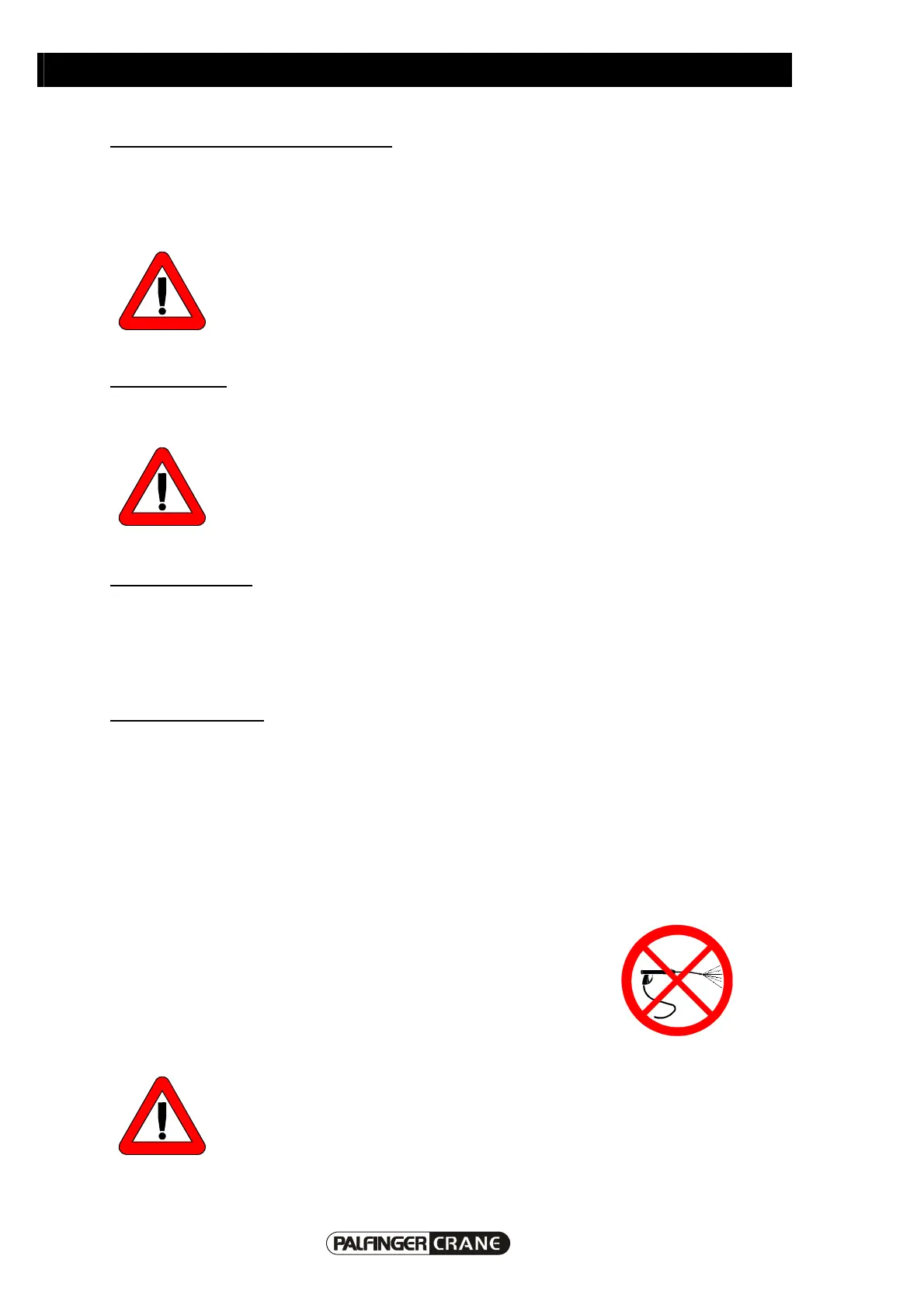
Areas which have been marked with the warning sign “High-pressure
cleaning prohibited” must also not be cleaned with high-pressure
cleaning equipment.
When using high-pressure cleaning equipment, the water
(cleaning agent) must not exceed a temperature of 60° C


 To Next Page