EasyManua.ls Logo

Panasonic AG-8700E - Users Bit

Panasonic AG-8700E
66 pages
Print Icon
To Next Page IconTo Next Page
To Previous Page IconTo Previous Page
Loading...
Time
code
The
“time
code,”
which
is
based
on
the
time
code
signal
generated
by
the
time
code
signal
generator,
recorded
on
tape,
and
read
out
by
the
time
code
signal
reader,
is
used
to
display
absolute
positions
on
the
tape
in
units
of
“hours:minutes:seconds:frames.”
Knowing
an
absolute
position
makes
it
possible
to
conduct
editing
accurately
and
search
operations
speedily.
ENGLISH
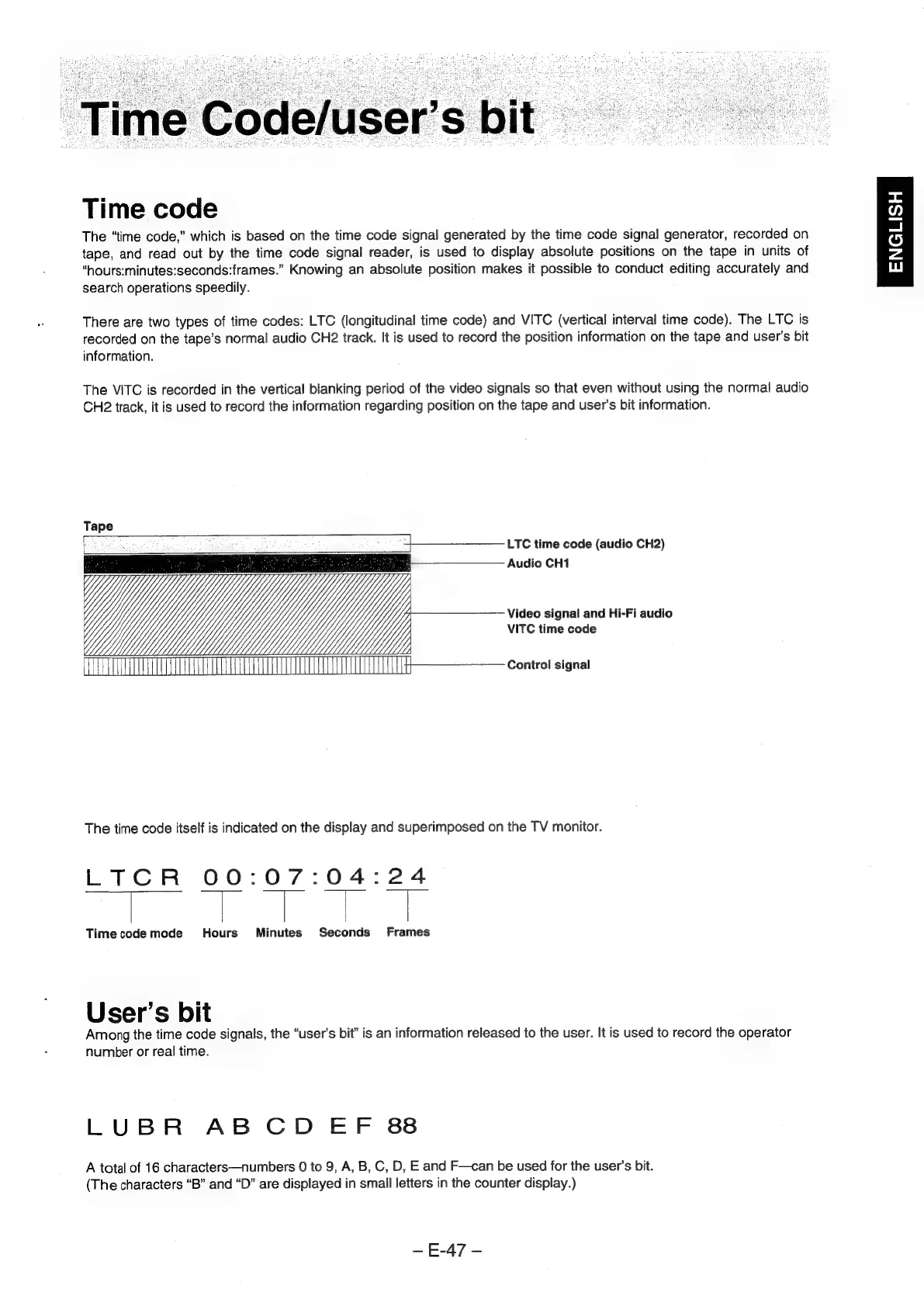
There
are
two
types
of
time
codes:
LTC
(longitudinal
time
code)
and
VITC
(vertical
interval
time
code).
The
LTC
is
recorded
on
the
tape’s
normal
audio
CH2
track.
It
is
used
to
record
the
position
information
on
the
tape
and
user's
bit
information.
The
VITC
is
recorded
in
the
vertical
blanking
period
of
the
video
signals
so
that
even
without
using
the
normal
audio
CH2
track,
it
is
used
to
record
the
information
regarding
position
on
the
tape
and
user’s
bit
information.
Cee
-|____-__
LTC
time
code
(audio
CH2)
Audio
CH1
Video
signal
and
Hi-Fi
audio
VITC
time
code
CUTOUT
TOUTES
TUTTI
Control
signal
The
time
code
itself
is
indicated
on
the
display
and
superimposed
on
the
TV
monitor.
LTCR
00:07:04:24
|
|
Timecode
mode
Hours
Minutes
Seconds
Frames
User’s
bit
Among
the
time
code
signals,
the
“user’s
bit”
is
an
information
released
to
the
user.
It
is
used
to
record
the
operator
number
or
real
time.
LUBR
ABCDEF
88
A
total
of
16
characters—numbers
0
to
9,
A,
B,
C,
D,
E
and
F—can
be
used
for
the
user’s
bit.
(The
characters
“B”
and
“D”
are
displayed
in
small
letters
in
the
counter
display.)
aE47=