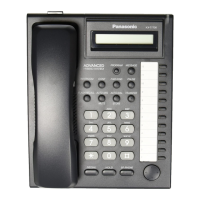
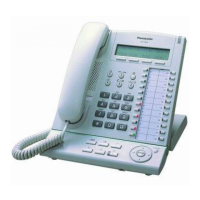
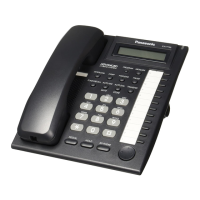
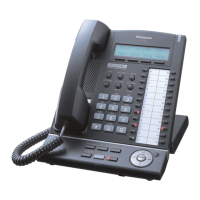
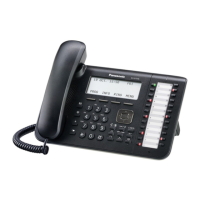
This document outlines the operational features of a Panasonic telephone system, focusing on making and transferring calls, holding calls, call pick-up, conference calls, one-touch dialing, button programming, call forwarding, and mailbox setup. The system is designed to enhance communication efficiency within an office environment, offering a range of functionalities for both internal and external calls.
Function Description
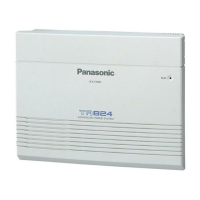
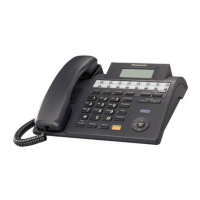
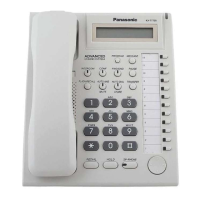
The Panasonic telephone system serves as a comprehensive communication tool, enabling users to manage various types of calls, including internal intercom calls, external calls, and conference calls. It integrates features like direct station selection (DSS) keys for quick access to extensions or stored numbers, call holding, and call forwarding to ensure that calls are managed effectively, even when users are busy or away from their desks. The system also includes a voicemail facility with personalized greetings and secure access.
Usage Features
Making Calls:
- Intercom Calls: To call an internal extension, users simply lift the handset and dial the extension number or press a pre-programmed DSS key.
- Operator Calls: To reach the operator, lift the handset and dial "0".
- Outside Numbers: For external calls, lift the handset, dial "9" to access an outside line, and then dial the phone number. Alternatively, users can lift the handset, press the "Line/Loop" key, and then dial the phone number.
Transferring Calls:
- To an Extension on the PBX: During an active call, press the "Transfer" key, dial the desired extension number, and then either replace the handset for an unsupervised transfer or announce the call and then replace the handset for a supervised transfer.
- Using DSS Key: Alternatively, during an active call, press the DSS key of the desired party, and then replace the handset or announce the call and replace the handset.
- To an Outside Number: During an active call, press the "Transfer" key, dial "9" followed by the external phone number. Wait for the call to be answered, announce the call, and then replace the handset.
Holding Calls:
- To place an active call on hold, press the "HOLD" button. This allows the user to make another call or perform other tasks.
- Retrieving Calls: To retrieve a held call, press the line/intercom button that is flashing green on the handset. If line buttons are numbered, a held call can be retrieved from another handset by pressing the same numbered line key that is flashing red. Note that if line keys are not numbered, this feature is unavailable, and users should refer to "Call Park" for alternative holding/transferring methods.
Call Pick Up:
- Answering a Call from another Telephone (Call Lift): Users can answer an incoming call ringing at another extension or group from their own phone.
- Using Keys: If a call is ringing at another phone and presents as a flashing Line Key or a Flashing DSS key assigned to the ringing extension, simply press the flashing key to answer.
- Group Call Lift: To pick up a call within a user's group, lift the handset and dial "*40 + Group No" (e.g., *40601).
- Directed Call Lift: To pick up a specified extension's call, lift the handset and dial "*41 + Extension No" (e.g., *41201).
Conference Calls:
- The system supports three-party through eight-party conference calls, with more than four parties possible when a user originates the conference.
- Unattended Conference: The conference originator can leave the conference, allowing other parties to continue. The originator can also return to the conference. Unattended conferences can only be established by users.
- Making a Conference Call:
- Dial the first party (internal or external). After they answer, press the "Conference" key, which automatically holds the call.
- Dial the extension number or "9" for an outside line, followed by the second party's telephone number.
- After the second party answers, press the "Conference" button again to bring them into the conference call.
- Repeat this procedure for additional parties until the desired number of participants is reached.
- All parties can then talk simultaneously.
- Warning: If the originator of a conference call exits and re-enters, it will terminate the call for all parties.
- Note: Maximum of 8 people on a digital handset; maximum of 2 other people making a 3-party call on analogue handsets.
- One Touch Keys: A user can access a person or feature by pressing a single button. This is activated by storing the number (extension, telephone, or feature number) in a One-touch Dialing button.
- Button Programming – One Touch Dialing: As an alternative to using Personal Directory space, spare DSS buttons can be assigned to frequently used numbers.
- With the phone idle, press the "PROGRAM" button.
- Press a spare DSS button.
- Dial '2' then '0' followed by the desired phone number (max. 32 digits).
- Press "ENTER" or "AUTODIAL/STORE" button.
- A confirmation tone will sound.
- Press "EXIT".
- Button Programming – Extension: Create an extension button at your phone that has not been assigned, or change existing extensions.
- Press the "PROGRAM" button.
- Press a spare DSS button.
- Dial '1' followed by the extension number.
- Press "ENTER" or "AUTODIAL/STORE" button.
- A confirmation tone will sound.
- Press "EXIT".
Call Forward:
- Call forwarding allows calls to be directed to programmable internal or external destinations under various conditions.
- All Calls: All incoming calls are forwarded. Pre-set extensions may also forward from their own receiving group.
- Busy: All calls are forwarded when the extension is busy.
- No Answer: All calls are forwarded if the call is not answered within a specified time period.
- Busy/No Answer (BSY/NA): All calls are forwarded if the extension is busy or if the call is not answered within a specified time period.
- Forward All Calls Immediately: Dial *7102 + EXT + # or *7102 + "9" + external number + #.
- Forward All Calls on Busy and No Answer: Dial *7105 + EXT + # or *7105 + "9" + external number + #.
- Forward All Calls on Busy Only: Dial *7103 + EXT + # or *7103 + "9" + external number + #.
- Forward All Calls on No Answer only: Dial *7104 + EXT + # or *7104 + "9" + external number + #.
- Cancel Call Forwards: Dial *7100 (Star7100) or press the "FWD/DND" button (fixed button) while in idle status to cycle the setting between FWD – DND – OFF.
- Call Forward – Main Incoming Group: Incoming calls on the Main Number are treated differently. To forward an Incoming Ring group to another number:
- To Set Forward: Lift handset, dial *7141, dial “Group Number” (default 603), dial “9” + desired phone number, dial #, receive confirmation tone, replace handset.
- To Cancel Call Forward: Lift handset, dial *7140, dial “Group Number” (default 603), dial #, receive confirmation tone, replace handset.
Opening & Setup of Mailbox for First Time:
- Initial Access: Dial 500 (or press the "Message" button). Press 0000 or 1234 (default password) and then #. The system will announce "You have zero new messages".
- Mailbox Management: Depending on the system, press 4 (NS700) OR 3 (TVM50) for "Mailbox Management".
- Change Password: Users must change their password. Press 2, then 1, and enter a new 4-digit password, followed by #. Press 2 to accept or follow prompts to change again. (Security Alert! DO NOT use common passwords like 1234, 8888, 1111).
- Record Name for Company Directory: This step is required to record your name for the company directory.
- Press 3 to change "Owner's Name".
- State your name after the tone and immediately press 1 to end recording.
- Follow the prompts if necessary.
- Press 2 to accept.
- Record Personal Greeting:
- Press 1 to record your personal greeting.
- Press 1 again to record your "No Answer Greeting".
- Record your greeting at the tone and press 1 to end recording.
- Follow the prompts as necessary: 1 to review | 3 to re-record | 2 to accept.
- Important Note: Do not miss step 14 (likely referring to a step in a more comprehensive manual) or the personal greeting recording will be lost.
Maintenance Features
The document does not explicitly detail maintenance features. However, the programming capabilities for one-touch dialing and extension buttons suggest that the system allows for user-level customization and configuration, which can be considered a form of ongoing system management. The ability to set and cancel call forwarding, as well as manage voicemail greetings and passwords, also falls under user-driven maintenance, ensuring the system adapts to individual communication needs. The absence of specific troubleshooting or repair instructions implies that any technical issues beyond user configuration would likely require professional support from CDC Voice and Data Solutions.

 Need help?
 General



 To Next Page