Technical Data
21
20
Mechanical Installation
5. Mechanical Installation
5.1 Installation Precaution
CAUTION!
Personal injury and machine damage may be caused by improper
movement of the inverter.
Please be strictly comply with the instructions of this manual
when moving the install the inverter.
WARNING!
Read all of these instructions, cautions, and warnings for the
EVERVOLT Hybrid inverter.
WARNING!
Installation and commissioning must be performed by a licensed
electrician in accordance with local, state and National Electrical
Code ANSI/NFPA 70 requirements.
WARNING!
The installation and wiring connection methods of this inverter in
the U.S. must comply with all US National Electric Code and
local requirements.
5.2 Selection for the Installation Position
The installation location selected for the inverter is quite critical in the aspect of
the guarantee of machine safety, service life and performance.
Ÿ EVERVOLT Hybrid Inverter has the NEMA 4X ingress protection, which allows
it to be installed outside the door.
Ÿ The installation position shall be convenient for wiring connection, operation
and maintenance.
5.2.1 Installation Environment Required
All indoor installations must be limited to a well-ventilated location in a garage or
a structure detached from any living spaces.
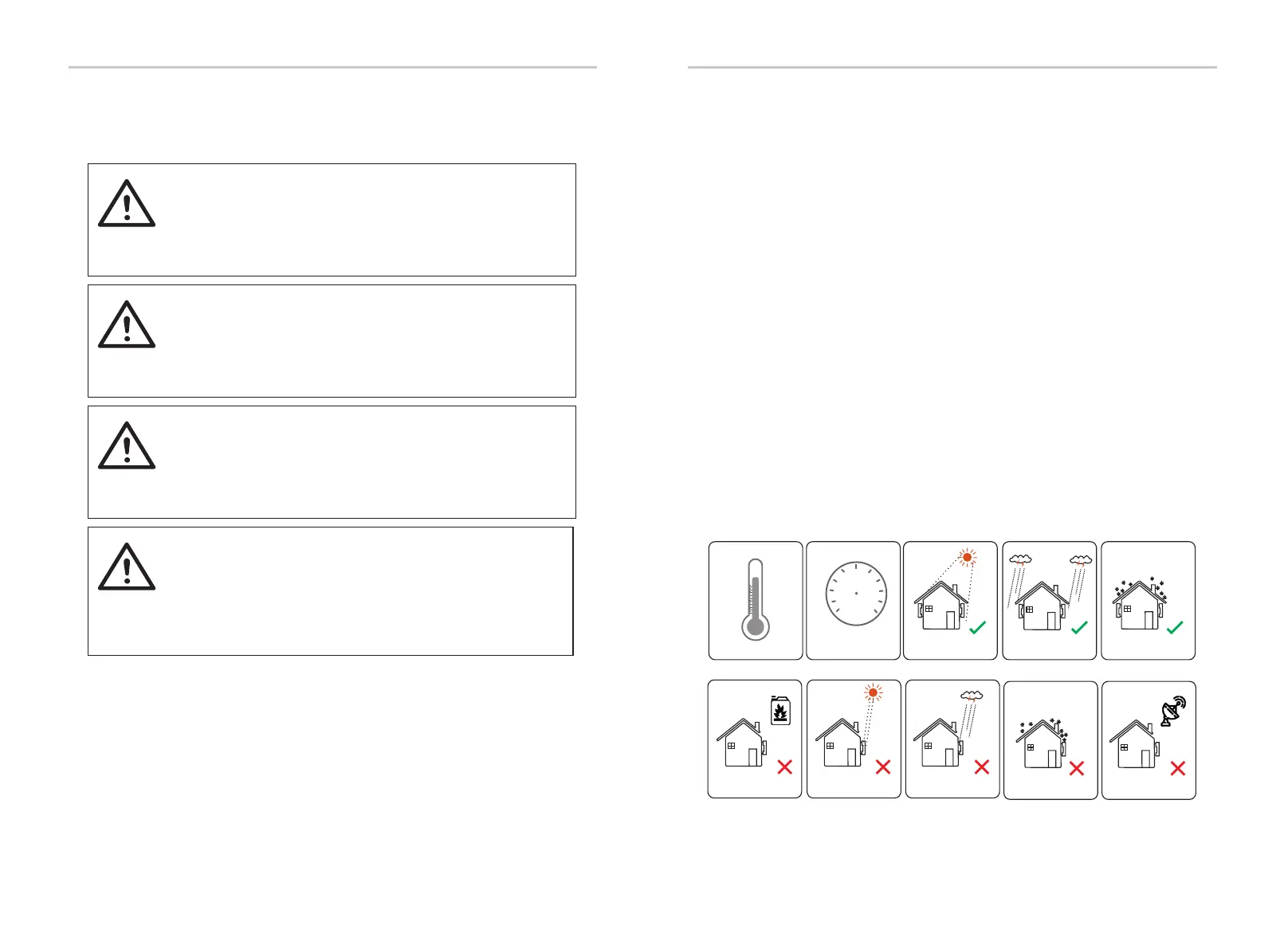
Make sure the installation site meets the following conditions:
Ÿ Not be exposed to glare.
Ÿ Not in areas where highly flammable materials are stored.
Ÿ Not in potential explosive areas.
Ÿ Not near the television antenna or antenna cable.
Ÿ Not higher than altitude of about 9843 ft (3000 m) above sea level.
Ÿ Not in environment of precipitation.
Ÿ Be sure the ventilation is good enough.
Ÿ The ambient temperature in the range of –13°F (-25°C) to +140°F (+60°C).
Ÿ The slope of the wall should be within ±5°.
Ÿ Avoid direct sunlight, rain exposure, snow laying up during installing and
operating.
No direct sunlight
No rain exposure
No snow lay up
Direct sunlight
Rain exposure
Snow lay up
Near antenna
Near combustibles
-25°C
+60°C
+140°F
-13°F
%RH
0
50
100
0-95%RH



 To Next Page