This document describes the KX-TG8201CB, KX-TG8202CB, and KX-TGA820CB series of Panasonic cordless telephones, providing a comprehensive overview of their functions, technical specifications, usage, and maintenance.
Function Description
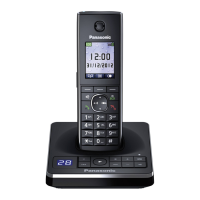
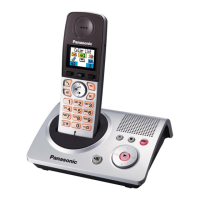
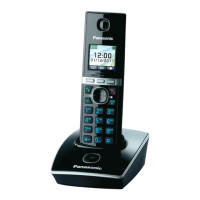
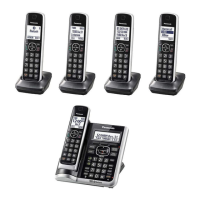
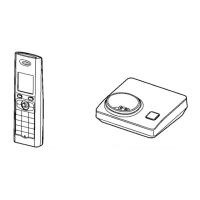
The KX-TG8201CB/KX-TG8202CB/KX-TGA820CB series are expandable digital cordless telephones designed for home and office use. They operate on the DECT 6.0 standard, offering secure and clear communication. The system typically consists of a base unit (KX-TG8201CB or KX-TG8202CB) and one or more handsets (KX-TGA820CB).
Key functions include:
- Telephone System: Supports multiple handsets (up to 6) with intercommunication capabilities.
- Caller ID Display: Shows the caller's name and/or number.
- Phonebook: Stores contact information for quick dialing.
- Answering System: Integrated digital answering machine for message recording (specific to KX-TG8202CB).
- Programmable Settings: Allows users to customize various features such as ringer volume, display settings, date and time, and call settings.
- Expandable System: The base unit can register additional handsets, allowing for a flexible communication setup.
- Signal Route Management: Manages the DTMF tone, Caller ID, and speech signals for both handset and base unit.
- Battery Management: Includes features for battery charging, low battery indication, and battery level display.
Important Technical Specifications
The devices adhere to the DECT 6.0 (Digital Enhanced Cordless Telecommunications 6.0) standard.
- Frequency:
- DECT Standard: 1.92 GHz to 1.93 GHz
- RF Transmission Power: Approx. 10 mW
- Bit Rate: 1.152 kbit/s
- Modulation: GFSK (Gaussian Frequency Shift Keying)
- Voice Coding: ADPCM 32 kbit/s
- Channel Spacing: 1.728 MHz
- Number of Channels: 60 Duplex Channels
- Power Source:
- Base Unit: AC Adaptor (PQLV207V, 120 V AC, 60 Hz)
- Handset: Rechargeable Ni-MH battery AAA (R03) size (1.2 V 550 mAh)
- Charger Unit: AC Adaptor (PQLV209V, 120 V AC, 60 Hz)
- Power Consumption:
- Base Unit: Standby: Approx. 1.7 W, Maximum: Approx. 4.8 W
- Handset: Standby: Approx. 0.7 W, Maximum: Approx. 3.5 W
- Charger Unit: Standby: Approx. 0.7 W, Maximum: Approx. 3.5 W
- Operating Environment: 5 °C – 40 °C (41 °F – 104 °F), 20 % – 80 % relative air humidity (dry)
- Dimensions (H x W x D):
- Base Unit: Approx. 44 mm x 116 mm x 113 mm (1 3/4" x 4 9/16" x 4 7/16" )
- Handset: Approx. 143 mm x 47 mm x 32 mm (5 5/8" x 1 7/8" x 1 1/4" )
- Charger Unit: Approx. 46 mm x 77 mm x 87 mm (1 13/16" x 3 1/32" x 3 7/16" )
- Mass (Weight):
- Base Unit: Approx. 178 g (0.39 lb.)
- Handset: Approx. 120 g (0.26 lb.)
- Charger Unit: Approx. 70 g (0.15 lb.)
- Ringer Equivalence No. (REN): 0.1
- Security Codes: 1,000,000
- Dialing Mode: Tone (DTMF)/Pulse
Usage Features
- Call Display Compatible: The devices support Caller ID functionality, allowing users to see incoming call information.
- Expandable Digital Cordless Phone: The system can be expanded by registering up to 6 handsets to a single base unit.
- Battery Life:
- In continuous use: 12 hours max.
- In continuous standby mode: 150 hours max.
- Battery operating time may be shortened over time depending on usage conditions and surrounding temperature.
- Programmable Settings: Users can navigate through menus using a joystick to customize various settings such as ringer volume, display wallpaper, language, date and time, alarm, and flash time.
- Handset Registration: Handsets must be registered to the base unit to function. The manual provides detailed steps for both initial registration and re-registration.
- Phonebook Copying: Allows copying phonebook entries between handsets, useful when replacing a defective handset or setting up a new one.
- User Setting Reset: Provides options to reset both the base unit and handsets to factory settings, clearing stored phone numbers, caller lists, and other user data. This is typically for troubleshooting or preparing a unit for service.
Maintenance Features
- Safety Notice: Emphasizes the use of specified manufacturer's parts for components identified with a triangle mark, as these have special characteristics important for safety.
- Lead-Free Solder (PbF) Information: Provides guidance on using lead-free solder for repairs, including recommended tip temperature and flux type. It also details the process for removing and installing flat package ICs and solder bridges, highlighting the importance of proper soldering techniques to avoid damaging the PCB.
- Troubleshooting Flowchart: Detailed flowcharts are provided for diagnosing common issues related to power, battery charge, link status, DTMF dial tone, and Caller ID reception for both the base unit and handset.
- Check Points: Specific check points are outlined for various components (e.g., VDD supplies, BBIC clock, charge control) with expected voltage values and procedures for adjustment or replacement.
- RF Check Flowchart: Guides technicians through checking link confirmation, control signal, X'tal frequency, and range confirmation to diagnose RF-related problems.
- JIG Setting Method: Instructions for connecting a Serial JIG and PC to the base unit or handset for batch file settings and adjustments. This includes a list of commands for reading/writing EEPROM, adjusting RFIC, checking hook status, and performing burst TX/RX tests.
- Adjustment Standard: Diagrams showing test points and expected values for flow solder side views of the base unit, charger unit, and handset, crucial for accurate measurements during repair.
- Component Replacement: Detailed instructions for disassembling and assembling the base unit, handset, and charger unit, including screw locations and specific steps for removing and installing components like the LCD.
- Parts List: Comprehensive lists of replacement parts, including cabinet and electrical parts, with part numbers and descriptions. This includes a note on "Retention Time Limited" (RTL) parts, indicating their availability after discontinuation.
- Service Mode: Provides access to engineering mode for advanced diagnostics and adjustments, such as registering handsets, setting telephone line parameters, and reading/writing EEPROM data. This mode requires careful operation to avoid damaging the unit.

 Need help?
 General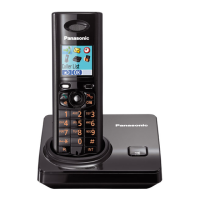


 To Next Page