Concerning
the
Remote
Control
Battery
installation
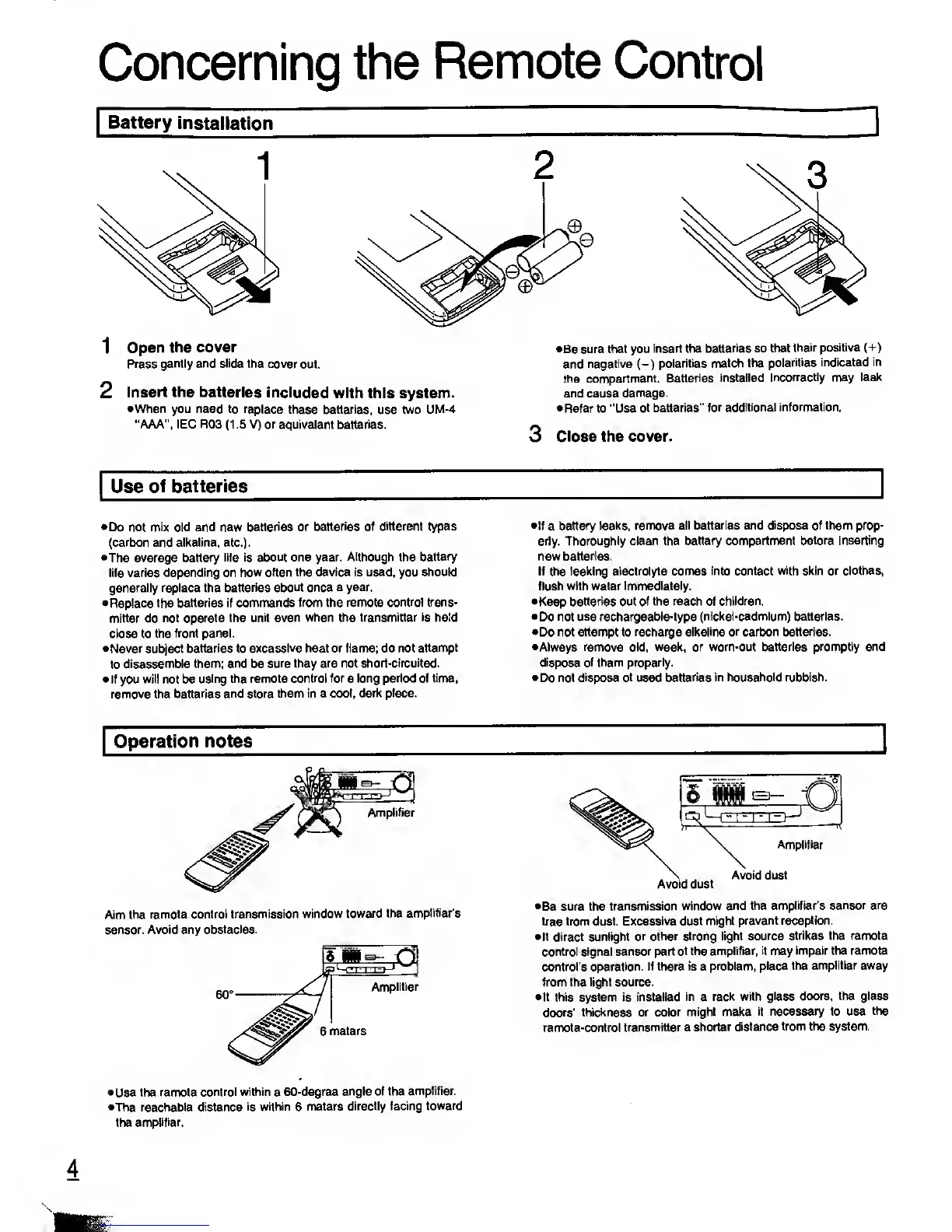
1
Open
the cover
Press
gently and slide
the cover
out.
2
Insert the batteries
included
with this system.
•When you need to replace
these batteries, use two
UM-4
"AAA", IEC R03
(1
.5 V) or equivalent batteries.
•Be sure that you
insert the
batteries so that
their positive
(+)
and negative
{-)
polarities match
the
polarities indicated
in
the
compartment.
Batteries installed
incorrectly may leak
and cause
damage.
•
Refer to "Use
of batteries"
for additional
information.
3
Close the cover.
Use
of batteries
•
Do not mix old and new
batteries or
batteries of different types
(carbon and alkaline, etc.).
•The average
battery life is about
one year. Although the battery
life varies depending on how
often the device is used, you
should
generally replace the batteries
about once a year.
•Replace
the batteries if
commands from the remote control
trans-
mitter do
not operate the unit
even when the transmitter is held
close to the
front panel.
•Never subject
batteries
to
excessive heat or flame; do not attempt
to
disassemble them;
and
be
sure they are not
short-circuited.
•If you will not be
using the remote control
for
a
long period of time,
remove the batteries
and store them in a cool,
dark
place.
•If
a
battery leaks, remove all
batteries and dispose of them prop-
erly. Thoroughly clean the
battery compartment before
inserting
new batteries.
If the leaking electrolyte comes
into contact with skin or clothes,
flush with water immediately.
•Keep
batteries out of the reach of children.
•
Do not use rechargeable-type
(nickel-cadmium) batteries.
•Do not attempt to recharge
alkaline or carbon batteries.
•Always
remove
old,
weak, or worn-out batteries promptly
and
dispose
of
them
properly.
•
Do not dispose of used
batteries in household rubbish.
Operation
notes
Aim
the remote control
transmission window
toward the
amplifier's
sensor. Avoid any
obstacles.
6 meters
5
ii—
\
Amplifier
dust
Avoid dust
•Be sure the
transmission window
and the amplifier's
sensor are
free from dust.
Excessive dust might
prevent reception.
•
If direct sunlight
or other strong light
source strikes the remote
control signal sensor
part of the amplifier,
it
may
impair the remote
control's
operation. If there is a problem,
place the
amplifier away
from the light
source.
•
If this system is installed
in
a
rack with
glass doors, the glass
doors' thickness or
color might make
it necessary to use
the
remote-control
transmitter a
shorter distance
from the system.
•
Use
the remote control
within
a
60-degree
angle of the
amplifier.
The
reachable
distance is
within
6
meters
directly facing
toward
the amplifier.
4



 To Next Page