www.parweld.co.uk
10
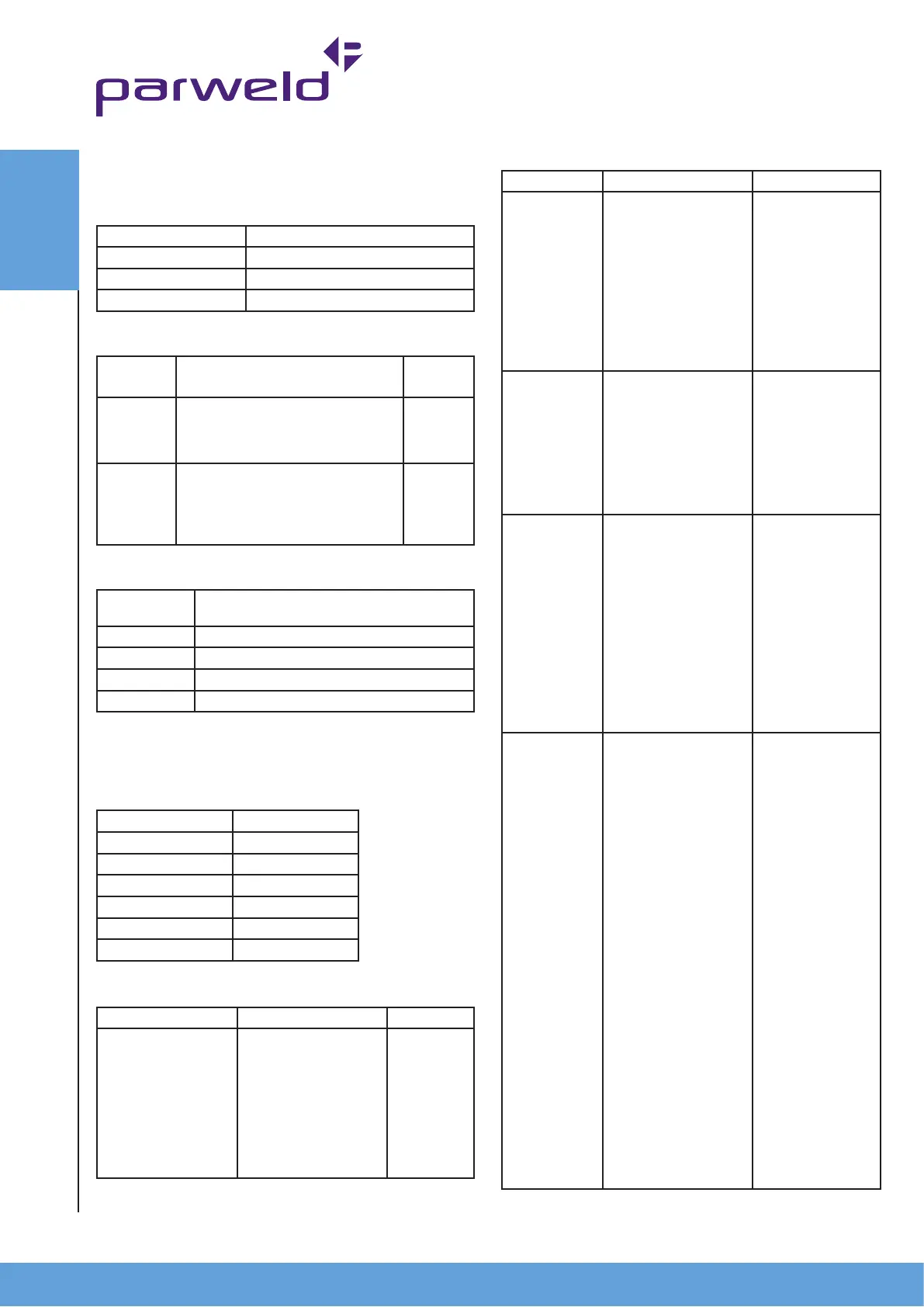
MMA WELDING PROBLEM
Description Possible cause Remedy
Crack occurring
in weld metal
soon after
solidication.
(a) Rigidity of joint.
(b) Insucient throat
thickness.
(c) Cooling rate is too
high.
(a) Redesign to
relieve weld joint of
severe stresses or
use crack resistance
electrodes.
(b) Travel slightly
slower to allow
greater build up in
throat.
(c) Preheat plate
and cool slowly.
A gap is left by
failure of the
weld metal to ll
the root of the
weld
(a) Welding current is
too low.
(b) Electrode too large
for joint.
(c) Insucient gap
(d) Incorrect sequence
(a) Increase welding
current
(b) Use smaller
diameter
electrode.
(c) Allow wider gap
(d) Use correct
build-up sequence
Portions of the
weld run do
not fuse to the
surface of the
metal or edge
of the joint.
(a) Small electrodes
used on heavy cold plate
(b) Welding current is
too low
(c) Wrong electrode
angle
(d) Travel speed of
electrode is too high
(e) Scale or dirt on joint
surface
(a) Use larger
electrodes and
preheat the plate
(b) Increase welding
current
(c) Adjust angle so
the welding arc is
directed more into
the base metal
(d) Reduce travel
speed of electrode
(e) Clean surface
before welding.
Non-metallic
particles are
trapped in the
weld metal
(slag inclusion).
(a) Non-metallic particles
may be trapped in
undercut from previous
run
(b) Joint preparation too
restricted
(c) Irregular deposits
allow slag to be trapped.
(d) Lack of penetration
with slag trapped
beneath weld bead.
(e) Rust or mill scale is
preventing full fusion.
(f) Wrong electrode for
position in which welding
is done.
(a) If bad undercut is
present, clean slag
out and cover with
a run from a smaller
diameter electrode.
(b) Allow for
adequate
penetration and
room for cleaning
out the slag
(c) If very bad,
chip or grind out
Irregularities
(d) Use smaller
electrode with
sucient current
to give adequate
penetration.
adequate
penetration. Use
suitable tools to
remove all slag from
corners
(f) Use electrodes
designed for position
in which welding
is done, otherwise
proper control of
slag is dicult.
TIG WELDING GUIDE RANGES
Electrode diameter DC current (amps)
0.040” (1.0mm) 30 – 60
1/16” (1.6mm) 60 – 115
3/32” (2.4mm) 100 – 165
TUNGSTEN ELECTRODE TYPES
Electrode
type
Welding application
Colour
code
Thoriated
2%
DC welding of mild steel, stainless
steel and copper. Excellent arc
starting, long life, high current carrying
capacity.
RED
Ceriated
2%
DC welding of mild steel, stainless
steel, copper, aluminium, their alloys
longer life, more stable arc, easier
starting, wider current range, narrower
more concentrated arc
GREY
GUIDE FOR SELECTING FILLER WIRE DIAMETER
Filler wire
diameter
DC current range
1/16” (1.6 mm) 20 - 90
3/32” (2.4 mm) 65 - 115
1/8” (3.2 mm) 100 - 165
3/16” (4.8 mm) 200 - 350
The ller wire diameter specied is a guide only, other diameter
wires may be used according to the welding application.
SHIELDING GAS SELECTION
Alloy Shielding gas
Aluminium & alloys Pure Argon
Carbon steel Pure Argon
Stainless steel Pure Argon
Nickel alloy Pure Argon
Copper Pure Argon
Titanium Pure Argon
MMA WELDING PROBLEM
Description Possible cause Remedy
Gas pockets or voids
in weld metal (porosity)
(a) Electrodes are damp
(b) Welding current is
too high.
(c) Surface impurities
such as oil, grease,
paint, etc
(a) Dry
electrodes
before use
(b) Reduce
welding
current
(c) Clean
joint before
welding
7.0 Fault Finding
FAULT
FINDING



 To Next Page