
 Need help?
Do you have a question about the Patriot Lighting SL0420B and is the answer not in the manual?
Explains how solar panels convert sunlight to electricity for night use.
Guides on choosing a spot with at least 8 hours of direct sunlight daily.
Details on cleaning the solar panel using a damp cloth, avoiding chemicals.
Information on the lithium batteries, their disposal, and safety.
Step-by-step guide for assembling the solar light fixture and mounting.
How to set the light's brightness switch before use.
Detailed steps for turning off, opening, and replacing the rechargeable batteries.
Steps to diagnose why the light may not be working correctly.
Details on warranty coverage, exclusions, and return procedures.
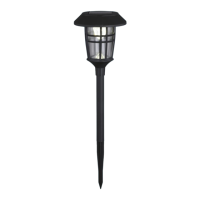
This document describes the Patriot Lighting Solar Light, Model Number SL0420B, a solar-powered outdoor lighting fixture designed for illuminating gardens, paths, and other outdoor areas at night.
The Patriot Lighting Solar Light operates by converting sunlight into electricity, storing this energy in a rechargeable battery, and then using the stored power to illuminate an LED light at night. The fixture is equipped with built-in solar panels that capture solar energy during the day. This energy is then transferred to and stored within two IFR 18500J 1100 mAh (3.2V) Lithium rechargeable batteries. When darkness falls, the stored energy is used to power the LED, providing illumination. The overall performance and the duration of illumination are significantly influenced by geographic location, prevailing weather conditions, and ambient temperature. Optimal performance is achieved with strong and prolonged exposure to direct sunlight, which maximizes the energy stored in the battery and, consequently, extends the lighting hours.
To ensure proper operation, the solar light requires careful placement. It is crucial to select an outdoor location that receives full, direct sunlight for at least eight hours daily. Shady areas will prevent the batteries from fully charging, leading to reduced lighting hours at night. Additionally, the solar light should not be placed near other light sources, such as street lights or porch lights, as these external lights may cause the solar light to automatically turn off or flicker. The fixture is designed for outdoor use and is ideal for night lighting in various settings, including gardens and pathways.
Assembly of the solar light involves several steps. First, the lamp base (F) should be placed on a flat, solid surface where the light will be mounted. Using the lamp base as a guide, three set holes need to be marked and drilled to a depth of approximately 2-1/4 inches using a 1/2-inch drill bit. Fastening screws are then inserted into these drilled holes with their threaded ends facing up. Hex nuts, spring pads, and metal pads are removed from the fastening screws. The lamp base (F) is then placed onto the fastening screws and secured with the metal pads, spring pads, and hex nuts using a wrench. It is essential to ensure the lamp base is stable before proceeding.
Next, pole-1 (E) is attached to the lamp base (F) and tightened with provided set screws using a Phillips screwdriver. Pole-2 (D) is then screwed onto pole-1 (E), and pole-3 (C) is screwed onto pole-2 (D) tightly. Finally, the finial (A) is installed onto the solar post lamp (B). All lamp poles must be secure and tight before placing the solar post lamp (B) onto pole-3 (C) and turning it clockwise until tight.
Before the solar light can operate, a switch located on the bottom of the dome must be set to either the "LOW" (75 lm) or "HIGH" (150 lm) position. This switch controls the illumination level of the LED.
Regular maintenance is important to ensure the longevity and optimal performance of the solar light. The solar panel should be cleaned periodically using a damp cloth. It is crucial to avoid using any chemical or abrasive cleaners, as these can damage the panel. Additionally, care must be taken to prevent moisture from entering the solar light.
The product contains two IFR 18500J 1100 mAh (3.2V) Lithium rechargeable batteries. When these batteries reach the end of their lifespan, they must be recycled or disposed of properly according to local waste disposal authority procedures. It is important not to expose the batteries to fire.
To change the batteries, the fixture must first be switched off. The solar post lamp (B) is turned upside down, and four metal frame screws are removed from the metal frame. Four fix screws are then removed from the dome, allowing the dome to be opened and the old batteries to be removed. New lithium rechargeable batteries (1100 mAh/3.2V) should be installed, ensuring correct polarity. The battery compartment is then reattached to the dome using the previously removed fix screws, and the dome is secured to the metal frame with the metal frame screws. Finally, the solar post lamp (B) is replaced onto pole-3 (C), and the fixture can be switched back on.
Troubleshooting steps are provided for instances where the light does not work. Users should first check that the switch is in the "LOW" or "HIGH" position and that the battery is installed correctly. Covering the solar panel to simulate darkness should cause the LED to light up immediately if functioning correctly. It is also important to verify that the rechargeable battery has sufficient charge; a normal battery can be temporarily used for testing if other components are working. The rechargeable battery requires several hours of daylight to recharge. Ensuring the light is not in a shaded area during the daytime and keeping it distant from other night light sources are also crucial for proper operation.
 General
| Brand | Patriot Lighting |
|---|---|
| Model | SL0420B |
| Finish | Black |
| Light Source | LED |
| Mounting Type | Wall Mount |
| Type | Outdoor Light |
| Material | Metal |
| Voltage | 120V |
| Color Temperature | 3000K |


 To Next Page